155th (East Africa) Heavy Anti-Aircraft Battery, E.A.A.
On 13th June 1943, the British element of the 155th (E.A.) H.A.A. Battery, E.A.A., formed from the 404th H.A.A. Battery, R.A., moved to site H.5A at Shimanzi. The surplus personnel of the 404th Battery moved to sites H.1 and H.2, coming under the 417th H.A.A. Battery, R.A. The 155th Battery was declared as having formed, with effect from 12th June. These British personnel left the next day for the Athi River A.A.T.C. for Africanisation and training.[1]
The Battery arrived in Mombasa on 12th September 1943, having completed training at the A.A. Artillery Depot and Training Centre at Athi River, and became regimented with the 16th (E.A.) H.A.A. Regiment, E.A.A. The Battery deployed on arrival to sites H.3 and H.6, in relief of the 417th H.A.A. Battery, R.A. The 417th Battery, which was to supply the British element of the 156th (E.A.) H.A.A. Battery, E.A.A., left for Athi River later that day and the following day ceased to be regimented with the 16th Regiment. A half troop of the 155th Battery, assumed to be a half troop of light anti-aircraft artillery, joined the Battery in Mombasa from Athi River on 30th November, together with guns and equipment taken from the 20th (E.A.) L.A.A. Regiment, E.A.A.[2]
The half troop of light anti-aircraft artillery returned to Athi River on 21st January 1944, ceasing to be attached to the Battery.
The 155th Battery, less one troop, moved from H.3 to H.7 on 5th May 1944, and established Battery H.Q. at H.6. The Battery was relieved of remaining commitments at site H.6 on 26th June and concentrated at H.7.[3]
On 23rd June 1944, at Mombasa, the 153rd, 154th and 155th H.A.A. Batteries, E.A.A. ceased to be regimented with the 16th H.A.A. Regiment, E.A.A. and became regimented with the 15th (E.A.) H.A.A. Regiment, E.A.A.[4]
‘B’ Troop, 155th Battery, was relieved at Kipevu by ‘B’ Troop, 156th Composite A.A. Battery, E.A.A. on 26th June 1944 and moved to Changamwe. During July, the Battery went on embarkation leave. Both 154th and 155th Batteries began training with mobile guns from the middle of the month, followed by the 153rd Battery at the end of July. Training continued until the end of September and on 27th September the engagement of ground targets with mobile guns was practiced. Final fitness (route marches) and jungle training was undertaken during October.[5]
The 15th H.A.A. Regiment, E.A.A., with the 153rd, 154th and 155th Batteries, embarked at Mombasa on 6th November 1944, on board the transport Salween for India. The transport sailed the next day and arrived at Chittagong on 2nd December. The Regiment and batteries disembarked, and the Regimental H.Q. was opened, coming under command of the 13th A.A. Brigade. The Batteries went to Punjab Lines, Chittagong. On 4th December, the 155th Battery moved by rail to Feni, where it relieved the 313th (W.A.) H.A.A. Battery. At Feni, the 155th Battery recorded no enemy action during the month but did receive several plots from the R.A.F.[6]
The 153rd Battery relieved the 155th Battery on 15th March 1945 and the latter unit returned to Chittagong later that day. The 155th Battery embarked for Akyab on 25th March and sailed the next day. Upon arrival on 27th March, the Battery came under the command of the XV Indian Corps. At Akyab, ‘A’ Troop, 155th Battery relieved one troop of the 8th (Belfast) H.A.A. Regiment, R.A. The Battery vehicles left Chittagong on 30th March and arrived on 1st April.[7]
The 155th Battery on Akyab remained under the command of the 13th A.A. Brigade, acting as an independent battery attached to the XV Indian Corps. The Battery Commander, Major R.B. Robson, was appointed as A.A.D.C. Akyab, responsible for not only his own battery but also the 36th and 37th L.A.A. Batteries, Indian Artillery. Robson left for the United Kingdom on 28th June 1945 and was succeeded by Captain A. Batty.[8]
The anti-aircraft defences at Akyab and Ramree were taken out of action on 21st July 1945. At Akyab, the 155th Battery handed in all guns and equipment on 20th August and embarked for Chittagong on 27th August. The Battery arrived the next day and went to Feni to re-join the Regiment the following day.[9]
The Battery remained with the Regiment at Feni until 4th October 1945, when it entrained for Calcutta for repatriation. The personnel of the Regiment reached the R.A. Depot & Training Centre at Athi River, Kenya on 21st October 1945.[10]
The Regiment, together with the 153rd, 154th and 155th Batteries, disbanded on 1st January 1946.[11]
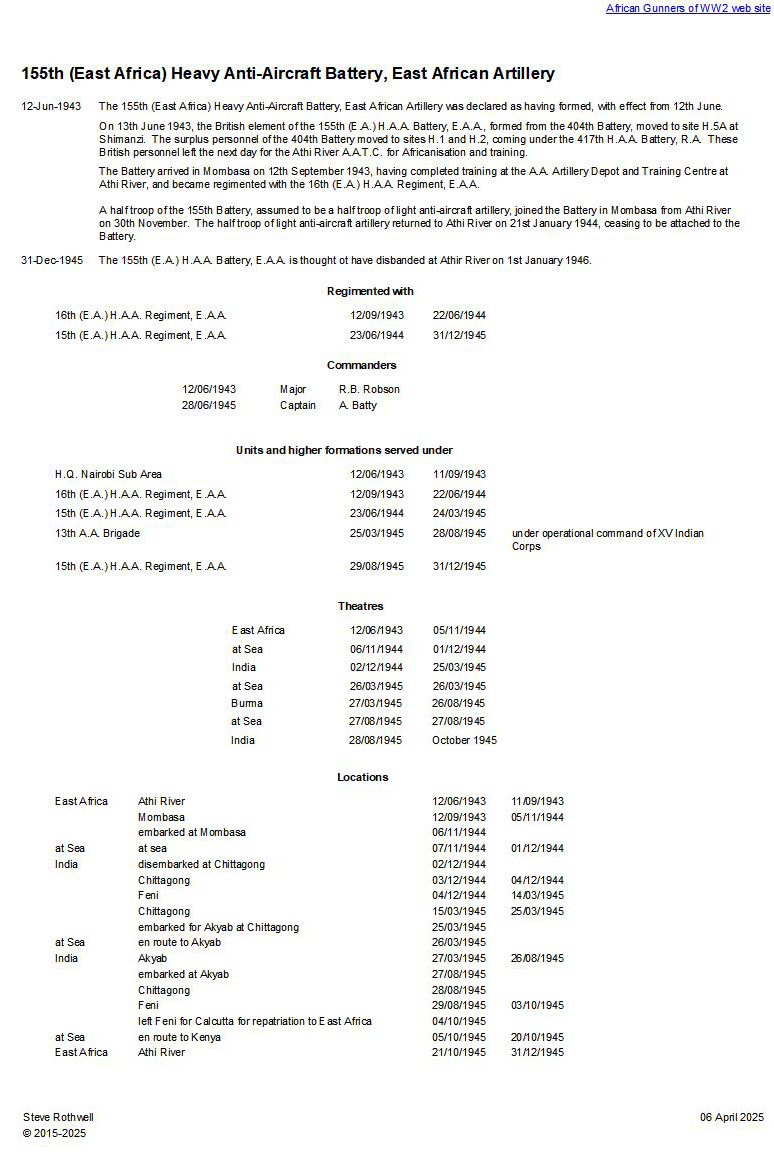
Summary history of the 155th (East Africa) H.A.A. Battery, E.A.A.
© Steve Rothwell
06 April 2025
[1] War diary 16th (E.A.) H.A.A. Regiment, E.A.A., WO 169/14094
[2] WO 169/14094; War diary A.A. Defence Commander, WO 169/14091
[3] War diary 16th (E.A.) H.A.A. Regiment, E.A.A., WO 169/18322
[4] WO 169/18322;
[5] War diary 15th (E.A.) H.A.A. Regiment, E.A.A., WO 169/18321
[6] WO 172/6524
[7] WO 172/9471
[8] WO 172/9471; War diary 155th H.A.A. Battery, E.A.A., WO 172/9472; ALFSEA, A.A. Artillery 1943-45, WO 203/1713
[9] WO 172/9471
[10] War diary 13th A.A. Brigade., WO 172/7155; War diary R.A. Depot & Training Centre, Athi River, WO 169/21790
[11] Frederick