1st Coast Regiment, West African Artillery
The 1st Coast Regiment, W.A.A. formed on 4th July 1941 (with effect from 27th March 1941) from the coast artillery at Bathurst, Gambia. Approval for the formation of Regiment had been given on 11th June 1941.[1]
The batteries of the Regiment were to be:
- 5.5-inch guns and C.A.S.Ls. manned by the 1st Coast Battery, W.A.A.,
- 4-inch guns and C.A.S.L.s manned by the 2nd Coast Battery, W.A.A.,
- 12-pounder and C.A.S.L.s manned by the 3rd Coast Battery, W.A.A.
(C.A.S.L. – Coast Artillery Searchlight)
Two 5.5-inch naval guns were allotted to Bathurst by 6th March 1941 and arrived from the United Kingdom on board the S.S. New Texas on 16th May. One 4-inch gun was sent to Bathurst from Takoradi during April 1941 and during May it was installed and made operational at Barra Point. It was also intended to send a 12-pounder. This gun had been salvaged from a merchant vessel but was in need of repair. The plan was to send this gun to Freetown for repair and then on to Bathurst. (The gun appears to have been a naval high-angle 12-pounder Mark IX.). It arrived in Bathurst in July but was found to be missing its stabiliser gear and could only be mounted on a static mount. It also arrived without ammunition. A second 12-pounder gun was despatched from the United Kingdom (en route during January 1942).[2]
A party of African gunners under Lieutenant C.M.H. Johnson, with three British N.C.O.s and one British gunner, designated as the 2nd Coast Battery, W.A.A., arrived at Bathurst from Freetown on 17th June 1941, on board the S.S. New Northland. They took over the 5.5-inch guns. The African gunners had been 3.7-inch gun carriers from the Gold Coast and had seen active service in East Africa, before attending a six-week coast defence gunnery course in Freetown. [These men may have been what was referred to as the Gambia Coast Defence Battery which had been attached to the Sierra Leone Coast Regiment at Freetown and left there to return to Gambia on 17th June 1941.][3]
After test firing the 5.5-inch naval guns, the Battery took over the guns from the detachment of the 5th Battalion, Gold Coast Regiment which had previously mounted the guns. Captain, acting Major J.P.McN. Wilson assumed command of the 2nd Battery on 30th June.[4]
On 4th July 1941, the 2nd Coast Battery, W.A.A. became the 1st Coast Battery, W.A.A. A detachment of the 5th Battalion, Gold Coast Regiment, under the command of Captain C.H. Major, and stationed at Barra, became the 2nd Coast Battery, W.A.A. The nucleus of the 3rd Coast Battery, W.A.A. was gathered by 25th July. Captain Wilson was in command of the Regiment. Further drafts of British and African personnel arrived during August. The construction of emplacements and the installation of searchlights and other equipment continued throughout the following months.[5]
Major Wilson was taken ill on 31st January 1942 and command of the Regiment was assumed by Lieutenant, acting Captain C.M.H. Johnson. On 14th May, Major A.S. Allen, W.A.A., transferred from the 16th Coast Regiment, R.A. at Freetown, disembarked at Bathurst and two days later assumed command of the Regiment. Major Allen was again in hospital from 8th September, command being assumed by Lieutenant Rendell, R.A. The unfortunate Major Allen returned to the United Kingdom on 5th October.[6]
The Standing Orders, Bathurst Fire Command issued on 12th October 1942 give details of how the Regiment was deployed, in conjunction with the anti-aircraft guns of the 4th Heavy Anti-Aircraft Regiment, W.A.A., which had formed at Bathurst on 23rd October 1941:[7]
INFORMATION
1. The Port of Bathurst lies at the mouth of the Gambia River.
2. BATHURST Fire Command consists of fixed defences sited for seawards defence and dual purpose (C.A./A.A.) guns.
3. The fixed defences are manned by 1st Coast Regiment, W.A.A., which comprises 1st, 2nd and 3rd Coast Batteries, W.A.A.
4. The Fire Commander is O.C. 1st Coast Regiment, W.A.A.
5. The dual-purpose guns are manned by personnel of 4th Heavy A.A. Regiment, W.A.A., which comprises 7th Heavy A.A. Battery, W.A.A., 313th Heavy Battery, W.A.A. and 64th Light A.A. Battery, W.A.A.
ORGANIZATION
6. The Fire Command Post and War Signal Station are situated at Marina and manned by the Headquarters personnel of the 1st Coast Regiment, W.A.A. and signallers provided by [the] Naval Officer-in-charge.
7. The armament comprises:-
|
Description |
Nos. |
Location |
Manned by |
|
Two 5.5-inch (Naval) |
M/1 & M/2 |
MARINA |
1st Coast Battery, W.A.A. |
|
One 4-inch Q.F. (Naval) |
B/1 |
BARRA |
2nd Coast Battery, W.A.A. |
|
One 12-pdr Q.F. (L.S.) |
B/2 |
BARRA |
2nd Coast Battery, W.A.A. |
|
One 12-pdr (L.P.) |
P/1 |
POINT |
3rd Coast Battery, W.A.A. |
|
One 40mm Bofors (dual purpose) |
P/2 |
POINT |
64th L.A.A. Battery, W.A.A. |
|
Two 4.5-inch (C.A./A.A.) (dual purpose) |
G/1 &G/2 |
GAOL |
7th H.A.A. Battery, W.A.A. |
8. The Coast Artillery Searchlights comprise:
|
Description |
Nos. |
Location |
Manned by |
|
Two 90˚ C.M. Beams |
1 & 2 |
BARRA |
2nd Coast Battery, W.A.A. |
|
One 90˚ C.M. Beam |
3 |
POINT |
3rd Coast Battery, W.A.A. |
|
Two 90˚ C.M. Beams |
4 & 5 |
MARINA |
1st Coast Battery, W.A.A. |
On 23rd December 1942, Captain C.M.H. Johnson was posted from the 1st Coast Battery to command the 2nd Coast Battery. Lieutenant M.B. Sykes assumed command of the 1st Coast Battery.[8]
Two 4.5-inch dual purpose guns had arrived by March 1943 but were not installed in the intended positions at the Gaol site (or maybe the C.A.S.L.s were not yet installed?)…. These guns were manned by ‘Z’ Section, 7th H.A.A. Battery, 4th H.A.A. Regiment, W.A.A., attached to the Regiment from 21st March. The ‘Z’ Section returned to the 4th H.A.A. Regiment on 14th May, having been detached by the 1st Coast Regiment.[9]
Major C.P. Mountain arrived at Bathurst on 12th January 1943 and assumed command of the Regiment. The 3rd Coast Battery was evacuated on 16th June 1943 and is thought to have disbanded by 1st October (being deleted from the H.Q. Gambia Area location statement on 11th October 1943). Major Mountain relinquished command of the Regiment on 15th August and was succeeded by Captain J.G. Millen. Major Mountain left Bathurst on 17th August to take up the command of the 2nd Coast Regiment, W.A.A. at Lagos, Nigeria. Captain T.H.M. Baird took command of the Regiment on 14th October, Captain Millen leaving three days later, on being appointed to G.H.Q. West African Force. Radar was installed and in operation from 25th October. Major G.E. Naish took command of the Regiment on 24th November.[10]
Major Naish relinquished command and was succeeded by Major R.A. Heighton on 27th April 1944. The Regiment remained fully occupied with an endless round of training, practice firing and inspection. On 1st September 1944, the 2nd Coast Battery became non-operational.[11]
The Regiment was re-organised as the 1st Coast/Anti-Aircraft Regiment, W.A.A., incorporating the 7th Coast/A.A. Battery, W.A.A., on 2nd May 1949. The Regimental H.Q. with the 3rd and 6th Coast Batteries was disbanded on 1st June 1953.[12]
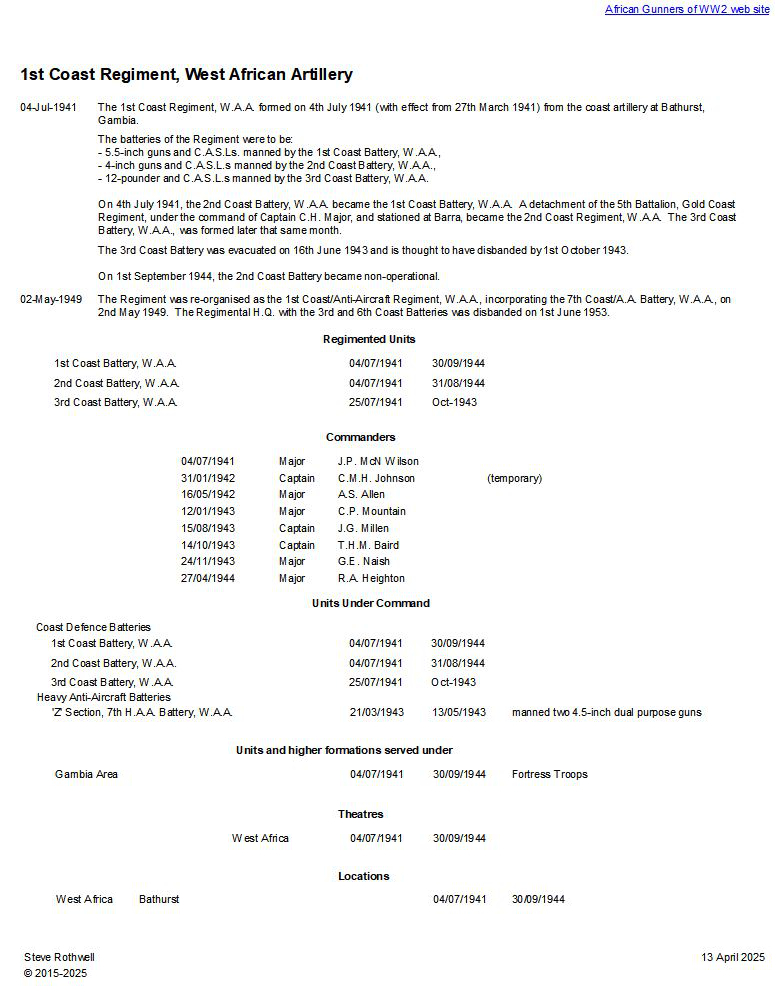
Summary history of the 1st Coast Regiment, W.A.A.
© Steve Rothwell
13 April 2025
[1] War diary 2nd Coast Battery, contained within WO 173/151; Coast Artillery West Africa, WO 106/2914
[2] WO 106/2914; War diary H.Q. Gambia Area, WO 173/140
[3] War diary 16th Coast Regiment, R.A., WO 173/153; West Africa Command Order of Battle, 1941, WO 365/10; WO 173/140
[4] War diary, 1st Coast Regiment, W.A.A., WO 173/151
[5] WO 173/151
[6] War diary, 1st Coast Regiment, W.A.A., WO 173/388; War diary, 16th Coast Regiment, R.A., WO 173/390
[7] WO 173/388
[8] WO 173/388
[9] War diary 4th H.A.A. Regiment, W.A.A., WO 172/750; War diary H.Q. Gambia Area, WO 173/715
[10] War diary, 1st Coast Regiment, W.A.A., WO 173/739; WO 173/715
[11] War diary, 1st Coast Regiment, W.A.A., WO 173/1057
[12] "Lineage Book of the British Army; Mounted Corps and Infantry, 1660-1968", Frederick J.B.M., Hope Farm Press (1969)