Sierra Leone Heavy/Coast Regiment, R.A. - 16th Coast Regiment, R.A.
Sierra Leone Heavy Regiment, R.A.
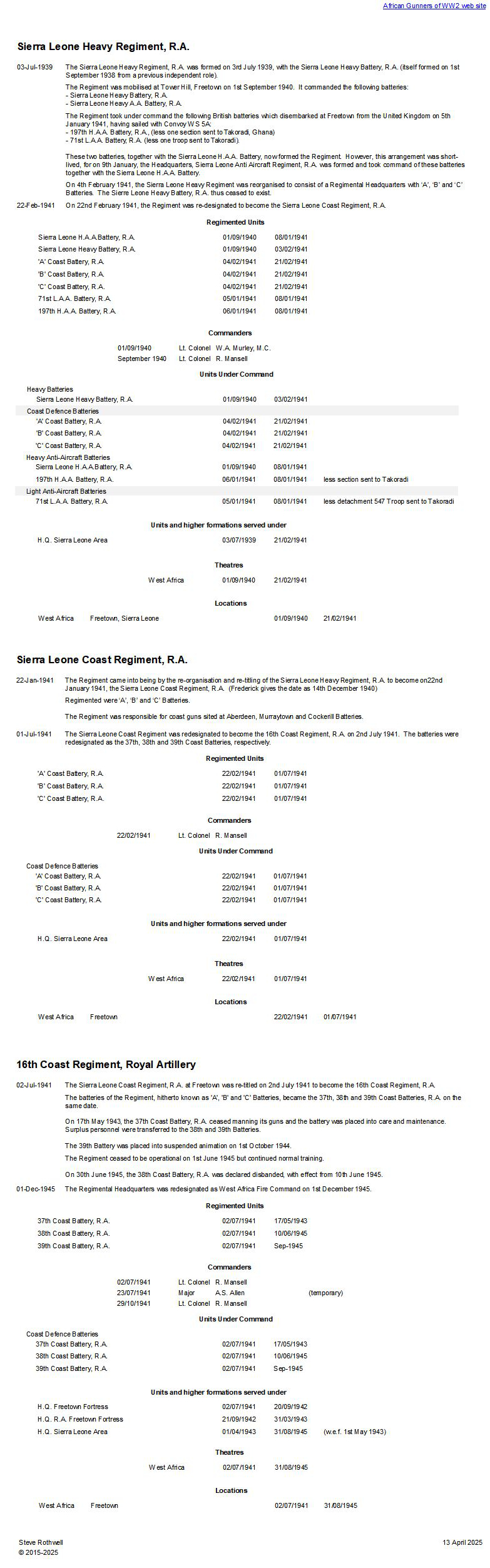
The Sierra Leone Heavy Regiment, R.A. was formed on 3rd July 1939, with the Sierra Leone Heavy Battery, R.A. (itself formed on 1st September 1938 from a previous independent role). The Regiment was mobilised at Tower Hill, Freetown on 1st September 1940. It commanded the following batteries:
- Sierra Leone Heavy Battery, R.A.
- Sierra Leone Heavy A.A. Battery, R.A.[1]
The Commanding Officer, Lt. Colonel W.A. Murley, M.C., R.A. returned to the United Kingdom on 4th September due to ill health. The duties of Commander Royal Artillery and of Officer Commanding, the Sierra Leone Heavy Regiment were assumed by Major C.J.L. Sheppard. However, when Major R. Mansell returned from Bathurst, Gambia, he assumed the two duties from Major Sheppard, who now took command of the H.A.A. Battery.[2]
The guns operated by the Regiment were varied:
- one 4-inch (4.5-inch) gun at Aberdeen, Freetown was manned by the Heavy Battery on 20th September 1940.
- 4.5-inch gun at Kissy (Kissi) West.
- one or more 3-inch H.A.A. guns at Aberdeen.
- two 2-pounder guns
- one 6-inch gun at Aberdeen (test fired on 6th November 1940).[3]
Two Vichy French planes overflew Freetown Harbour on 27th September 1940 and were engaged by the guns of the Royal Navy ships in the harbour. The land-based guns did not open fire that day but the next day the H.A.A. Battery fired three rounds at a French aircraft. On 20th October 1940, the Kissy East site was manned by the Left Section, A.A. Battery. There were further probes by French aircraft beginning in October 1940, some of which were engaged but with no damage observed.[4]
On 16th November 1940, at Freetown, a reinforcement draft joined the Regiment, having sailed from the United Kingdom with Convoy WS 4. These men were posted as follows:
- Heavy Battery two Officers, 15 British Other Ranks
- A.A. Battery two Officers and 22 British Other Ranks.[5]
On 3rd December 1940, four 40mm Bofors light anti-aircraft guns arrived from the United Kingdom. Training in the use of these guns began immediately. On 27th December, the Headquarters, H.A.A. Battery moved from Tower Hill to Kissy East.[6]
The Regiment took under command the following British batteries which disembarked at Freetown from the United Kingdom on 5th January 1941, having sailed with Convoy WS 5A:
- 197th H.A.A. Battery, R.A., (less one section sent to Takoradi, Ghana)
- 71st L.A.A. Battery, R.A. (less one troop sent to Takoradi).
These two batteries, together with the Sierra Leone H.A.A. Battery, now formed the Regiment. However, this arrangement was short-lived, for on 9th January, the Headquarters, Sierra Leone Anti‑Aircraft Regiment, R.A. was formed and took command of these batteries together with the Sierra Leone H.A.A. Battery.[7]
On 4th February 1941, the Sierra Leone Heavy Regiment was reorganised to consist of a Regimental Headquarters with ‘A’, ‘B’ and ‘C’ Batteries. The Sierre Leone Heavy Battery, R.A. thus ceased to exist.[8]
On 22nd February 1941, the Regiment was re-designated to become the Sierra Leone Coast Regiment, R.A.[9]
Sierra Leone Coast Regiment, R.A.
On 22nd February 1941, the Sierra Leone Heavy Regiment, R.A was re-designated to become the Sierra Leone Coast Regiment, R.A. Regimented were ‘A’, ‘B’ and ‘C’ Batteries (it had been intended to title these batteries as the 1st, 2nd and 3rd, however the war diary confirms that they were referred to as ‘A’, ‘B’ and ‘C’). The Regiment was responsible for coast guns sited at Aberdeen, Murraytown and Cockerill Batteries.[10]
The Regiment was commanded by Major R. Mansell, R.A. Captains Were and College commanded ‘A’ and ‘B’ Batteries respectively, however both left for the United Kingdom on 10th March. Captain Lawrie took command of ‘A’ Battery.[11]
On 12th May 1941, the Regiment ceased being responsible for providing guards for Lumley Beach and Tower Hill Barracks. A detachment of the 3rd (Coast Defence) Battalion, Sierra Leone Regiment was attached to the Regiment to take on these duties.[12]
The Gambia Coast Defence Battery had been attached to the Regiment also and this Battery left Freetown to return to Gambia on 17th June 1941.[13]
The Sierra Leone Coast Regiment was redesignated to become the 16th Coast Regiment, R.A. on 2nd July 1941. The batteries were redesignated as the 37th, 38th and 39th Coast Batteries, respectively.[14]
16th Coast Regiment, R.A.
The Sierra Leone Coast Regiment, R.A. at Freetown was re-titled on 2nd July 1941 to become the 16th Coast Regiment, R.A.[15]
The batteries of the Regiment, hitherto known as 'A', 'B' and 'C' Batteries (although also designated as the 1st, 2nd and 3rd Batteries), became the 37th, 38th and 39th Coast Batteries, R.A. on the same date. (the war diary of the Freetown Fortress first mentions the 39th Battery, 16th Regiment as early as 11th June 1941). Lt. Colonel R. Mansell, R.A., was the Commanding Officer but left for the United Kingdom on leave on 23rd July. He was succeeded by Major A.S. Allen, E.D., W.A.A. Mansell returned on 29th October and assumed command the next day. During October and November, several Polish Officers were attached to the Regiment for training.[16]
According to the Freetown Fixed Defence Scheme issued on 15th January 1942, the 16th Regiment was responsible for coast artillery guns located at the Murraytown, Aberdeen and Cockerill battery areas; together with the observation position at Wilberforce Spur and the coast defence searchlights (D.E.Ls.) at Murraytown Cape and Cape Sierra Leone.[17]
Lt. Colonel Mansell left for the United Kingdom on 21st June 1942 on medical grounds. Major C.D.T. Pope had taken over command earlier on 16th June.[18]
On 21st September 1942, upon formation of the H.Q. R.A. Freetown Fortress, the Regiment came under this command.[19]
On 17th May 1943, the 37th Coast Battery, R.A. ceased manning its guns and the battery was placed into care and maintenance. Surplus personnel were transferred to the 38th and 39th Batteries. The 4‑inch gun manned by the 38th Battery was also put into care and maintenance this day. Lt. Colonel G.H. Sloane-Stanley, R.A. took command of the Regiment on 21st, Lt. Colonel Pope returning to the United Kingdom.[20]
During June 1944, mention is made of a Training Battery.[21] The 39th Battery was placed into suspended animation on 1st October 1944 (the war diary H.Q. Sierra Leone Area gives this date as 1st September). On 7th October, a number of men were transferred to the 1st Coast Regiment, W.A.A. at Bathurst, Gambia. Major G.L. Dendy assumed command of the Regiment during October 1944. Unfortunately, the Major was taken ill in January 1945 and returned to the United Kingdom. Command was assumed by Captain P. Bryan-Smith on 30th January until replaced by Major G.N. Butterworth on 9th April, the Major transferring from the Lagos Fire Command in Nigeria.[22]
The Regiment ceased to be operational on 1st June 1945 but continued normal training.[23]
On 30th June 1945, the 38th Coast Battery, R.A. was declared disbanded, with effect from 10th June 1945.[24]
Layout of Coast Artillery, Freetown, Sierra Leone – May 1943
16th Coast Regiment, R.A.
H.Q. and Fire Command Post with C.A. Radar set
Wilberforce Spur
Range finding and Forward Observation Posts
Tower Hill, Goderich and Aberdeen
38th Coast Battery, R.A.
Aberdeen Battery: 2 X 6inch guns
Aberdeen
1 X 4-inch gun (in care and maintenance)
Aberdeen
2 X 12-pounder
Aberdeen
C.A. Radar set
Aberdeen
Murraytown Battery: 2 X 6-inch guns (in care and maintenance)
Murraytown
39th Coast Battery, R.A.
Cockerill Battery: 2 X 9.2-inch guns
Cockerill
Battery Observation Post
Cockerill
2 X Battery Observation Post
Wilberforce Spur
C.A. Radar set
Wilberforce Spur
Targets:
9.2-inch guns
Capital and block ships
6 and 4-inch guns
Light cruisers and destroyers
12-pounders
Motor torpedo boats and submarines
Summary history of the Summary history of the Sierra Leone Heavy/Coast Regiment, R.A. - 16th Coast Regiment, R.A.
© Steve Rothwell
08 April 2025
[1] "Lineage Book of the British Army; Mounted Corps and Infantry, 1660-1968", Frederick J.B.M., Hope Farm Press (1969); War diary Sierra Leone Heavy Regiment, WO 173/32
[2] WO 173/32
[3] WO 173/32
[4] WO 173/32
[5] WO 173/32
These men are most likely to have travelled in Convoy WS 4, which arrived in Freetown on 14th November 1940 (Fast) and 15th November 1940 (Slow). (Naval History web site, WS Convoys – accessed May 2023)
[6] WO 173/32
[7] War diary 1st H.A.A. Regiment, W.A.A., WO 173/160; WO 173/32
[8] War diary 16th Coast Regiment, R.A., WO 173/153
[9] WO 173/153
[10] War diary 16th Coast Regiment, R.A., WO 173/153; West Africa OB, 1940-1941, WO 212/294; War diary C.R.A. Freetown Fortress, WO 173/132
[11] WO 173/153
[12] WO 173/153
[13] WO 173/153
[14] WO 173/153
[15] War diary 16th Coast Regiment, R.A., WO 173/153
[16] WO 173/153; War diary C.R.A. Freetown Fortress, WO 173/132
[17] War diary 16th Coast Regiment, R.A., WO 173/390
[18] WO 173/390
[19] War diary H.Q. & C.R.A. Freetown Fortress, WO 173/363
[20] War diary 16th Coast Regiment, R.A., WO 173/742; War diary 37th Coast Battery, R.A., WO 173/743
[21] War diary H.Q. Sierra Leone Area, WO 173/750
[22] War diary 16th Coast Regiment, R.A., WO 173/1060, WO 173/1228
[23] War diary 16th Coast Regiment, R.A., WO 173/1228
[24] War diary 38th Coast Battery, R.A., WO 173/1229
[25] War diary Freetown Fortress, WO 173/702