2nd Coast Regiment, West African Artillery
On 4th July 1941 (but with effect from 1st March 1941) the coast artillery at Lagos, Nigeria, until then known as the Lagos Coast Defence Battery, became known as the 2nd Coast Regiment, W.A.A. Approval for the formation of Regiment had been given on 11th June 1941.[1]
The batteries were:
- 6-inch and C.A.S.L.s manned by the 4th Coast Battery, W.A.A.,
- 12-pounder gun and C.A.S.L.s manned by the 5th Coast Battery, W.A.A.
It was planned to add one 4-inch gun to the above and that an additional unit be created, to be known as the 7th Coast Battery, W.A.A.[2]
The two 6-inch naval guns had arrived at Lagos in September 1940 (certainly by 3rd October 1940). They were two of four guns which were to be sent by the Royal Navy, having been removed from the armed merchant cruiser H.M.S. Corfu which had been damaged in a collision, the other two were destined for Takoradi but in the end these latter could not be removed from the ship. The four 12-pounders, converted by being mounted on anti-aircraft mountings, were found unsuitable and were reconverted for the A.M.T.B. role (beginning in October 1941). Two of these guns were later sent to Takoradi, where they were installed by 27th December 1941.[3]
The two 6-inch naval guns had been installed by civilian contractors and in November 1940, Captain C.H. Major, Gold Coast Regiment, took command of the new battery. Firing trials were held during the month. On 3rd January 1914, he handed command to Captain J.F. Crossley, R.A. The battery at this time was referred to as the Lagos Coast Defence Battery.[4]
Major Crossley handed over to Captain A. Keay on 14th May 1942 and went on leave.[5]
Although the war diary records the unit title as being the 2nd Coast Regiment, W.A.A., reference is made only to a signal, undesignated battery. It is only in the entries for March 1942 that the first reference is made to the 4th and 5th Batteries.[6]
Work on camouflaging the 4-inch gun and its emplacement began on 9th January 1942. The protection wall began construction on 21st May. Ammunition for the gun was received during June.[7]
Captain Purcell assumed command of the 4th Coast Battery on 1st July 1942. Captain Keay left on leave to the United Kingdom on 14th September, command of the Regiment passing to Captain G.E. Naish. Lieutenant J.L.J. Edwards assumed command of the 4th Battery on 21st November 1942 while Lieutenant J.B. Ashmore assumed command of the 5th Battery, vice Lieutenant Edwards.[8]
Captain N.C. Rogerson assume command of the 4th Battery on 1st February 1943.[9]
It is possible that the 7th Coast Battery, W.A.A. was formed from 1st January 1943 to man the 4-inch gun.[10]
On 13th February 1943, an American DC-3 made a forced landing on Lighthouse Beach, approximately five miles west of the 4th Battery. However, the plane was undamaged and on 25th February was able to take off from the beach. During the month, a four-day exercise was held which included attacks on the defences by six American fighter bombers using wooden bombs. Between 5th and 7th April, the 4-inch gun was moved to a new site, but on 28th June it was placed under care and maintenance. The 7th Coast Battery, W.A.A. moved out of Hanwell Barracks to the new 4-inch gun site on 10th April. Lieutenant Edwards was posted to the 7th Battery on 14th July. Major Naish was posted to the 1st Coast Regiment, W.A.A., with effect from 15th August 1943, succeed by Major C.P. Mountain.[11]
It is possible that the 7th Coast Battery was disbanded on 1st October 1943.[12]
[The war diary for September and October 1943 is missing.]
Major Mountain relinquished command on 13th August 1944 and was succeeded by Major G.N. Butterworth. The 5th Battery ceased to be operational on 4th September 1944.[13]
On 1st October 1944, the Regiment was re-designated as Lagos Fire Command.[14]
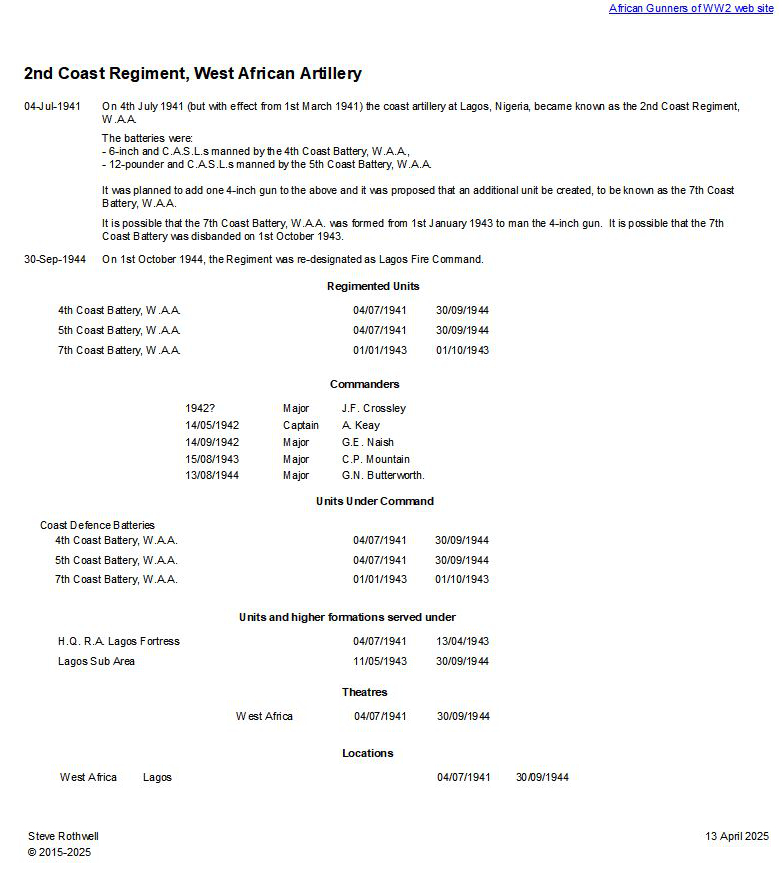
Summary history of the 2nd Coast Regiment, W.A.A.
© Steve Rothwell
13 April 2025
[1] War diary 1st Coast Regiment, W.A.A., WO 173/151, Coast Artillery West Africa, WO 106/2914
[2] WO 106/2914
[3] WO 106/2914
[4] Lagos Coast Defence Battery, WO 173/157; WO 106/2914
[5] War diary 2nd Coast Regiment, W.A.A., WO 173/389, WO 173/152
[6] WO 173/389, WO 173/152
[7] WO 173/389
[8] WO 173/389
[9] War diary 2nd Coast Regiment, W.A.A., WO 173/740
[10] "Lineage Book of the British Army; Mounted Corps and Infantry, 1660-1968", Frederick J.B.M., Hope Farm Press (1969)
[11] War diary 2nd Coast Regiment, W.A.A., WO 173/740; War diary H.Q. Lagos Sub Area, WO 173/699
[12] Frederick
[13] War diary 2nd Coast Regiment, W.A.A., WO 173/1058
[14] War diary Lagos Fire Command, WO 173/1032