14th (West African) Anti-Aircraft Brigade
The 14th A.A. Brigade formed at Woolwich in the United Kingdom on 23rd August 1941. It was formed as a mobile brigade H.Q. Having embarked on board the S.S. Narkunda at Gourock, Scotland on 28th September, the headquarters, under the command of Brigadier F.E.H. Ferguson, sailed from the United Kingdom for West Africa on 29th September 1941 with Convoy WS 12. The convoy arrived in Freetown Harbour, Sierra Leone, on 14th October and the personnel, six Officers and six Other Ranks, disembarked the next day.[1]
The Brigade H.Q. became operational on 24th October 1941, under the direct control of the Commander, Freetown Fortress. The Fortress Commander was responsible for the general policy for anti-aircraft defence, including:
- the general method of fire control,
- anti-aircraft training policy,
- lay out and expansion of anti-aircraft artillery,
- associated building programme.
The Commander, 14th A.A. Brigade, was to allocate equipment and personnel according to the policy laid down by the Fortress Commander. The guns were gathered into four groups for control and signals:
|
Group |
Gun Station |
G.L. Site* |
Group Centre |
|
|
Lumley Group |
Cape |
4 guns |
Lumley or |
Battery H.Q. - |
|
|
Aberdeen |
2 guns |
Goderich |
Lumley site |
|
|
Lumley |
2 guns |
|
|
|
|
Cockerill |
4 guns |
|
|
|
|
|
|
|
|
|
Brookfields Group |
Signal Hill |
4 guns |
Brookfields |
Battery H.Q, |
|
|
Murraytown |
2 guns |
|
Beehive House, |
|
|
King Tom |
2 X 4.5-inch |
|
Brookfields |
|
|
Brookfields |
2 X 4.5-inch |
|
|
|
|
|
|
|
|
|
Kissi Group |
Foura |
4 guns |
Wellington |
Battery H.Q., |
|
|
Kissi West |
4 guns |
|
Kissi E. or |
|
|
Kissi East |
4 X 4.5-inch |
|
New Kissi |
|
|
New Kissi |
4 guns |
|
|
|
|
|
|
|
|
|
Hastings Group |
Allen Town |
4 guns |
Rockell |
Battery H.Q., |
|
|
Hastings East |
4 guns |
|
Hastings Town |
|
|
|
|
|
|
|
Waterloo Group |
Gorahum |
2 guns |
Bassu Town |
Bassu Town |
|
|
Bagbammah |
2 guns |
|
|
|
|
Bassu Town |
2 guns |
|
|
|
|
|
|
|
|
|
|
|
|
|
|
[Note: ‘G..L. – Ground Locating – anti-aircraft radar] [2]
However, on 10th November 1941, it was decided that no anti-aircraft guns would be sited on Signal Hill or Cockerill; instead, these guns would be used to reinforce Lumley and Aberdeen.
The 1st and 2nd H.A.A and the 1st L.A.A. Regiments, W.A.A. came under command on 24th October 1941.[3]
On 21st September 1942, the Brigade H.Q. became H.Q. R.A. Freetown Fortress. The 1st and 2nd H.A.A. Regiments, W.A.A. and the 1st L.A.A. Regiment, W.A.A. remained under command.[4]
A warning order was received on 3rd March 1943 detailing that the 1st and 2nd H.A.A. Regiments, W.A.A. were to reorganise for possible overseas service. All work on existing gun sites was stopped. On 1st April 1943, the H.Q. R.A. Freetown Fortress reformed as the H.Q. 14th A.A. Brigade, on the war establishment of a mobile H.A.A. brigade. However, this latter detail was quickly amended and the H.Q. was ordered to reform as a static brigade H.Q. on 13th April. The Brigade was ordered to begin mobilisation on 20th April and that it was to comprise the 1st, 2nd and 3rd H.A.A. Regiments, W.A.A. The 1st L.A.A. Regiment, W.A.A. went to join the 81st W.A. Infantry Division, converting to become an L.A.A./anti-tank regiment. Mobilisation was to be completed by 12th May 1943. Further orders were received on 20th April that the 1st and 2nd H.A.A. Regiments were to mobilise on a static basis and the 3rd H.A.A. Regiment as a mobile unit. All three regiments were equipped with the same 3.7-inch gun on mobile platforms – the static war establishment had a much-reduced number of motor vehicles and was therefore unable to move itself without additional transport being loaned. Brigadier Ferguson was succeeded in command of the Brigade on 1st May by Brigadier D.H.M. Carberry.[5]
The anti-aircraft requirements for the defence of India and Ceylon and for the reconquest of Burma were dependent upon British reinforcements arriving from the United Kingdom and on the expansion of the Indian anti-aircraft artillery, most notably through the so-called ‘Madrassi Scheme’. British manpower was both in great demand and in short supply, not only for India but for other theatres of war. By early 1943, India was asked to release British anti-aircraft units for transfer to the Middle East. As the Indian expansion programme would not be able to replace these in the short term, it was eventually decided to send three West African heavy anti-aircraft regiments as reinforcements for India. As a consequence, the 14th (W.A.) A.A. Brigade, with the 1st, 2nd and 3rd Heavy Anti-Aircraft Regiments under command, was assembled in Sierra Leone and at the end of May 1943 embarked at Freetown for India. The Brigade H.Q., with the 1st H.A.A. Regiment, W.A.A. and the 5th H.A.A. Battery, W.A.A., embarked on the Nieuw Holland (given the code designation of H.T.P68) on 26th May. The 308th H.A.A. Battery, R.A. and the 6th H.A.A. Battery, W.A.A. had embarked on a second ship on 23rd May. The gunners waited in Freetown Harbour until 3rd June, when the ships sailed with convoy WS30, en route from the United Kingdom to the Middle East and India. Sailing via South Africa, the ship arrived at Bombay on 9th July 1943, the Brigade H.Q. disembarked three days later and moved to Dhond (today Daund), with the 2nd and 3rd H.A.A. Regiments, the 1st going to Kedgaon Camp, Ahmednagar. The Brigade H.Q. now came under the command of H.Q. Southern Army. The arrival in India of the Brigade with its three regiments released two static British regiments, from Ceylon, (the 54th and
the 65th) for redeployment to the Middle East.[6]
At Dhond, the units of the Brigade awaited the arrival of anti-aircraft equipment. It was on 22nd July 1943 that the Brigade received the first intimation of its probable role in India, most likely with Eastern Army. The following day, the 1st H.A.A. Regiment, W.A.A. was selected to precede the Brigade’s move to the Eastern Army area to come under the command of the 9th A.A. Brigade. The 1st Regiment was due to leave Dhond in early August but was delayed due to breaks in the railway lines running to the Northeast, most likely due to sabotage by Indian nationalists. One battery left for Assam on 28th August, followed by the balance of the Regiment on 30th August. The 1st Regiment eventually arrived in the 9th A.A. Brigade area on 8th September. The R.H.Q. with the 1st Battery, W.A.A. and the 197th Battery, R.A., deployed at the Manipur Road Base. The 2nd Battery, W.A.A. went to Gauhati.[7]
Next to leave was the 2nd Regiment, W.A.A, with the Regiment’s advance party leaving on 23rd September 1943. This was followed by the advance party of the 3rd Regiment, W.A.A. on 26th September. During October, the Brigade released nine Officers and 27 N.C.O.s from the 2nd and 3rd Regiments, W.A.A. to reinforce the artillery units of the 81st (West Africa) Infantry Division. In October, Eastern Army was re-organised to create the H.Q. 14th Army – the field headquarters responsible for operations against the Japanese – and H.Q. Eastern Command. The 9th A.A. Brigade came under 14th Army on 15th October, and the 14th Brigade would do so when it eventually arrived in Assam. The 2nd Regiment, W.A.A. did not arrive in the 9th A.A. Brigade area until 10th December; the R.H.Q. and the 6th Battery, W.A.A. at Gauhati; the 308th Battery, R.A and the 5th Battery, W.A.A. at Misamari and Tezpur respectively. With the arrival of the 6th H.A.A. Battery, the 2nd Battery, 1st H.A.A. Regiment, W.A.A. left for Golaghat, arriving within a day two.[8]
The 14th Brigade Headquarters finally left Dhond for Assam on 13th November 1943, accompanied by the R.H.Q., 3rd Regiment, W.A.A., the 251st Battery, R.A. and part of the 4th Battery, W.A.A. The 405th Battery, R.A. and the balance of the 4th Battery left Dhond on 17th November. The Brigade H.Q. arrived by river steamer at Pandu on 4th December but the personnel were unable to disembark until the next day and were delayed in the onward move by the need to wait for baggage and stores to be unloaded. After what must have been a trying journey, the Brigade H.Q. arrived at Shillong on 11th December. Shillong was the capital of Assam and a pre-war cantonment town. At 00:01 on 13th December, the Brigade assumed command of the 1st, 2nd, 3rd H.A.A. Regiments, W.A.A., the 118th L.A.A. Regiment, R.A., the 2nd L.A.A. Regiment, I.A. and the 6th Battery, 1st L.A.A. Regiment, I.A. The Brigade's area of responsibility included: 251 Lines of Communication Sub-Area; 252 Lines of Communication Sub-Area not covered by the 9th Anti-Aircraft Brigade; 353 Lines of Communication Sub-Area north of latitude 25 (roughly level with the present day east-west border between north-eastern Bangladesh and India) and Kohima. The Brigade was now under command of the H.Q. 14th Army. The 3rd H.A.A. Battery, W.A.A., meanwhile was disposed with the R.H.Q. at Urunarband, near Silchar; the 251st H.A.A. Battery at Kumbhirgram; the 405th H.A.A. Battery at Agartala; the 4th H.A.A. Battery at Hailakandi/Rajyeswarpur.[9]
On 20th December, the Brigade H.Q. moved from a scattering of bungalows to one building for offices and one for quarters for African other ranks. The weather in the Assam hills proved to be too cold for the African soldiers to live in tented accommodation, several men became sick with chest colds, fortunately there were no serious cases. By the end of December, it was reported that the African soldiers were becoming more use to the cold weather – no doubt it helped them having been issued with thick underclothing, battledress and ‘woollen comforts’.[10]
In January 1944, the 2nd Battery, 1st H.A.A. Regiment, W.A.A. moved to Hailakandi, arriving on or just after 26th January. The first engagement of a Japanese aircraft by a West African unit did not occur until 15th February, when the 251st H.A.A. Battery fired on a Japanese reconnaissance plane over the Surma Valley. On or just after 11th February, the R.H.Q. 2nd H.A.A. Regiment, W.A.A. arrived at Sonabheel (Tezpur) from Gauhati.[11]
In February/March 1944, the 3rd Light and the 19th Heavy A.A. Batteries, Indian Artillery came under the command of the Brigade when they were moved to Sylhet. Here, the Indian gunners provided air defence for the main headquarters of the Chindits. This was provided during the fly-in of the Chindits on Operation ‘Thursday’ and for the air link maintained throughout the duration of the operation.[12]
Brigade location statement 27th December 1943
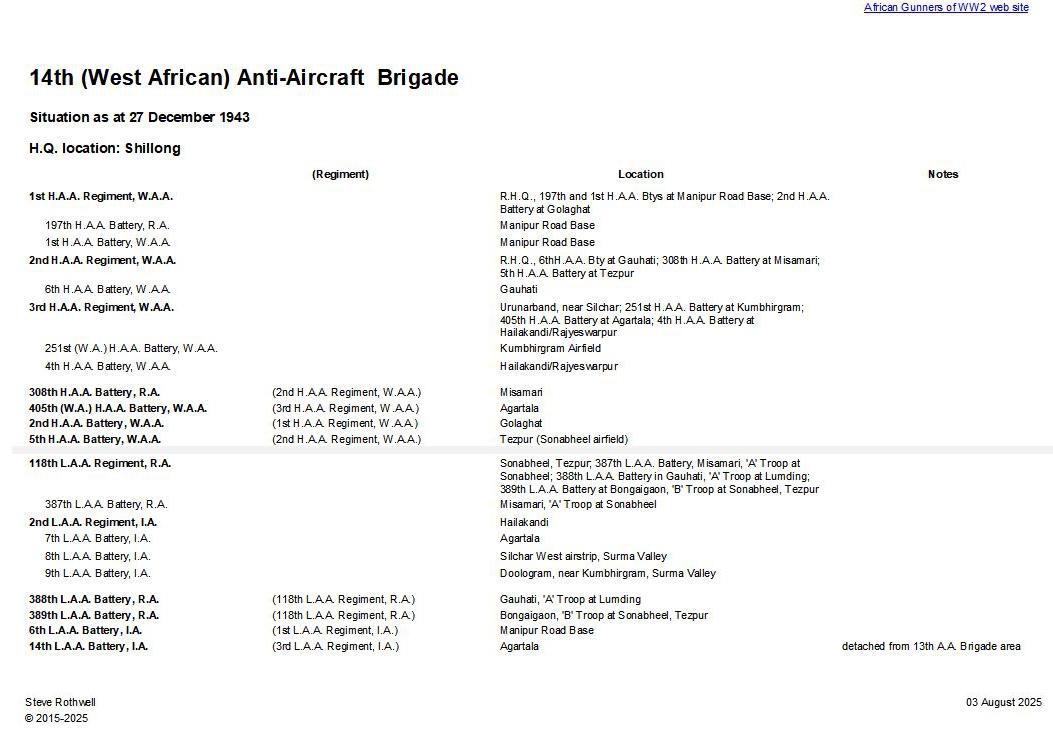
Summary history of the 14th (W.A.) A.A. Brigade
© Steve Rothwell
There were no further changes in the location of the West African heavy anti-aircraft regiments until the Summer of 1944. This situation differed greatly from that of the light anti-aircraft regiments, British and Indian, which were frequently on the move, driven largely by the airfield defence requirements of the R.A.F. and the U.S.A.A.F. Then, in June, a troop of the 2nd Battery, 1st H.A.A. Regiment, W.A.A. moved from Hailakandi to Sylhet, arriving on 5th June. The second troop arrived by 14th June. This was followed in July by the move of the 6th Battery, 2nd H.A.A. Regiment, W.A.A. from Gauhati to Manipur Road, which was completed on 18th July. This move released the 1st Battery, 1st H.A.A. Regiment, W.A.A. to move to Imphal where it arrived on 28th July.[13]
During September 1944, there were further moves of the West African heavy anti-aircraft artillery. The 5th Battery, 2nd H.A.A. Regiment, W.A.A. arrived at Manipur Road from Tezpur on 2nd September. The Regimental H.Q. and the 197th Battery, 1st H.A.A. Regiment, W.A.A moved to the Imphal area from Manipur Road: the 197th Battery less one troop to Palel; the second troop to Tulihall, Imphal. The R.H.Q., 2nd H.A.A. Regiment, W.A.A. arrived at Manipur Road from Tezpur on 5th September. Tezpur was now defended by the Battery H.Q. and a troop of the 308th Battery, 2nd H.A.A. Regiment, W.A.A. from Misamari.[14]
The final months of 1944 saw further, minor reshuffling of West African batteries. The 308th Battery, 2nd H.A.A. Regiment, W.A.A. moved to Jorhat from Tezpur, arriving on 23rd November, where it came under the command of the 3rd Indian A.A. Brigade. A troop of the 405th Battery, 3rd H.A.A. Regiment, W.A.A. moved from Agartala to Kalaura, arriving on 28th November. The 4th Battery, 3rd H.A.A. Regiment, W.A.A. arrived at Sylhet from Hailakandi/Rajyeswarpur on 15th December. The 2nd Battery, 1st H.A.A. Regiment, W.A.A. was thus allowed to move from Sylhet to Imphal where it was declared ready for action at Tulihall on 26th December. The troop of the 197th Battery previously at Tulihall moved to Kangla where it too was ready for action on 29th December. Perhaps of slightly more significance, the 4th H.A.A. Regiment, W.A.A. at Comilla, previously serving with the 13th A.A. Brigade, was placed under the command of the 14th (W.A.) A.A. Brigade on 31st December; this regiment had been earmarked for disbandment.[15]
In January 1945, the Brigade was earmarked to move into Burma to relieve anti-aircraft units of the 14th Army but the order was cancelled by the end of the month. That same month, planners at H.Q. ALFSEA proposed that the Brigade be retained for future projected operations as a semi-mobile brigade. It was suggested that the Brigade would be composed of: 1st and 2nd West African Heavy Regiments; the 4th, 16th and 18th L.A.A. Regiments, I.A.; the 16th Coast Battery, I.A. On 11th February 1945, H.Q. ALFSEA issued orders that the Brigade be considered under its command for all purposes except local administration, which was to be the responsibility of the appropriate area or sub-area within the Lines of Communication Command. During the month, none of the guns under the command of the Brigade were deployed for action. The Brigade H.Q. was by now a static anti-aircraft formation and it remained at Shillong where, from March 1945, together with the West African Regiments under command, it awaited orders to move elsewhere in India.[16]
During February 1945, the 3rd H.A.A. Regiment, W.A.A., was ordered to become non-operational and for all units of the Regiment to concentrate at their present locations. In March, the Brigade, with the 1st, 2nd and 3rd H.A.A. Regiments, W.A.A., the 69th L.A.A. Regiment, R.A. (less one troop) and the 18th L.A.A. Regiment, I.A. were warned of the withdrawal of the Brigade to India. On 1st April, a decision was taken by G.H.Q. (India) that the withdrawal to India would be a preliminary to returning the West African Brigade to Africa. The 69th L.A.A. Regiment, R.A. and the 18th L.A.A. Regiment, I.A. left for Ranchi. On 20th April, the 4th L.A.A. Regiment, I.A. was placed under command of the 13th A.A. Brigade. By late April, only the three original West African H.A.A. regiments remained under the command of the Brigade, the 4th H.A.A. Regiment, W.A.A. having been disbanded at Comilla by 1st April.[17]
The first of the West African regiments to leave was the 3rd H.A.A. Regiment which, less the troop of the 405th Battery at Agartala, left for India on 1st May 1945 and arrived at Kumbhargaon, near Poona on 7th May. The remaining troop of the 405th Battery left the Surma Valley for India on 12th May, reaching Kumbhargaon seven days later. The move of the Brigade H.Q. and last two regiments was delayed until September. At first it looked as though the personnel of the 1st and 2nd H.A.A. Regiments, W.A.A. would go straight to Calcutta for embarkation for West Africa and that the Brigade H.Q. would be disbanded following the embarkation. All elements of the 1st Regiment concentrated at Manipur Road by 13th August but on 30th August notification was received that the embarkation of the 1st and 2nd Regiments for West Africa had been postponed (due to a severe shortage of shipping).[18]
The Brigade H.Q. reported that the morale of all ranks was sorely tested due to these delays. The situation was made worse by the fact that many Officers and British Other Ranks had deferred their own release to accompany the African soldiers back to West Africa. The feeling amongst these men was that they did not want to be released or repatriated until they had seen the African soldiers safely home. G.H.Q. (India) was asked by the H.Q. 14th Brigade to suspend the release of these men and this request was accepted. This helped to restore morale amongst the affected British personnel and with the move to Kalyan, these two factors also raised the morale of the African soldiers.[19]
Finally, on 16th September, the 2nd Regiment, together with the 197th and 2nd Batteries, left Manipur Road for Kalyan, near Bombay, en route to embarkation. These units arrived at Kalyan on 22nd/23rd September. On 29th September, the 1st Regiment was in transit from Manipur Road to Kalyan.[20]
With all units under command now dispersed or on the way home to West Africa, the H.Q. 14th (W.A.) Brigade was disbanded at Shillong on 30th September 1945.[21]
14 September 2025
[1] War diary 14th A.A. Brigade, WO 173/158
The H.Q. was identified as “H.Q. 14 Lt. A.A. Brigade” in the list of units which sailed with convoy WS 12 (W.S. Convoys, W.S.9 to W.S.19, March 1941-June 1942, WO 193/55).
[2] War diary 1st L.A.A. Regiment, W.A.A., WO 173/172; War diary C.R.A. Freetown Fortress, WO 173/132
[3] WO 173/158; War diary C.R.A. Freetown Fortress, WO 173/132
[4] War diary 14th A.A. Brigade, WO 173/395
[5] War diary 14th A.A. Brigade, WO 173/756; War diary H.Q. Sierra Leone Area, WO 173/700
[6] A.A. Requirements, WO 106/4562; War diary 14th W.A. A.A. Brigade, WO 172/746, WO 172/4073; War diary 23rd A.A. Brigade, WO 172/3790; War diary 54th H.A.A. Regiment, WO 169/9821 ; War diary 65th H.A.A. Regiment, WO 169/9829; War diary 1st H.A.A. Regiment, W.A.A., AP NAIDLF00780841
[7] War diary 9th A.A. Brigade, WO 172/2140; War diary 14th W.A. A.A. Brigade, WO 172/2145; WO 172/4073
[8] WO 172/2140; WO 172/4073
[9] Sawyer; WO 172/2140; WO 172/4073
[10] Sawyer; WO 172/2140; WO 172/4073
[11] War diary 14th A.A. Brigade, WO 172/6638
[12] Sawyer; WO 172/6638
[13] WO 172/6638
[14] WO 172/6638
[15] WO 172/6638
[16] H.Q. ALFSEA – A.A. Artillery, WO 203/1713
[17] War diary 14th A.A. Brigade, WO 172/9578
[18] WO 172/9578
[19] WO 172/9578
[20] WO 172/9578
[21] WO 172/9578