Sierra Leone Anti-Aircraft Regiment, R.A. - 1st Heavy Anti-Aircraft Regiment, W.A.A.
The Sierra Leone Anti-Aircraft Regiment, R.A., formed on 9th January 1941, was redesignated to become the 1st H.A.A. Regiment, W.A.A on 1st May 1941. For a brief period, between 1st July and 1st October 1941, the Regiment was redesignated as the 1st A.A. Regiment, W.A.A., denoting it as a composite regiment formed of both heavy and light anti-aircraft regiments. From October 1941, the Regiment reverted to being designated as a heavy anti-aircraft regiment. .
Sierra Leone Anti-Aircraft Regiment, R.A.
On 9th January 1941, the Headquarters, Sierra Leone Anti-Aircraft Regiment, R.A. was formed by order of the Commander, Royal Artillery (C.R.A.), Sierra Leone Area and opened at Murray Town, Freetown. The Commanding Officer was Lt. Colonel C.J.L. Sheppard, M.C.
The Sierra Leone A.A. Regiment was composed as follows:
- Sierra Leone H.A.A. Battery, R.A.
- 197th H.A.A. Battery, R.A., (less one section sent to Takoradi, Ghana)
- 71st L.A.A. Battery, R.A. (less one troop sent to Takoradi).
These batteries had all previously served with the Sierra Leone Heavy Regiment, R.A.[1]
The Regiment’s deployments were:
H.Q. Sierra Leone H.A.A. Battery, R.A. Kissi East
- two sections (each two 4.5-inch) Kissi East
- one section (two 4.5-inch) King Tom
- one section (two 4.5-inch) Brookfields
H.Q. 197th H.A.A. Battery, R.A. Murray Town
- one section (3.7-inch) deploying to Cockerill
- one section (3.7-inch) deploying to Cape Sierra Leone
- one section (QF 3-inch 20cwt) at Cape Sierra Leone
- one section (4.5-inch) in transit to Takoradi, Ghana
H.Q. 71st L.A.A. Battery, R.A. (8 X Bofors) Bishop’s Court, Freetown
- one troop (Bofors) deploying to Kissi Oil Tanks
- two sub-sections (Bofors) deploying to Bishop’s Court
- one sub-section (Bofors) deploying to King Tom
- one sub-section (Bofors) deploying to Farren Point
- one troop (Bofors) in transit to Takoradi, Ghana.
On 10th January 1941, the 71st L.A.A. Battery, R.A. had eight Bofors guns in action in the Freetown area. The Regimental H.Q. moved to Bishop’s Court on 30th January. That same day, a French aircraft was engaged by both heavy and light guns and two hits were claimed. A batch of African recruits arrived from Daru on 24th February and immediately began training. A second batch of 53 A.O.R.s arrived on 28th February for training at Murray Town. British Officer reinforcements arrived from the United Kingdom, on board the S.S. Highland Brigade, which had sailed as part of Convoy WS 6, and disembarked on 4th March.
These reinforcements appear to have been the H.Q. ‘X’ H.A.A. Regiment, R.A. which arrived at Freetown from the United Kingdom on 2nd March 1941, on board the S.S. Highland Brigade. This H.Q. had formed in the United Kingdom in December 1940 for service in West Africa as the R.H.Q. for the 197th H.A.A. Battery, R.A. and the 71st L.A.A. Battery, R.A. The H.Q. personnel disembarked on 4th March and went to Murraytown.[2]
Five of these Officers were posted to the Batteries. Lt. Colonel T. Nettleton disembarked on 7th March and assumed command from Major T. Durrant on 9th March. A further fifty African recruits arrived from ‘up country’ on 5th March. The R.H.Q. moved to Murray Town on 10th March. Another fifty African recruits arrived on 19th March and fifty more on 26th March. More recruits arrived during April, and there were frequent engagements of French aircraft.[3]
On 1st May 1941, the Regiment was re-titled to become the 1st Heavy Anti-Aircraft Regiment, W.A.A.[4]
1st Heavy Anti-Aircraft Regiment, W.A.A.
1st Heavy Anti-Aircraft Regiment, W.A.A.
On 1st May 1941, the Sierra Leone A.A. Regiment, R.A. was re-titled to become the 1st Heavy Anti-Aircraft Regiment, W.A.A. The Commanding Officer was Lt. Colonel T. Nettleton. The Regiment was formed of the following batteries:
- 197th H.A.A. Battery, R.A., (less one section sent to Takoradi, Ghana)
- 1st H.A.A. Battery, W.A.A. formerly Sierra Leone H.A.A. Battery, R.A.
- 2nd H.A.A. Battery, W.A.A. a newly formed unit.[5]
Between 18th February 1941 and 1st May, 449 African Other Ranks (A.O.R.s) had been recruited into the Regiment (and its predecessor). The Vichy French air force continued to send its Martin aircraft over Freetown and on 15th May, six 4.5-inch rounds were fired at on aircraft but without result. During 15th May, the R.H.Q. moved from Murray Town to Kortright House, Freetown. On 20th May, it was the turn of the 3.7-inch guns to fire at encroaching French aircraft, and again the next day.
Ten Officers and 14 British Other Ranks (B.O.R.s) disembarked at Freetown from the United Kingdom on 25th May 1941 and were posted to the 1st H.A.A. Regiment, W.A.A. These men most likely travelled with Convoy WS 8A and were from/made up the disbanding R.H.Q. ‘X’ Regiment, R.A.[6]
1st Anti-Aircraft Regiment, W.A.A.
The title of the Regiment was changed once again, when on 1st July 1941, it became known as the 1st Anti-Aircraft Regiment, W.A.A., R.W.A.F.F. However, this was short lived, and by 1st October, the title had reverted to be 1st H.A.A. Regiment, W.A.A., no doubt in compliance with War Office nomenclature for regiments consisting entirely of H.A.A. batteries.[7]
1st Heavy Anti-Aircraft Regiment, W.A.A.
During August 1941, the first Nigerian recruits began arriving at Freetown and more followed during September. The gun site at Brookfields was temporarily handed over to the 308th H.A.A. Battery, R.A. on 15th September. On 3rd October, the Kissi West site was handed over by the 1st H.A.A. Battery, W.A.A. to the 308th H.A.A. Battery, R.A. The Cape Sierra Leone site was taken over on 14th October by the 197th H.A.A. Battery, R.A., with personnel of the 2nd H.A.A. Battery, W.A.A. That day, ninety-four personnel of the 313th H.A.A. Battery, R.A. disembarked at Freetown and were attached to the batteries of the 1st H.A.A. Regiment, W.A.A. for all purposes. On 31st October, the 197th H.A.A. Battery, R.A. left Murray Town and moved to Beehive House, Wilberforce, Freetown.[8]
On 5th January 1942, the 197th and 2nd Batteries exchanged gun sites at Freetown: H.1 going to the 2nd Battery; H.3 going to the 197th Battery. The Regimental H.Q. moved from Wilberforce Girl’s School to Tower Hill on 16th January. Two static 3.7-inch guns were emplaced at site H.5 that month: No.1 gun on 23rd January; No.2 gun on 25th January. A new gun site, H.29, was occupied by the 1st H.A.A. Battery on 10th February. Sixty-four A.O.R.s were posted to the Regiment from the Anti-Aircraft Training Centre on 11th February. On 19th February, four Officers and fifteen B.O.R.s arrived from the United Kingdom to join the Regiment. Forty-two B.O.R.s were posted to the Regiment from the 2nd H.A.A. Regiment, W.A.A. on 23rd February. Gun sites were exchanged with the 2nd Regiment on 25th February:
- H.14 taken over by the 1st H.A.A. Battery
- H.20 handed over to the 2nd Regiment.
The Battery H.Q., 1st H.A.A. Battery moved Brookfields on 25th February.[9]
The code names of the gun sites in and around Freetown changed on 5th March 1942. The attached personnel of the 313th H.A.A. Battery, W.A.A. embarked on 25th March to re-join their unit. The gun station A.3 at Aberdeen, reported ready for action with two 3.7-inch guns on 4th April, was handed over to the 2nd H.A.A. Regiment, W.A.A. on 28th April. The Regimental H.Q. moved from Tower Hill to Signal Hill on 1st May. Lt. Colonel Nettleton left for leave in the United Kingdom on 21st June; Major W.S. Crane took over in his absence. Gun station A.3 at Aberdeen, occupied by the 6th Battery, 2nd H.A.A. Regiment, W.A.A., was taken over by the 197th H.A.A. Battery, R.A. on 8th July. However, the two guns at that site were removed and handed over to the 6th Battery between 15th/16th August. The personnel of the 197th Battery, previously at site A.3, took over site D.2 from the 4th Battery, 2nd H.A.A. Regiment, W.A.A. on 10th September. In November, gun site B.1 was taken over from the 1st H.A.A. Battery by the Anti-Aircraft Training Centre. That same day, 15th November, gun site D.1. was taken over by the 1st H.A.A. Battery.[10]
On 1st March 1943, the 71st L.A.A. Battery, R.A. was brought under command of the 1st Regiment, but left on1st May.[11]
The Regiment was mobilised and embarked for India at Freetown on 27th May 1943. After arriving at Bombay, it disembarked on 11th July and moved to Kedgaon Camp, Ahmednagar. On 30th August, it left for service with Eastern Army in Assam. The Regiment, less the 2nd H.A.A. Battery, W.A.A., arrived at Manipur Road on 8th/9th September and relieved the 2nd H.A.A. Regiment, Indian Artillery. The Regiment came under the command of the 9th A.A. Brigade. The 2nd Battery went to Gauhati where it relieved the 1st H.A.A. Battery, Indian Artillery. On 14th September, the Commanding Officer, Lt. Colonel T. Nettleton, assumed the duty of Anti-Aircraft Defence Commander Manipur Road.[12]
During October 1943, the Regiment became known officially as the 1st (W.A.) H.A.A. Regiment, R.A. [It was official policy within Indian Command and the 14th Army to designate the ‘nationality’ of units in their title, to remove the risk of any opportunity for confusion where units of the same type also had the same unit number: for example, the 8th H.A.A. Battery, R.A. and the 8th (Indian) H.A.A. Battery, I.A.)]. The three batteries also included the ‘(W.A.)’ identifier in the unit titles at the same time.[13]
The 2nd H.A.A. Battery moved to Golaghat on 12th December 1943. On 13th December, the Regiment returned to the command of the 14th (W.A.) A.A. Brigade, when this Headquarters arrived in Assam. The 2nd H.A.A. Battery moved again on 24th January 1944, to Hailakandi. Lt. Colonel W.L. Abel-Smith assumed command of the Regiment on 6th February. The 2nd H.A.A. Battery, W.A.A. was in action on 12th March when it engaged a formation of Japanese fighters. Thirteen rounds were fired and the fire stopped when a group of Spitfires engaged the Japanese. It was believed that the burst of anti-aircraft fire had guided the R.A.F. planes on to the Japanese formation.[14]
At the end of March 1944, in the light of the approaching Japanese offensive, the Regiment reviewed its local defence measures and from 5th April all defences were manned continuously, the Regiment forming its own defence ‘box’. These measures were relaxed from 17th May. The 2nd H.A.A. Battery moved to Sylhet on 14th June, with four 3.7-inch mobile guns. The 1st H.A.A. Battery, W.A.A. moved to Imphal on 25th July, followed on 1st September by the R.H.Q. and the 197th Battery (to Palel) upon relief by the 2nd H.A.A. Regiment, W.A.A. and the 5th H.A.A. Battery, W.A.A. There was another sweep of Japanese fighters on 5th November, with three destroyed claimed by the R.A.F. Two African Other Ranks were declared missing, believed killed when the transport aircraft in which they were supply dropping was shot down on 8th November.[15]
In December 1944, many British Other Ranks on long service status were repatriated to the United Kingdom. They were replaced by reinforcement drafts, one of which came from the 4th H.A.A. Regiment, W.A.A., which had just been declared surplus to requirements and would soon be disbanded. On 18th December, the 2nd H.A.A. Battery moved from Sylhet to Tulihal.[16]
The Battery moved from Imphal to Manipur Road on 11th August 1945. Lt. Colonel Abel-Smith was posted way on 2nd July 1945 on release. Major W.S. Crane assumed command of the Regiment on 13th August and was promoted to acting Lt. Colonel.[17]
News was received on 12th September 1945 that under the authority of the C-in-C India, all repatriation and release of British Officers and Other Ranks in 14th (W.A.) A.A. Brigade had been suspended. The measure was implemented to ensure that there were sufficient European personnel to take the Brigade back to West Africa, It was also thought that the morale of the African gunners would suffer considerably if their Officers and British counterparts continued to leave on a large scale. AN undertaking was given to all British personnel affected that they would be repatriated to the United Kingdom as a priority after their arrival in West Africa.[18]
On 17th September, the 197th and 2nd Batteries entrained, en route for Kalyan where they arrived on 23rd September. From Kalyan, the two Batteries went to Bombay on 28th September where they embarked on the ship H.M.T. Highland Princess (code-named B.T. 11), being played on board by the Sierra Leone Band. The ship weighed anchor the next day and arrived at Freetown on 19th October 1945 and the personnel disembarked on 20th October.[19]
The 1st Regiment H.Q. did not leave Manipur Road until 29th September when it headed for the transit camp at Kalyan, near Bombay. It arrived there on 5th October and embarked at Bombay on the H.M.T. Bergensfjord between 6th and 9th October. Disembarking at Freetown on 31st October, the men went to the demobilisation camp. Nine British Officers and seventeen B.O.R.s embarked for the United Kingdom on board the Highland Princess on 1st November. With the A.O.R.s released early in November, the remaining British Officers and men embarked for the United Kingdom on the Bergensfjord on 11th November. The 1st H.A.A. Regiment, W.A.A. was officially disbanded on 15th November 1945.[20]
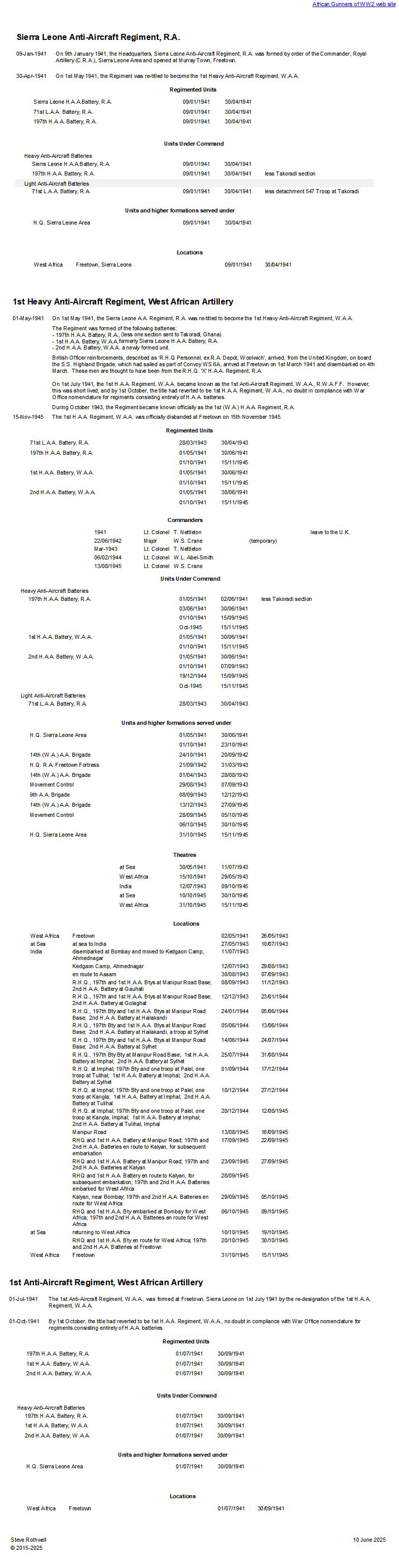
Summary history of the Sierra Leone A.A. Regiment, R.A. - 1st H.A.A./A.A. Regiment, W.A.A.
© Steve Rothwell
[1] War diary 1st H.A.A. Regiment, W.A.A., WO 173/160
[2] War diary C.R.A. Freetown Fortress, WO 173/132
[3] WO 173/160; Naval History web site, WS Convoys – accessed May 2023
[4] WO 173/160
[5] War diary 1st H.A.A. Regiment, W.A.A., WO 173/160
[6] WO 173/160; "Lineage Book of the British Army; Mounted Corps and Infantry, 1660-1968", Frederick J.B.M., Hope Farm Press (1969); Naval History web site, WS Convoys – accessed May 2023
[7] WO 173/160
[8] WO 173/160
[9] War diary 1st H.A.A. Regiment, W.A.A., WO 173/396
[10] WO 173/396
[11] War diary 1st H.A.A. Regiment, W.A.A., WO 173/747
[12] WO 173/747; War diary 1st HAA Regiment, W.A.A., Abhilekh Patal NAIDLF00780841
[13] NAIDLF00780841
[14] NAIDLF00780841
[15] NAIDLF00780841
[16] NAIDLF00780841
[17] War diary 1st H.A.A. Regiment, W.A.A., WO 172/9588
[18] WO 172/9588
[19] WO 172/9588
[20] War diary 1st H.A.A. Regiment, W.A.A., WO 173/1230