‘D’ H.A.A. Regiment, R.A. - 4th Heavy Anti-Aircraft Regiment, W.A.A.
The 4th Heavy Anti-Aircraft Regiment, W.A.A. was formed on 25th October 1941 by the redesignation of the Headquarters, ‘D’ Heavy Anti-Aircraft Regiment, R.A.
H.Q. ‘D’ Heavy Anti-Aircraft Regiment, R.A.
The Regimental Headquarters, ‘D’ Heavy Anti-Aircraft Regiment, R.A. was formed for service in West Africa at Woolwich Depot, in United Kingdom on 10th September 1941. Lt. Colonel K. Hargraves was posted from the 96th H.A.A. Regiment, R.A. to become the Commanding Officer of the new H.Q. On 25th September 1941, the Headquarters left Euston Station for Gourock where it embarked the next day on ‘Ship No. 20’ (H.M.T. B.20 – S.S. Narkunda). While waiting to sail, Lt. Colonel Hargraves was recalled by the War Authority just prior to the ship sailing with Convoy WS 12 on 1st October. The Narkunda arrived off Freetown with the convoy on 14th October. Two days later, the R.H.Q., ‘D’ H.A.A. Regiment, R.A. disembarked and re-embarked on ‘Ship ‘D’’ and on 21st October left Freetown for Bathurst, Gambia, where it arrived on 23rd October. The personnel disembarked the next day, with Major J.N. Passmore in command, and was immediately re-titled to become the 4th H.A.A. Regiment, W.A.A.[1]
4th Heavy Anti-Aircraft Regiment, W.A.A.
The Regiment formed on 25th October 1941, with the following batteries being regimented:
- 313th H.A.A. Battery, R.A. Jeswang aerodrome site
- 64th L.A.A. Battery, R.A., B.H.Q. and ‘C’ Troop B.H.Q. at Denton Bridge, 3 guns at Jeswang.
During December 1941, African Other Ranks began arriving from Freetown and were attached to the 313th H.A.A. Battery, R.A. for training. Two static 3.7-inch H.A.A. guns were test fired at Jeswang on 1st December, being the first H.A.A. guns to be fired in the Gambia. On 8th December, the mounting of guns at Kanifing began. Vichy French Martin aircraft flew over Jeswang on 13th December and again on 14th December when they were engaged by the 313th H.A.A. Battery, R.A. Major Passmore was promoted to Lt. Colonel on 21st December. A troop of light anti-aircraft personnel arrived on 25th December, consisting of two Officers and 38 B.O.R.s. These men were attached to the 64th L.A.A. Battery, R.A. Four Bofors guns were sited on 30th December: one at Half Die; one at Denton Bridge; two at Jeswang. It appears that the 7th H.A.A. Battery, W.A.A. was formed within the Regiment at this time (November-December 1941: Frederick states 1st November 1941 but the 7th Battery is not mentioned in the 4th Regiment’s war diary until March 1942).[2] [3]
‘A’ L.A.A. Troop, only recently posted to the 1st L.A.A. Battery, W.A.A. in Freetown, left for the Gambia, where it arrived on 6th January 1942 to be posted to the 64th L.A.A. Battery, R.A. Four Bofors guns arrived from the United Kingdom on 22nd January and were disposed with one each at: the P.W.D. Site; Swamp at Half Die; Denton Bridge; Jeswang aerodrome. On 25th January, the R.H.Q. moved from the P.W.D. (Public Works Department) to Cape St. Mary. From 3rd February, the 64th L.A.A. Battery, R.A. was to undertake the dual role of anti-aircraft and coast defence at: Half Die (three guns); Bathurst Point (one gun); Denton Bridge (two guns). Four 3.7-inch guns arrived for the 7th H.A.A. Battery, W.A.A. on 18th February but were not unloaded until 27th February when they were taken to Half Die.[4]
The Battery H.Q., 7th H.A.A. Battery, W.A.A. moved from Jeswang North to Gael on 10th March 1942. Four 3.7-inch guns were ready for action at Half Die (Site A5) on 20th March. Lt. Colonel Passmore left on leave in the United Kingdom and command of the Regiment was assumed by Major G.M.E. Barber on 20th July 1942. Passmore re-assumed command on 20th November 1942, upon his return. On 17th July 1942, the Regiment was deployed as follows:[5]
- 313th H.A.A. Battery, R..A.
two 4.5-inch A.3 site
two 4.5-inch A.4 site (not yet installed)
four 3.7-inch A.5 site
- 7th H.A.A. Battery, W.A.A.
four 3.7-inch A.1 site
four 3.7-inch A.2 site
- 64th L.A.A. Battery, R.A.
twelve 40mm distributed in tactical positions.[6]
On 10th February 1943, six Bofors guns, four tractors and three predictors were withdrawn from the 64th L.A.A. Battery at Bathurst and sent to Lagos, Nigeria. The Battery personnel concentrated at Brikama between 15th and 17th March. The 313th and 7th H.A.A. Batteries were reorganized on 5th March, on the basis of one troop and two sections. ‘Z’ Section was attached to the 1st Coast Regiment for all purposes on 21st March.[7] The Regimental H.Q. with the 313th and 7th H.A.A. Batteries concentrated at Lamin on 27th April. The ‘Z’ Section returned to the 4th H.A.A. Regiment on 14th May, having been detached by the 1st Coast Regiment. On 17th May, Lt. Colonel Passmore was posted to 3 Holding Battalion, with effect 1st June 1943. He was succeeded by Lt. Colonel G.H. Sloane-Stanley.[8]
During May and early June 1943, the Regiment made preparations to move to Freetown, Sierra Leone. On 9th June, the Regimental H.Q., 7th and 313th H.A.A. Batteries embarked on board H.M.T. Elizabethville for Freetown. The 64th L.A.A./Atk Battery became an independent unit, having been reorganised from the 1st L.A.A. Battery on 1st June. The ship sailed on 10th June and arrived in Freetown harbour on 12th June. The personnel disembarked two days later. Sites were occupied as follows:
- Regimental H.Q. Kortright
- 313th H.A.A. Battery
B.H.Q. and ‘B’ Troop Lumley
‘A’ Troop Cape Sierra Leone
- 7th H.A.A. Battery
B.H.Q. and ‘A’ Troop Rokupa
‘B’ Troop Kissi East.[9]
A warning order was received from H.Q. Sierra Leone Area on 24th June 1943, advising the Regiment to be prepared to move on or after 15th July. It embarked at Freetown on 13th July on the H.M.T. Largs Bay. Major Duncan assumed command of the Regiment, with Lt, Colonel Sloane-Stanley being posted to the 16th Coast Regiment. The Largs Bay sailed on 15th July and arrived at Lagos, Nigeria on 19th July, the Regiment disembarking the next day and entraining for Kano. The Regiment arrived at Kano on 23rd July. Lt. Colonel R.A. O’Connor was posted to the Regiment as Commanding Officer with effect from 1st August and took over on 6th August.[10]
On 29th August 1943, it was confirmed that the 4th Regiment would be available to move to India during late December that year. G.H.Q., India was, however, required to release a British H.A.A. regiment - either a mobile unit for service in the Middle East or a static unit for service under Persia and Iraq Command, the latter in turn releasing a British mobile regiment from that theatre for service in the Middle East.[11]
The 8th H.A.A. Battery, W.A.A. was regimented with the 4th H.A.A. Regiment, W.A.A. on 1st September 1943, on the disbandment of the 5th H.A.A. Regiment, W.A.A. The 4th Regiment was ordered to mobilise for overseas service on 13th October 1943 and the 313th and 7th H.A.A. Batteries moved to Lagos between 18th and 21st October.[12]
Between 1st and 9th December 1943, the 4th H.A.A. Regiment, W.A.A. was fully mobilised and awaiting embarkation for India at Lagos, Nigeria. At this time the Regiment was formed as follows:
- Regimental H.Q.
- 313th H.A.A. Battery, W.A.A.
- 7th H.A.A. Battery, W.A.A.
- 8th H.A.A. Battery, W.A.A.
The Regiment embarked at Lagos on the H.T. Dunnottar Castle on 9th December 1943 and sailed the next day.[13]
Arriving at Bombay on 14th January 1944, the Regiment disembarked three days later and entrained for Dhond where it arrived on 18th January. Four static and eight mobile 3.7-inch guns arrived with the Regiment on 28th January. During March, the Regiment moved to Assam, with one train leaving Dhond on 28th Match and a second two days later. The trains arrived at Calcutta on 2nd and 3rd April respectively and the personnel went into Alipur Transit Camp. On 13th April, the Regiment entrained for Comilla, but on reaching Chandpur was diverted to a new destination, Chittagong. This was reached on 15th April. After three days at a transit camp, the Regiment finally arrived at Comilla where it came under the command of the 13th A.A. Brigade and took over the accommodation and operational commitments of the 6th H.A.A. Regiment, I.A.[14]
The 13th A.A. Brigade issued orders on 16th April 1944, for a redeployment of heavy anti-aircraft units within its command area, given the impending arrival of the 4th H.A.A. Regiment, W.A.A. By that date, the Regiment had arrived at Chittagong and thus within the Brigade area. The Regimental H.Q., 4th H.A.A. Regiment, W.A.A. arrived at Comilla on 18th April. The following day, the eight guns of the 313th Battery were reported as ready for action at Feni. This was followed by the deployment of a troop of the 7th Battery at Chittagong on 22nd April. The other troop of the Battery was reported as being in action at Chandina, with the Battery H.Q. at Comilla, on 23rd April. The 8th Battery arrived at Comilla on 24th April and was declared ready for action the next day. The Regiment was thus deployed as follows:
- Regimental H.Q. at Comilla,
- 313th H.A.A. Battery, R.A. at Feni,
- 7th H.A.A. Bty, W.A.A. – Battery H.Q. at Comilla, ‘C’ Troop at Chittagong and ‘D’ Troop at Chandina,
- 8th H.A.A. Battery, W.A.A. at Comilla.[15]
Units and sub-units of the British, Indian and colonial armies were listed in order of precedence. Individual corps and arms of service followed rules of strict precedence and within these, British units take precedence over colonial units. The unusual make-up of the 4th H.A.A. Regiment, W.A.A., with one British Royal Artillery and two West African batteries, leads to the 313th Battery, R.A., being listed before, taking precedence over, the 7th and 8th West African Batteries. Earlier in the war, each battery in a British artillery regiment would typically designate its troops beginning with the letter ‘A’. Later, artillery regiments came to designate the troops across the batteries to give each troop within a regiment a unique designator. Thus, by 1944, the 4th H.A.A. Regiment, W.A. was organised as follows:
- Regimental H.Q.,
- 313th H.A.A. Battery, R.A. with ‘A’ and ‘B’ Troops,
- 7th H.A.A. Battery, W.A.A. with ‘C’ and ‘D’ Troops,
- 8th H.A.A. Battery, W.A.A. with ‘E’ and ‘F’ Troops.
Early in June 1944, the four guns of ‘D’ Troop, 7th H.A.A. Battery at Chandina moved to Comilla and were declared ready for action on 6th June.[16]
On 17th October 1944, the Regiment was visited at Comilla by the Emir of Katsina, rule of one of the kingdoms of Nigeria. ‘D’ Troop, 7th H.A.A. Battery moved to Chittagong with the Battery H.Q. and was declared ready for action on 25th October, the Battery now being complete in Chittagong. On 18th November, ‘F’ Troop of the 8th Battery relieved a troop of the 7th Battery at Chittagong. The 7th Battery sent both gun troops to Chiringa where they relieved the 20th Battery, 7th (Rajput) H.A.A. Regiment, I.A. on 21st November. However, after only a few days, a troop of the 7th Battery returned to Chittagong on 26th November and was declared ready for action the next day. The Regiment was now deployed as follows:
- Regimental H.Q. at Comilla,
- 7th H.A.A. Battery H.Q. and one troop at Chittagong and a troop at Chiringa,
- 8th H.A.A. Battery H.Q. and ‘E’ Troop at Comilla, ‘F’ Troop at Chittagong,
- 313th H.A.A. Battery at Feni.[17]
Brigade orders issued on 28th November 1944, described a re-organisation of the heavy anti-aircraft artillery under command of the Brigade. ‘F’ Troop, 8th H.A.A. Battery went to Hathazari where it was declared ready for action on 1st December. It was replaced at Chittagong by ‘E’ Troop which had recently moved to Hathazari. However, it was then decided to concentrate the 4th H.A.A. Regiment at Comilla. The troop of the 7th Battery at Chiringa was relieved by the 35th Battery, 6th H.A.A. Regiment, I.A. on 3rd December. The troop at Hathazari was relieved by the incoming 154th Battery, 15th (East Africa) H.A.A. Regiment on 4th December. The East African 155th Battery relieved the 313th West African Battery at Feni on 5th December and this Battery went to Comilla the following day. An East African troop relieved the Chittagong troop of the 7th Battery on 5th December. This troop went to Comilla, arriving together with the Chittagong troop of the 8th Battery on 8th December. The only element of the 4th Regiment in action, ‘E’ Troop of the 8th Battery, was relieved by a troop of the 153rd Battery, 15th (East Africa) H.A.A. Regiment that same day. This completed the concentration of the 4th Regiment at Comilla. At the end of January or during early February, Comilla ceased to be under the command of the 13th A.A. Brigade and neither the location nor the 4th H.A.A. Regiment are mentioned again. Comilla appears to have been within the area of the Headquarters, 404 Lines of Communication Area.[18]
Papers drawn up in early December 1944, to assess the future requirements for anti-aircraft defences within the ALFSEA area of operations, identified the 4th H.A.A. Regiment as being surplus, given the arrival of the 25th H.A.A. Regiment, I.A., and proposed that the 4th Regiment be disbanded to release British and West African manpower for other roles. The 4th Regiment was described as being ‘in L of C Command’.[19]
An instruction from H.Q. ALFSEA, dated 31st December 1944, placed the 4th H.A.A. Regiment, W.A.A., with immediate effect, under the command of the 14th (West African) A.A. Brigade for all purpose except local administration. For the latter, the Regiment came under Lines of Communication Command.[20]
The official letter of disbandment was received from H.Q. ALFSEA, dated 5th January 1945, was received on 13th January. Many men now began to be posted away to other units and some British N.C.O.s were repatriated under the PYTHON scheme. By 22nd March, only four British Officers, four British N.C.O.s and twenty-nine A.O.R.s remained, concentrated at Regimental H.Q. The Regiment disbanded at Comilla on 1st April 1945.[21]
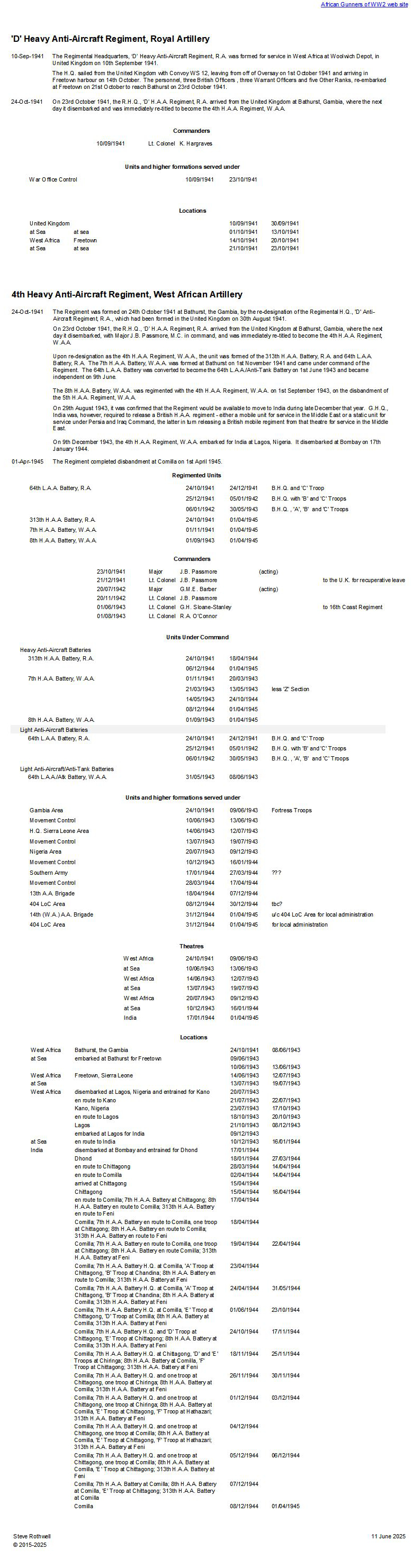
Summary history of the 'D' H.A.A. Regiment, R.A. - 4th H.A.A. Regiment, W.A.A.
© Steve Rothwell
11 June 2025
[1] War diary 4th H.A.A Regiment, W.A.A., WO 173/163; War diary 3rd H.A.A Regiment, W.A.A., WO 173/162
[2] WO 173/163; "Lineage Book of the British Army; Mounted Corps and Infantry, 1660-1968", Frederick J.B.M., Hope Farm Press (1969
[3] These men are believed to have been ‘B’ L.A.A. Troop which had sailed from the United Kingdom as part of Convoy WS 14 and which had arrived at Freetown on 21st December before sailing on to Bathurst. Upon arrival at Bathurst, these men were attached to the 64th Battery (W.S. Convoys – WS9-WS19, 1941-1942, WO 193/55)
[4] War diary 4th H.A.A Regiment, W.A.A., WO 173/399; War diary 1st L.A.A. Battery, W.A.A., WO 172/411
[5] WO 173/399
[6] War diary H.Q. Gambia Area, WO 173/373
[7] This may have been the ‘Z’ H.A.A. Section which arrived at Freetown from the United Kingdom on 19th February 1942 and was posted to the 405th H.A.A. Battery?
[8] War diary 4th H.A.A. Regiment, W.A.A., WO 172/750
[9] WO 172/750
[10] WO 172/750
[11] India Anti-Aircraft, WO 106/4562
[12] WO 172/750
[13] War diary 4th H.A.A Regiment, W.A.A., WO 172/4084
[14] WO 172/4084
[15] War diary 13th A.A. Brigade, WO 172/4471
[16] WO 172/4471
[17] WO 172/4471
[18] WO 172/4471; WO 172/7155
[19] ALFSEA, A.A. Artillery 1944-45, WO 203/1843
[20] ALFSEA, A.A. Artillery 1943-45, WO 203/1713
[21] WO 203/1713; Frederick; War diary 4th H.A.A. Regiment, W.A.A., WO 172/9591