1st Light Anti-Aircraft Regiment, W.A.A.
The 1st Light Anti-Aircraft Regiment, W.A.A. was formed with effect from 1st May 1941 at Freetown, Sierra Leone. Regimented were:
- 71st L.A.A. Battery, R.A. transferred from the Sierra Leone H.A.A. Battery
- 1st L.A.A. Battery, W.A.A. newly formed.[1]
Lt. Colonel C.H. Drew arrived in Freetown on 29th May 1941 and assumed command of the Regiment, with effect from 1st May. The Regimental H.Q. was established at Bishop’s Court, Freetown on 2nd June.[2]
The 1st L.A.A. Battery, W.A.A. was comprised of seven Officers and 96 British Other Ranks who arrived at Freetown from the United Kingdom on 26th May 1941. The Battery was at first encamped at Kissi East awaiting organisation and allocation to gun sites. The Battery Commander was Major J.A. Macnabb, R.A. The guns were soon in action when on 4th June there was an aerial ‘dive machine-gun attack’. The Regiment fired twenty-nine rounds at the aircraft but it seems that it escaped unharmed. Three days later, orders were received from the Commander Royal Artillery, Colonel Deacon, that all guns were to be manned fully given the increased possibility of war with Vichy France, initiated perhaps by the British entry into Syria that same day.[3]
Fourteen Predictors A.A. No.3 Mk I, with generators and other equipment, arrived from the United Kingdom on 13th July 1941. However, the Regiment continued to suffer from an acute lack of motor transport.[4]
2nd A.A. Regiment, W.A.A.
On 15th July 1941, the designation of the 1st L.A.A. Regiment was changed to become the 2nd Anti-Aircraft Regiment, W.A.A., with effect from 1st July 1941. The 71st L.A.A, Battery, R.A. and the 1st L.A.A. Battery, W.A.A. continued to form part of this Regiment.[5]
Throughout 1941, the Freetown was visited regularly by Vichy French reconnaissance aircraft which were occasionally engaged by the guns of the Regiment, but without effect.[6]
On 16th September 1941, two reinforcement drafts arrived from the United Kingdom with Convoy WS 11, disembarked at Freetown and were temporarily attached to the 1st L.A.A. Battery. Details of the drafts are:
Serial 31295c ‘C’ Troop, 109th L.A.A. Bty 2 Officers and 39 B.O.R.s
Serial 31301 ‘A’ Troop, 64th L.A.A. Bty, R.A. 2 Officers and 58 B.O.R.s.[7]
[Notes: The remaining elements of Serial 31301, the 64th L.A.A. Battery, R.A. went to Bathurst, Ghana (B.H.Q. and ‘C’ Troop) and Lagos, Nigeria (‘B’ Troop).]
The personnel of Serial 31295c, ‘C’ Troop, 109th L.A.A. Battery, R.A. was posted to the 71st L.A.A. Battery, R.A. on 28th September 1941, whilst the 58 British Other Ranks (B.O.R.s) of the 64th L.A.A. Battery draft, being ‘A’ Troop, were posted to the 1st L.A.A. Battery, followed by their two Officers on 26th September. ‘A’ Troop appears to have retained its identify within the 1st Battery.[8]
Meanwhile, on 26th September 1941, a 3-inch 20cwt gun manned by the 1st L.A.A. Battery was handed over to the Royal Navy Boom Defence detachment.[9]
1st L.A.A. Regiment, W.A.A.
On 8th October 1941, the 2nd A.A. Regiment, W.A.A. was re-titled to become once again the 1st L.A.A. Regiment, W.A.A., with the 71st L.A.A. Battery, W.A.A. and the 1st and 3rd L.A.A. Batteries, W.A.A. remaining under command.[10]
The 3rd L.A.A. Battery, W.A.A., began forming on 7th October 1941, from personnel arrived from the United Kingdom. This draft was followed by four Officers and 80 British Other Ranks (B.O.R.s) who disembarked at Freetown on 15th October. The Battery deployed to Hastings aerodrome between 25th and 27th October.[11]
The Regiment came under the command of the 14th A.A. Brigade from 24th October 1941, when that H.Q. came into operation. The Regiment was by now equipped with fourteen Bofors guns, out of thirty-six as required by the war establishment. Four of these guns were not in operation, being used for training purposes at the L.A.A. Training Centre.[12]
The Battery H.Q., 3rd L.A.A. Battery moved from the transit camp to Hastings Hill on 14th November 1941. On 4th December, the Nigeria II Troop was posted to the 3rd Battery from the L.A.A.T.C. The Battery took over four semi-mobile Bofors guns on 10th December and deployed to Hastings aerodrome. ‘C’ L.A.A. Troop, R.A. disembarked at Freetown on 13th December, having arrived with Convoy WS12Z (note: this convoy arrived at Freetown on 25th November 1941), with a strength of two Officers and 38 B.O.R.s. These men were the European component for an Africanised L.A.A. troop and were posted to the 3rd L.A.A. Battery.[13]
On 15th December 1941, the Regiment was deployed to operational gun sites. The 71st and 1st L.A.A. Batteries moved two guns each to Waterloo and Hastings aerodromes, the guns being taken from the L.A.A.T.C. (A.A.T.S.??). ‘B’ Troop, 71st L.A.A. Battery, W.A.A. moved from Waterloo to Cape Sierra Leone on 27th December. The next day, the Nigeria II Troop moved from the A.A.T.S. to Waterloo and ‘C’ Troop, 3rd L.A.A. Battery moved from Annie Walsh School to Waterloo.[14]
On 29th December 1941, ‘A’ L.A.A. Troop, an R.A. detachment of two Officers and 38 B.O.R.s from the United Kingdom disembarked from Bathurst, the Gambia and went to Annie Walsh School. This detachment had sailed to West Africa with Convoy WS 12Z and had arrived at Freetown on 25th November 1941. It would seem that the detachment then went on to its intended destination, Bathurst, only to return to Freetown in December. On 6th January 1942, ‘A’ L.A.A. Troop was posted to the 1st L.A.A. Battery, W.A.A., with effect from 29th December 1941. However, this was purely an administrative action, for ‘A’ L.A.A. Troop had already left for the Gambia, where it arrived on 6th January 1942 to be posted to the 64th L.A.A. Battery, R.A.[15]
Forty-four A.O.R.s were posted to the 71st L.A.A. Battery, R.A. from the A.A.T.C. on 26th January 1942, making ‘A’ Troop completely ‘Africanised’. Troops of the 3rd L.A.A. Battery, W.A.A. were called out to assist the Civil Police at Hastings on 30th January. During February, two mobile troops, identified as M1 and M2, were formed by the 71st L.A.A. Battery, the second by the posting of two Officers, 22 British N.C.O.s and the 44 A.O.R.s of Nigeria IV Troop to the new sub-unit. These units were equipped with Bofors guns on mobile mounts towed by motor ‘tractors’. On 19th February, ten British Officers just arrived from the United Kingdom were posted to the Regiment. By the end of the month, the Regiment had thirty-eight Bofors guns of all types. During March, detachments from all three Batteries took part in anti-tank firing practice.[16]
The Regimental H.Q. moved from Kortright to Tower Hill on 1st May 1942. On 12th May, eight B.O.R.s from the Regiment embarked at Freetown to join the 4th L.A.A. Battery, W.A.A. at Kano, Nigeria. The mobile M.2 Troop was absorbed by the 3rd L.A.A. Battery on 22nd May, presumably to replace ‘B’ Troop which moved to Lumley Camp in readiness for posting to the 4th L.A.A. Battery. Two Officers, fifteen B.O.R.s and forty-nine A.O.R.s embarked at Freetown on 16th June for Kano, Nigeria where they were to join the 4th L.A.A. Battery, W.A.A. Lt. Colonel T. Durrant, former Commanding Officer of the 2nd H.A.A. Regiment, W.A.A., assumed command of the 1st Light Regiment on 18th June. The Regiment was reorganised on 19th September 1942, with each of its three batteries to consist of two 6-gun Troops. After a period of training, the 71st Battery took over the defence of Hastings aerodrome and Jui Flying Boat Base on 7th November. This move released the 3rd Battery which went to Kissi for training, which began on 16th November. The 3rd Battery completed training and moved to Cape Sierra Leone where it relieved elements of the 71st Battery. The Battery H.Q. of the 3rd Battery went to Bishops Court, whilst that of the 71st Battery went to Hastings Ridge.[17]
January 1943 saw the Regiment continuing to train. On 7th February, four junior Officers joined from the United Kingdom (from reinforcement draft RFWKY). Notification was received on 12th February of the intended reorganisation of the 1st L.A.A. Battery, W.A.A. as a mobile L.A.A./anti-tank battery to become part of the 6th (W.A.) Infantry Brigade Group. In the event, on 6th March, the Regiment received orders to reorganize immediately to become the 1st L.A.A./Anti-Tank Regiment, W.A.A., a divisional unit of the 81st (W.A.) Infantry Division. The 1st Battery was retained, as the 1st L.A.A./Anti-Tank Battery, W.A.A., however the 71st L.A.A. Battery, R.A. and the 3rd L.A.A. Battery, W.A.A. left on 28th March to come under the command of the 1st and 2nd H.A.A. Regiments, W.A.A. respectively.[18]
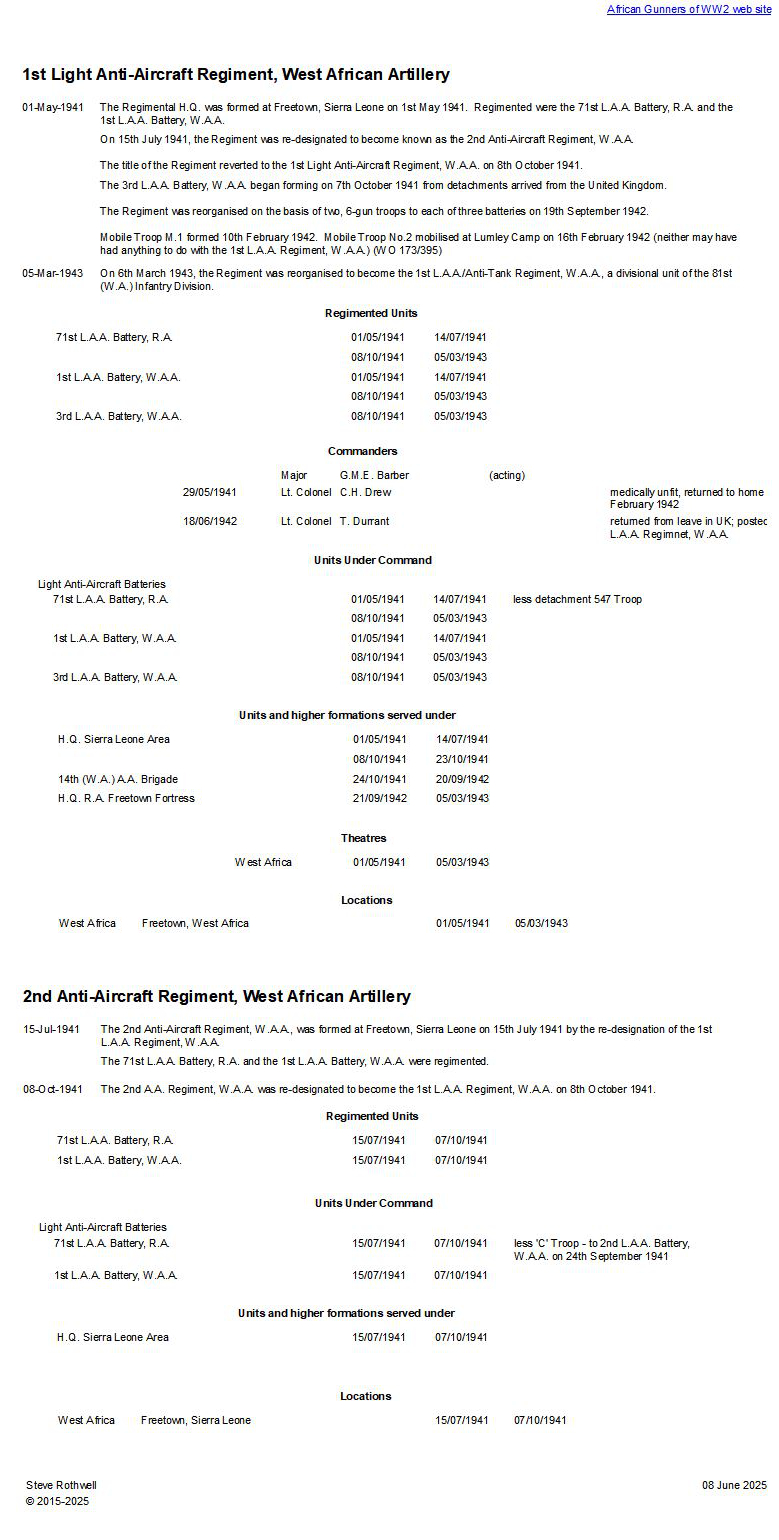
Summary history of the 1st L.A.A. - 2nd A.A. Regiment, W.A.A.
© Steve Rothwell
08 June 2025
[1] War diary 1st L.A.A. Regiment, W.A.A., WO 173/172
[2] WO 173/172
[3] WO 173/172
[4] WO 173/172
[5] WO 173/173
[6] WO 173/173
[7] WO 173/172; WO 173/173; W.S. Convoys – WS9-WS19, 1941-1942, WO 193/55
[8] WO 173/172
[9] WO 173/172
[10] WO 173/172
[11] WO 173/172; W.S. Convoys – WS9-WS19, 1941-1942, WO 193/55; "Lineage Book of the British Army; Mounted Corps and Infantry, 1660-1968", Frederick J.B.M., Hope Farm Press (1969); Naval History web site, WS Convoys – accessed May 2023
[12] WO 173/172
[13] WO 173/172; WO 193/55
[14] WO 173/172
[15] WO 173/172; WO 193/55; Naval History; War diary 1st L.A.A. Regiment, W.A.A., WO 173/410; War diary 4th H.A.A Regiment, W.A.A., WO 173/399; War diary 1st L.A.A. Battery, W.A.A., WO 172/411
[16] WO 173/410
[17] War diary 14th A.A. Brigade, WO 173/158; WO 173/410
[18] War diary 1st L.A.A./Atk Regiment, W.A.A., WO 173/725