'S' H.A.A. Battery - 4th Heavy Anti-Aircraft Battery, W.A.A.
Upon arrival in Freetown, on 15th October 1941, the ‘S’ H.A.A. Battery joined with an advance party to form the 4th H.A.A. Battery, W.A.A.
'S' Heavy Anti-Aircraft Battery
'S' H.A.A. Battery was formed in the United Kingdom on or around 2nd August 1941 for service in West Africa, from a cadre of the 405th H.A.A. Battery, R.A. It was formed of a battery H.Q. and one four-gun section. 'S' H.A.A. Battery left the United Kingdom on 29th September 1941, sailing on the Narkunda, part of Convoy WS 12, from off Oversay on 1st October. The ship arrived at Freetown on 14th October 1941 and the Battery disembarked the following day. On 15th October 1941, the personnel of 'S' H.A.A. Battery joined an advance party to form the 4th H.A.A. Battery, W.A.A., part of the 2nd H.A.A. Regiment, W.A.A.[1]
4th Heavy Anti-Aircraft Battery, W.A.A.
At Freetown, on 7th October 1941, four Officers and thirty-four British Other Ranks disembarked from the United Kingdom. This detachment comprised the advance party for the 4th H.A.A. Battery, W.A.A. They were taken on the strength of the 2nd H.A.A. Regiment, W.A.A. upon disembarkation. The advance party went to Murraytown Barracks on 15th October where it was joined later that day by the rear party, consisting of two Officers and thirty B.O.R.s., disembarked from the United Kingdom having travelled with Convoy WS 12 as a unit known as ‘S’ H.A.A. Battery H.Q., with one four-gun section. Amongst this latter group was the Commanding Officer, Major H.J. Lyons. However, Lyons was posted to take over command of the 308th H.A.A. Battery on 30th October, his post with the 4th Battery being taken by Captain R.T. Howell who assumed command on 1st November.[2]
The Battery took on sixty-four Nigerian Other Ranks on 1st December 1941 and began training with them. The Battery moved to the Hastings East gun site on 8th December, taking two 3.7-inch mobile guns. Two more of these guns were taken over on 12th December and training continued into 1942.[3]
Two 3.7-inch guns were removed from the Hastings gun site and handed over to the 1st H.A.A. Battery, W.A.A. on 10th February 1942. The Battery H.Q. moved to Bassu Town on 21st February. On 23rd February, forty Sierra Leonian Other Ranks and four 18-pounder field guns arrived at Bassu for training. Two more 18-pounders arrived the next day. The African gunners were quick learners and impressed British Officers after only two weeks’ training. On 19th April, a Pan American Airways aircraft crashed into the mangrove swamps outside of the Hastings airfield. The Battery sent a detachment to help with the rescue but unfortunately the crew and twenty-three passengers were all found dead.[4] Training continued with both the 3.7-inch H.A.A. guns and the 18-pounders.[5]
The Battery relocated from Bassu Town and Hastings to Murraytown between 9th and 10th September 1942.[6] The 4th Battery moved to the Wharf to embark on 29th September but was forced to return to Murraytown to await further instructions. The Battery was ordered to leave the Regiment but did not embark for the Gold Coast until 11th November where, upon arrival at Takoradi on 18th November, it joined the 3rd H.A.A. Regiment, W.A.A. The next day, the Battery was declared ‘in action’ with four 3.7-inch mobile guns at ‘I’ Site.[7]
The Regimental H.Q. appears to have left Takoradi on the journey to India at the end of May 1943. Arriving at Bombay on 9th July, the Regiment disembarked three days later and moved to Dhond, where it remained until around 13th November.
During October 1943, the Battery became known officially as the 4th (W.A.) H.A.A. Battery, W.A.A.
The 4th Battery appears to have travelled to Assam separately from the Regiment and arrived at Hailakandi/Rajyeswapur on around 29th November 1943 where it remained non-operational until early 1944. The 4th Battery arrived at Sylhet from Hailakandi/Rajyeswapur on 15th December.[8]
The Regiment left Silchar on 1st May 1945 and arrived at Kumbhargaon on 7th May. Here it remained, awaiting repatriation to West Africa. The 4th H.A.A. Battery, W.A.A. embarked at Bombay on 9th October 1945, on board the S.S. Bergensfjord, bound for West Africa. The 3rd H.A.A. Regiment was still at Kumbhargaon on 31st May.[9]
On 1st May, the Regiment left Silchar and arrived at Kumbhargaon on 7th May. Here it remained, awaiting repatriation to West Africa. The 4th H.A.A. Battery, W.A.A. embarked at Bombay on 9th October 1945, on board the S.S. Bergensfjord, bound for West Africa. The rest of the Regiment remained at Kumbhargaon until early November when it returned to West Africa and was disbanded.[10]
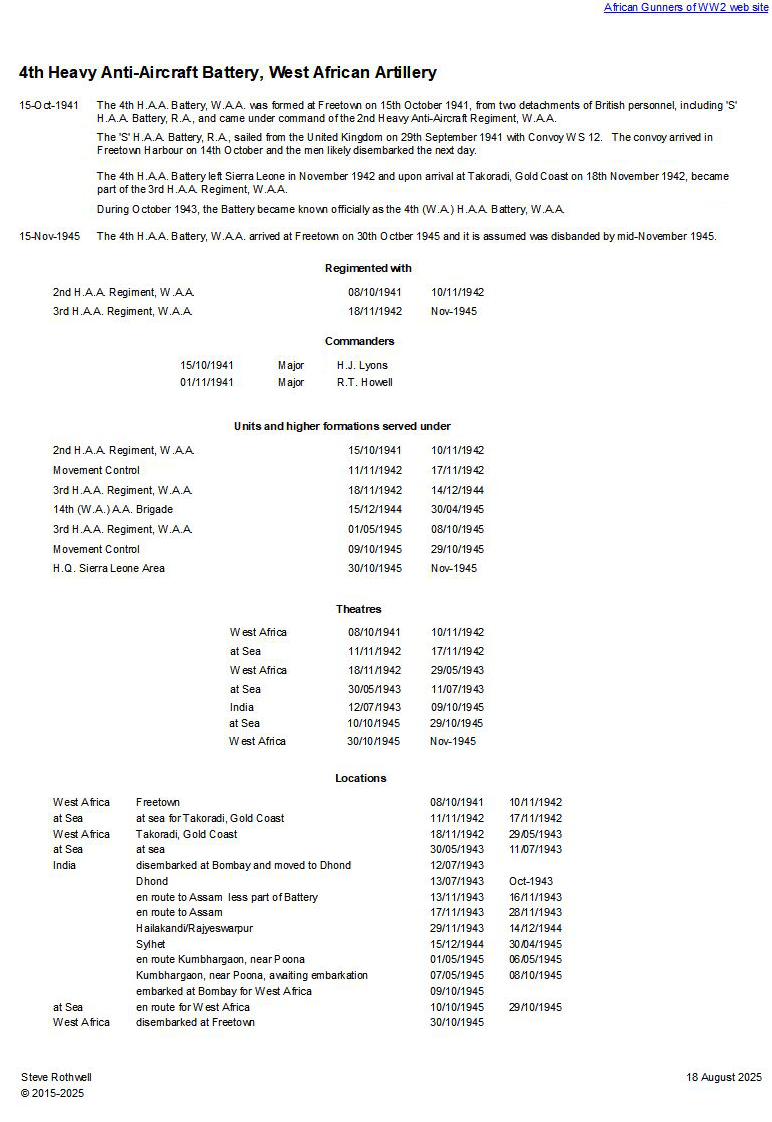
Summary history of ‘S’ H.A.A. Battery, R.A. - 4th H.A.A. Battery, W.A.A.
© Steve Rothwell
18 August 2025
[1] "Lineage Book of the British Army; Mounted Corps and Infantry, 1660-1968", Frederick J.B.M., Hope Farm Press (1969); WS Convoys - WS9-WS19, 1941-1942, WO 193/55; War diary 4th A.A. Regiment, W.A.A., WO 173/164
[2] War diary 4th H.A.A. Battery, W.A.A., WO 173/167
[3] WO 173/167; War diary 4th H.A.A. Battery, W.A.A., WO 173/404
[4] The aircraft, a Douglas C-49H (a Wright Cyclone powered DC-3 impressed by the U.S.A.A.F. from a civilian airline) is listed as being an aircraft of the U.S.A.A.F. by the Aviation Safety Network and crashed on take-off (https://aviation-safety.net/database/record.php?id=19420419-0 accessed June 2023).
[5] WO 173/404
[6] WO 173/404
[7] WO 173/397; War diary 3rd H.A.A. Regiment, W.A.A., WO 173/398; War diary Takoradi Fortress, WO 173/371
[8] War diary 14th (W.A.) A.A. Brigade, WO 172/6638, WO 172/4073; War diary 13th A.A. Brigade, WO 172/2143
[9] War diary 3rd H.A.A. Regiment, W.A.A., WO 173/9590
[10] War diary 3rd H.A.A. Regiment, W.A.A., WO 173/9590; List of Units India Command ALFSEA - November 1945, Abhilekh Patal NAIDLF00886141