‘E’ H.A.A. Regiment, R.A. - 5th Heavy Anti-Aircraft Regiment, W.A.A.
The 5th Heavy Anti-Aircraft Regiment, W.A.A. was formed on 3rd January 1942 by the redesignation of the Headquarters, ‘E’ Heavy Anti-Aircraft Regiment, R.A.
‘E’ Heavy Anti-Aircraft Regiment, Royal Artillery
The Regimental H.Q. was raised with effect from 1st October 1941 at Woolwich, with Lt. Colonel D.B. Mitchell in command. Movement instructions to proceed overseas to West Africa with Convoy WS 12Z were received on 6th October. In the end, the H.Q. left Woolwich for Liverpool on 2nd December, arriving the next day and embarked on board the ship, H.M.T. ‘Z3’, which was to form part of Convoy WS 14. The convoy formed and sailed from off of Oversay on 9th December.[1]
Convoy WS 14 arrived in Freetown harbour on 21st December 1941. ‘E’ H.A.A. Regiment, R.A. sailed on to Lagos, Nigeria, where the men disembarked on 2nd January 1942. The next day, 3rd January, the unit was re-designated to become the 5th H.A.A. Regiment, W.A.A.[2]
5th Heavy Anti-Aircraft Regiment, W.A.A.
Upon disembarkation at Lagos, Nigeria, on 3rd January 1942, the R.H.Q., 'E' H.A.A. Regiment, R.A. was re-designated to become the 5th H.A.A. Regiment, W.A.A. Regimented with the new unit were the 251st H.A.A. Battery, R.A. and the 109th L.A.A. Battery, R.A. The Commanding Officer was Lt. Colonel D.B. Mitchell.[3]
On 5th January 1942, information was received from regarding the proposed siting of guns, the arrival of equipment and the organisation and manning of anti-aircraft batteries and formations in West Africa. It was proposed to form the 8th H.A.A. Battery, W.A.A. from surplus British personnel following the ‘Africanisation’ of the 251st and 109th Batteries. Equipment for the 8th H.A.A. Battery was due to arrive in April or May. The guns available to the Regiment in January were eight 3.7-inch guns in the Ordnance Depot and four Bofors guns ready for action.[4]
The 109th L.A.A. Battery sent its ‘A’ Troop by train to the airport at Maiduguri, leaving on 23rd January 1942. The Troop was ready for action with four guns late on 28th January.[5]
A draft of 320 African Other Ranks was posted to the Regiment at Lagos from the A.A.T.C. on 16th February 1942. Two 3.7-inch guns went into action at the Racecourse, bringing the total to four. A reinforcement draft (RFFWW) of two Officers and six British N.C.O.s was posted to the Regiment on 26th February. Major H.S. Johnston, Commanding Officer of the 109th L.A.A. Battery, returned to the United Kingdom on 13th March, his place taken by Major R.H.C. Duncan.[6]
Notification was received on 16th March of the imminent formation of the 4th L.A.A. Battery, W.A.A. The new Battery was formed from personnel of the 109th L.A.A. Battery on 1st April 1942. Major G.R. Bell was appointed as Commanding Officer.[7]
The 8th H.A.A. Battery, W.A.A. was formed on 7th April 1942, with effect from 16th February, and moved into Windsor Barracks. Major T.M. Bland assumed command with effect from 16th February. The 4th L.A.A. Battery moved to Kano on 27th May. Twenty Officers and twenty B.O.R.s of draft RFGOK arrived from the United Kingdom and were posted to the Regiment on 3rd June. Two 4.5-inch Quick Firing dual purpose guns were transported to the Lighthouse Beach Site on 8th June. An L.A.A. troop (two Officers, fifteen B.O.R.s and forty-nine A.O.R.s) disembarked at Lagos and were posted to the Regiment. Three Officers, twenty-four B.O.R.s and forty-five A.O.R.s of the 8th H.A.A. Battery moved to Slough Barracks on 3rd August to man the dual purpose 4.5-inch guns.[8]
‘C’ Troop, 109th L.A.A. Battery, R.A. took over four Bofors guns at sites at Apapa from ‘D’ Troop on 15th August 1942. ‘D’ Troop then left Apapa on 17th August to relieve ‘B’ Troop at Maiduguri. The detached troop of the 109th L.A.A. Battery at Maiduguri was posted complete to join the 4th L.A.A. Battery, W.A.A. on 3rd November. The 4th L.A.A. Battery left the Regiment on 20th December and became an independent battery administered by the C.R.A. Nigeria Area.[9]
The Regiment remained at Lagos into 1943. During April 1943, all guns and equipment of the 251st and the 8th H.A.A. Batteries were handed in to the ordnance depot, with the exception of coast defence equipment in the case of the 8th Battery (16th April for the 251st Battery; 21st April for the 8th Battery). On 1st June 1943, the 251st H.A.A. Battery was de-regimented to join the 3rd H.A.A. Regiment, W.A.A. and later left to join the new regiment in India (date). Lt. Colonel Mitchell left on recuperative leave to the United Kingdom on 12th July and Major T.M. Bland assumed command of the Regiment. However, Major Bland left on recuperative leave to South Africa on 30th July and was in turn replaced by Major M.O. Lucas.[10]
The 109th L.A.A. Battery, R.A., converted to become the 109th L.A.A./Anti-Tank Battery, W.A.A. by 1st July 1943. On 9th August 1943, the 109th L.A.A./Atk Battery left the Gold Coast to join the 2nd L.A.A/Anti-Tank Regiment, W.A.A. Major Lucas accompanied the battery.[11]
Orders were received on 19th August for the disbandment of the 5th H.A.A. Regiment with effect from 1st September 1943. The Regiment disbanded at Lagos on that date.[12]
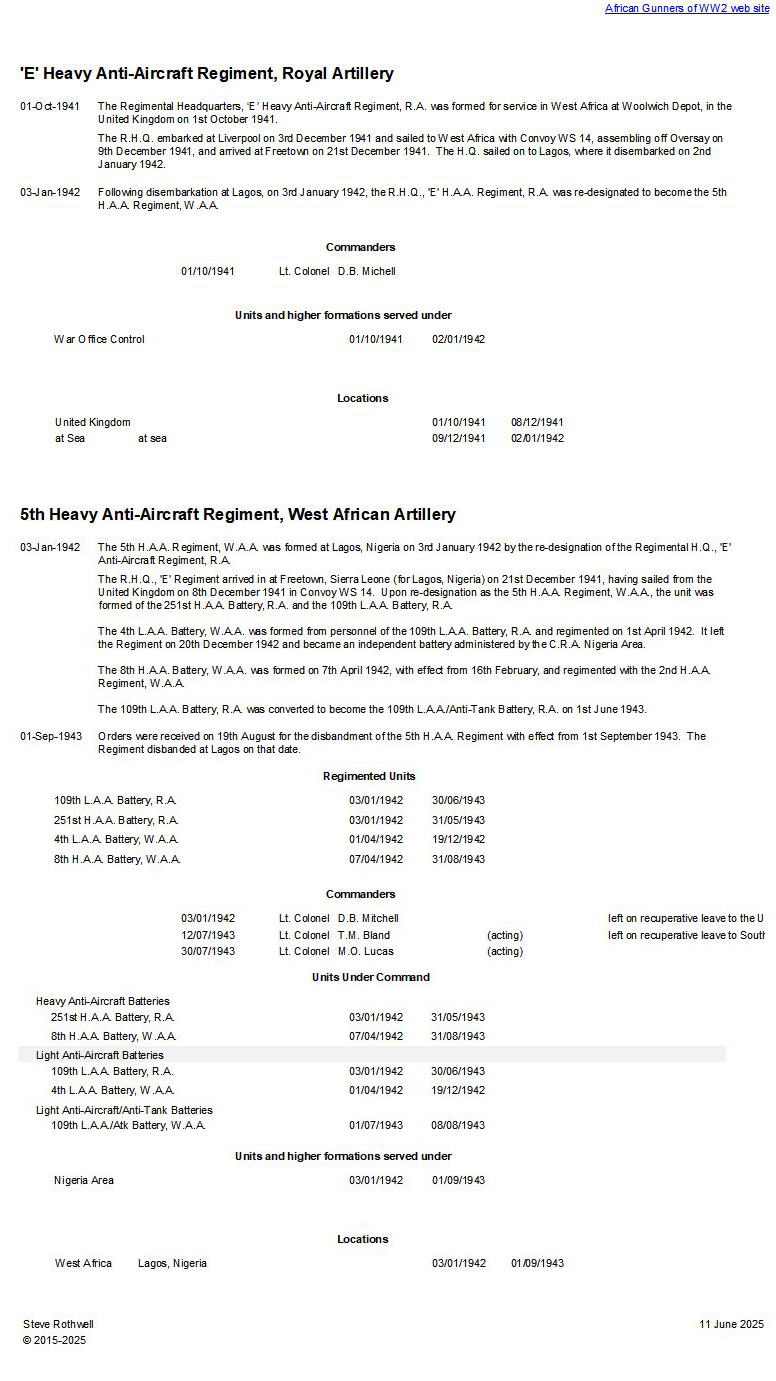
Summary history of the 'E' H.A.A. Regiment, R.A. - 5th H.A.A. Regiment, W.A.A.
© Steve Rothwell
11 June 2025
[1] War diary ‘E’ H.A.A. Regiment, R.A., WO 166/2334; WO 173/159
[2] War diary 5th H.A.A. Regiment, W.A.A., WO 173/400
[4] WO 173/400
[5] WO 173/400
[6] WO 173/400
[7] WO 173/400
[8] WO 173/400
[9] WO 173/400
[10] War diary 5th H.A.A. Regiment, W.A.A., WO 173/751
[11] War diary 2nd L.A.A./Atk Regiment, W.A.A , WO 173/726; WO 173/751
[12] WO 173/751