4th Anti-Aircraft - 2nd Heavy Anti-Aircraft Regiment, W.A.A.
The 4th A.A. Regiment, W.A.A., was formed on 15th September 1941 but shortly afterwards, on 8th October 1941, was redesignated to become the 4th H.A.A. Regiment, W.A.A.
4th Anti-Aircraft Regiment, W.A.A.
The 4th Anti-Aircraft Regiment W.A.A. was formed at Bishop’s Court, Freetown on 15th September 1941. Major T. Durrant was posted to the new Regiment as Commanding Officer. A temporary Regimental H.Q. was established at Bishop’s court. The 308th H.A.A. Battery, R.A. disembarked that same day and was regimented. The Battery had a strength of eleven Officers and 372 British Other Ranks (B.O.R.s). The 308th Battery relieved the 197th H.A.A. Battery, R.A. at the Brookfields site, where were emplace two 4.5-inch guns.[1]
On 7th October 1941, the 4th H.A.A. Battery, W.A.A. was formed and the advance party for this battery arrived.
2nd Heavy Anti-Aircraft Regiment, W.A.A.
The 4th A.A. Regiment, W.A.A. was re-titled on 8th October 1941 to become the 2nd H.A.A. Regiment, W.A.A. The Commanding Officer was Lt. Colonel T. Durrant. The 308th H.A.A. Battery, R.A. and the 4th H.A.A. Battery, W.A.A. were regimented. Personnel for the Regimental H.Q and for the 4th Battery disembarked on 15th October, having arrived the previous day with Convoy WS 12. Those posted to the former appear to have been the H.Q. ‘B’ H.A.A. Regiment, R.A., consisting of three Officers and eight Other Ranks. The two Officers and thirty British Other Ranks ‘S’ H.A.A. Battery, a Battery H.Q. and a single, four-gun section, joined with additional personnel, who had formed the advance party for the 4th Battery and had arrived earlier on 7th October with Convoy WS 11X. These men now formed the 4th H.A.A. Battery, W.A.A. A temporary R.H.Q. was set up at Hut 60, Wilberforce Transit Camp. Captain R.T. Howell took over command of the 4th Battery and Major J.L. Breeze took over command of the 308th Battery. The Heavy A.A. Training School Administration and Training was taken over from the 1st H.A.A. Regiment, W.A.A. on 1st November: administration by the 308th Battery; training by the 4th Battery. Several Polish Officers were posted to the Regiment. The 4th Battery undertook firing practice at Lumley Beach on 16th November.[2]
The 4th Battery moved to the gun sites at Hastings East on 8th December 1941. The 408th H.A.A. Battery, R.A. disembarked at Freetown on 13th December, having travelled from the United Kingdom with Convoy WS 12Z. This battery was immediately re-designated as the 5th H.A.A. Battery, W.A.A. The 5th Battery H.Q. went to the Annie Walsh School whilst the operational section of the Battery took over the operational commitments at Murray Town from the H.A.A.T.C. The 5th Battery was commanded by Major E.O’B. Horsford.[3]
On 23rd December 1941, ‘D’ H.A.A. Battery, R.A. disembarked at Freetown and was re-designated as the 6th H.A.A. Battery, W.A.A. The seven Officers and eighty-two British Other Ranks had travelled with Convoy WS 14. The Battery Commanding Officer was Major B.G. Atkins.[4]
The 5th Battery was ‘Africanised’ on 11th February 1942 by the inclusion of the Nigeria III Troop. The 4th Battery H.Q, moved to Bassu Town on 21st February. British personnel of the 4th Battery went to Bassu Town on 23rd February, where seven 18-pounder field guns were delivered to the Battery. Forty Sierra Leonian Other Ranks were posted to the Battery to man these guns. The 308th Battery formed two 4-gun sections at H.15 and H.19. Seventy-one A.O.R.s were posted from the A.A.T.C. to the 6th Battery on 2nd March. Other African postings followed, one of the largest was of sixty-three men of Nigeria V Troop who were posted to the 308th Battery on 1st April. On 2nd April, four 18-pounder guns at Bassu Town were moved to Hastings Green. Another four moved to Benguema on 4th April. The 4th Battery held a practice shoot with 3.7-inch guns on 17th April. The Hastings site assisted in the rescue following the crash of a Pan American aeroplane on 19th April. On 24th April, an unfortunate British gunner was killed by a lightning strike. The Regimental H.Q. moved to Hastings Green on 30th April.[5]
The ‘Africanisation’ of the 308th Battery was completed on 19th May 1942, with the arrival of sixty-three Nigerian gunners from the A.A.T.C. Lt. Colonel Durrant, recently returned from leave in the United Kingdom, was posted to the 1st L.A.A. Regiment, W.A.A. on 18th June. He was succeeded by Lt. Colonel J.S. Wilson. Four 18-pounders of the 4th Battery were located at the new Battery H.Q. of the 4th Battery at Waterloo Hill on 20th June. On 21st July, one Officer and fifteen B.O.R.s embarked for recuperative leave in the United Kingdom. Another party of two Officers and thirty B.O.R.s left for recuperative leave in South Africa on 28th July. The West African climate was harsh on British personnel, many of whom were fortunate enough to take advantage of such leave schemes. The 4th Battery moved to the Wharf to embark on 29th September but was forced to return to Murray Town to await further instructions. Lt. Colonel J.S. Wilson left on recuperative leave in the United Kingdom on 29th October. Major Atkins assumed command in his absence. The Battery did not embark for the Gold Coast until 11th November where, upon arrival on 18th November, it joined the 3rd H.A.A. Regiment, W.A.A. During November, the Regiment formed the 1st and 2nd Static Defence Troops; the 1st at Hastings airfield; the 2nd at Waterloo. These appear to have been armed with 18-pounder field guns.[6]
On 8th March 1943, Lt. Colonel J.S. Wilson returned from recuperative leave in the United Kingdom, relieving Major B.G. Atkins. The 2nd Static Defence Troop left Waterloo Hill on 1st March and went to Bassu Town where it came under the command of the 1st L.A.A. Regiment, W.A.A. The 1st Static Defence Troop at Hastings airfield ceased to be operational on 17th March and began removing the guns and equipment. The four 18-pounder guns were returned to the ordnance depot on 5th April and the personnel posted elsewhere within the 1st H.A.A. Regiment, W.A.A.[7]
Together with the 14th A.A. Brigade and the 1st and 3rd H.A.A. Regiments, W.A.A., the 2nd Regiment embarked at Freetown at the end of May 1943, for service in India. Sailing via South Africa, the ship arrived at Bombay on 9th July 1943, the Brigade disembarked three days later and moved to Dhond (today Daund), where it came under the command of H.Q. Southern Army. The arrival in India of the Brigade with its three regiments released two static British regiments, from Ceylon, (the 54th and the 65th) for redeployment to the Middle East. The 2nd Regiment left for Assam in September, arriving in the 9th A.A. Brigade area on 10th December; the R.H.Q. and the 6th Battery, W.A.A. at Gauhati; the 308th Battery, R.A and the 5th Battery, W.A.A. at Misamari and Tezpur respectively.[8]
On or just after 11th February 1944, the R.H.Q. 2nd H.A.A. Regiment, W.A.A. arrived at Sonabheel (Tezpur) from Gauhati. The 6th Battery, 2nd H.A.A. Regiment, W.A.A. moved from Gauhati to Manipur Road, which was completed on 18th July. The 5th Battery, 2nd H.A.A. Regiment, W.A.A. arrived at Manipur Road from Tezpur on 2nd September. The R.H.Q., 2nd H.A.A. Regiment, W.A.A. arrived at Manipur Road from Tezpur on 5th September. Tezpur was now defended by the Battery H.Q. and a troop of the 308th Battery, 2nd H.A.A. Regiment, W.A.A. from Misamari. The 308th Battery, 2nd H.A.A. Regiment, W.A.A. moved to Jorhat from Tezpur, arriving on 23rd November, where it came under the command of the 3rd Indian A.A. Brigade.[9]
The R.H.Q., 2nd H.A.A. Regiment, remained at Manipur Road into 1945. On 12th March, the Regiment ceased to be operational and Lt. Colonel Wilson relinquished the appointment of A.A.D.C. Manipur Road.[10]
With the standing down of anti-aircraft units not directly involved in the reconquest of Burma, in March 1945, the 14th (W.A.) A.A. Brigade, with the 1st, 2nd and 3rd H.A.A. Regiments, W.A.A., the 69th L.A.A. Regiment, R.A. (less one troop) and the 18th L.A.A. Regiment, I.A. were warned of the withdrawal of the Brigade to India. On 1st April, a decision was taken by G.H.Q. (India) that the withdrawal to India would be a preliminary to returning the West African Brigade to Africa. By late April, only the three original West African H.A.A. regiments remained under the command of the Brigade, the 4th H.A.A. Regiment, W.A.A. having been disbanded at Comilla by 1st April.[11]
The move of the Brigade H.Q. and last two regiments to India was delayed until September. At first it looked as though the personnel of the 1st and 2nd H.A.A. Regiments, W.A.A. would go straight to Calcutta for embarkation for West Africa and that the Brigade H.Q. would be disbanded following the embarkation. All elements of the 1st Regiment concentrated at Manipur Road by 13th August 1945. Brigadier Carberry, C.O. of the 14th (W.A.) A.A. Brigade, arrived at Manipur Road on 20th August on a farewell visit to the 2nd Regiment. However, on 30th August notification was received that the embarkation of the 1st and 2nd Regiments for West Africa had been postponed (due to a severe shortage of shipping).[12]
Finally, on 16th September 1945, the 2nd Regiment, together with the 197th and 2nd Batteries, left Manipur Road for Kalyan, near Bombay, en route to embarkation. These units arrived at Kalyan on 22nd/23rd September.[13]
The 197th Battery went to Bombay on 28th September where it embarked on the ship code-named B.T. 11, being played on board by the Sierra Leone Band. The ship carrying the Battery weighed anchor the next day and arrived at Freetown on 19th October 1945 and the personnel disembarked on 20th October.[14]
It is thought that the 2nd Regiment H.Q. also embarked at Bombay on the H.M.T. Highland Princess on 28th September 1945. Disembarking at Lagos on 31st October, the men went to the demobilisation camp. The 2nd H.A.A. Regiment, W.A.A. was disbanded in Lagos with effect from 24th November 1945.[15]
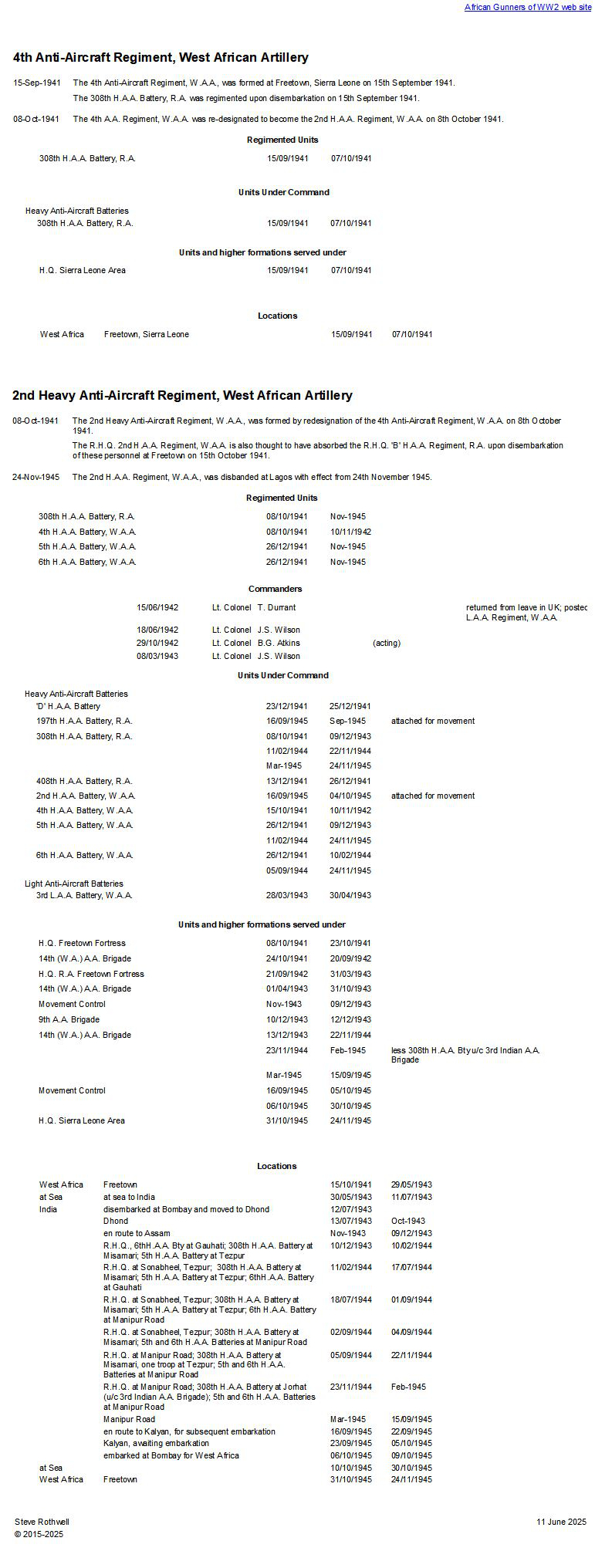
Summary history of the 4th A.A. - 2nd H.A.A. Regiment, W.A.A.
© Steve Rothwell
11 June 2025
[1] War diary 4th A.A. Regiment, W.A.A., WO 173/164
[2] War diary 2nd H.A.A. Regiment, W.A.A., WO 173/161; Convoys WS 6, 7, 8, 8C, WO 193/53
[3] WO 173/161; WO 193/53
[4] WO 173/161; WO 193/53
[5] War diary 2nd H.A.A. Regiment, W.A.A., WO 173/397
[6] WO 173/397
[7] War diary 2nd H.A.A. Regiment, W.A.A., WO 173/748
[8] A.A. Requirements, WO 106/4562; War diary 14th W.A. A.A. Brigade, WO 172/746, WO 172/4073; War diary 23rd A.A. Brigade, WO 172/3790; War diary 54th H.A.A. Regiment, WO 169/9821 ; War diary 65th H.A.A. Regiment, WO 169/9829; WO 172/2140
[9] WO 172/6638
[10] War diary 2nd H.A.A. Regiment, W.A.A., WO 173/9589
[11] War diary 14th A.A. Brigade, WO 172/9578
[12] WO 172/9578; WO 173/9589
[13] WO 172/9578
[14] War diary 197th H.A.A. Battery, W.A.A.
[15] War diary 1st H.A.A. Battery, W.A.A., WO 173/1230; War diary H.Q. Lagos Sub Area, WO 173/1211