64th Light Anti-Aircraft Battery, R.A.
The 64th Light Anti-Aircraft Battery, R.A. was formed in the United Kingdom on 21st January 1939, as part of the 20th L.A.A. Regiment, R.A. Having moved to West Africa, arriving in September 1941, on 1st June 1943, the Battery converted to become the 64th L.A.A./Anti-Tank Battery. On 22nd January 1944, the Battery was reorganised as an anti-tank battery. In September 1945 (tbc), in India, the Battery converted to the light artillery role. Here is a summary:
64th Light Anti-Aircraft Battery, R.A.
21st January 1939 formed in the United Kingdom
1st June 1943 converted to become the 64th L.A.A./Anti-Tank Battery, W.A.A.
64th L.A.A./Anti-Tank Battery, W.A.A.
1st June 1943 converted from the 64th L.A.A. Battery, R.A.
22nd January 1944 reorganised as the 64th Anti-Tank Battery, W.A.A.
64th Anti-Tank Battery, W.A.A.
22nd January 1944 by reorganisation of the 64th Anti-Tank Battery, W.A.A.
September 1945 reorganised as the 64th Light Battery, W.A.A.
September 1945 by reorganisation of the 64th Anti-Tank Battery, W.A.A.
1946 disbanded in West Africa.
64th Light Anti-Aircraft Battery, R.A.
The 64th Light Anti-Aircraft Battery, R.A. was formed on 21st January 1939, as part of the 20th L.A.A. Regiment, R.A. The Battery was mobilised for overseas service at Sheffield in early August 1941. On 27th August, the Battery entrained for embarkation at Liverpool(?) the following day. The ship carrying the Battery (designated C.11) left port on 30th August to join Convoy WS 11.[1]
The convoy arrived in Freetown Harbour on 15th September 1941. Here, ‘A’ Troop, consisting of two Officers and 58 British Other Ranks, disembarked on 16th September. These men were posted to the 1st L.A.A. Battery, W.A.A., apparently as a formed troop. ‘B’ Troop remained embarked, destined for Lagos, Nigeria (? APO S102). The Battery H.Q. with ‘C’ Troop disembarked and then re-embarked on the H.M.T. New Northland which sailed from Freetown on 21st September for Bathurst (Banjul), Gambia. This port was reached two days later and on 24th September, the personnel disembarked and went to camp at Denton Bridge. The four Bofors guns with ‘C’ Troop were installed by the end of the month, but had no forward sights, spare barrels, tools or lubricant. Three guns were at Jeswang and the fourth was mounted on the R.A.F. Depot Ship, H.M.T. Dumana, serving as a seaplane tender, for the protection of the harbour and seaplane anchorage.[2]
The Battery H.Q. and ‘C’ Troop at Bathurst came under the command of the 4th Heavy Anti-Aircraft Regiment, W.A.A. on 25th October 1941. The Regimental H.Q., 4th H.A.A. Regiment, W.A.A. was formed by the re-titling of the H.Q. ‘D’ Regiment, R.A. which had arrived the previous day.[3]
On 25th December 1941, a light anti-aircraft troop arrived at Bathurst, consisting of two Officers and 38 B.O.R.s. This is believed to have been ‘B’ L.A.A. Troop which had sailed from the United Kingdom as part of Convoy WS 14 and which had arrived at Freetown on 21st December before sailing on to Bathurst. Upon arrival at Bathurst, these men were attached to the 64th Battery, becoming the Battery’s ‘B’ Troop.[4]
The ‘A’ L.A.A. Troop, only recently posted to the 1st L.A.A. Battery, W.A.A. in Freetown, left for the Gambia, where it arrived on 6th January 1942 to be posted to the 64th L.A.A. Battery, R.A. Four Bofors guns arrived from the United Kingdom on 22nd January and were disposed with one each at: the P.W.D. Site; Swamp at Half Die; Denton Bridge; Jeswang aerodrome. From 3rd February 1942, the 64th L.A.A. Battery, R.A. was to undertake the dual role of anti-aircraft and coast defence at: Half Die (three guns); Bathurst Point (one gun); Denton Bridge (two guns).[5]
By January 1943, the Battery appears to have become designated as being of the West Africa Artillery (W.A.A.), and no longer R.A., presumably due to it having been moved to a mixed war establishment of British and African personal (‘Africanised’). [No documents have been found to confirm any change in designation of former R.A. units to become W.A.A.] [6]
On 10th February 1943, six Bofors guns, four tractors and three predictors were withdrawn from the 64th L.A.A. Battery at Bathurst and sent to Lagos, Nigeria. The Battery personnel concentrated at Brikama between 15th and 17th March.[7]
On 27th May 1943, a new war establishment (W/E.III/AE/210/2 – L.A.A./Atk Battery in W.A. or W.A.R.A.) was received, together with instructions that the Battery should re-organise as from 1st June 1943. The Battery was converted to become the 64th L.A.A./Anti-Tank Battery on 1st June 1943. This new battery joined the 2nd L.A.A./Atk Regiment, W.A.A. at Accra, Gold Coast on 18th September 1943, having left Bathurst, Gambia, on 6th September.[8]
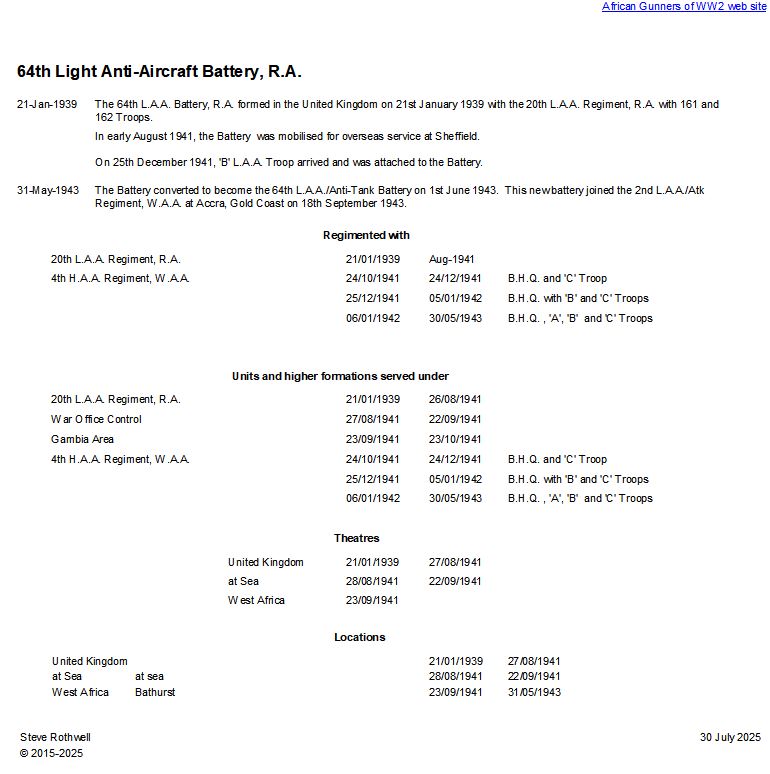
Summary history of the 64th L.A.A. Battery, R.A. / W.A.A.
© Steve Rothwell
30 July 2025
[1] "Lineage Book of the British Army; Mounted Corps and Infantry, 1660-1968", Frederick J.B.M., Hope Farm Press (1969); Naval History web site, WS Convoys – accessed May 2023; War diary 64th L.A.A. Battery, WO 173/175.
[2] WO 173/175; War diary 1st L.A.A. Regiment, W.A.A., WO 173/172; War diary 1st L.A.A. Battery, W.A.A., WO 173/173; War diary H.Q. Gambia Area, WO 173/140
[3] WO 173/175
[4] War diary 4th H.A.A. Regiment, W.A.A., WO 173/163; W.S. Convoys – WS9-WS19, 1941-1942, WO 193/55
[5] War diary 4th H.A.A Regiment, W.A.A., WO 173/399; War diary 1st L.A.A. Battery, W.A.A., WO 172/411
[7] War diary 4th H.A.A. Regiment, W.A.A., WO 172/750
[8] War diary 64th L.A.A./Atk Battery, W.A.A., WO 173/731; War diary 2nd L.A.A/Atk. Regiment, W.A.A., WO 173/726; War diary H.Q. Gambia Area, WO 173/715