‘S’ Anti-Tank Battery, R.A. - 1st Anti-Tank Battery, W.A.A.
The 1st Anti-Tank Battery, W.A.A. was formed by the redesignation of ‘S’ Anti-Tank Battery, R.A. in Nigeria on 2nd March 1942.
‘S’ Anti-Tank Battery, R.A.
The ‘S’ Anti-Tank Battery, R.A. was formed for overseas service on 1st January 1942 at Hitchin, from a cadre provided by the 4th Reserve Anti-Tank Regiment, R.A. The Battery sailed for West Africa on 28th January 1942, via Gibraltar. It disembarked at Lagos, Nigeria on 27th February. On arrival at Enugu, Nigeria, ‘S’ Anti-Tank Battery, R.A. was re-designated to become the 1st Anti-Tank Battery, W.A.A. on 2nd March 1942.[1]
1st Anti-Tank Battery, W.A.A.
The 1st Anti-Tank Battery, W.A.A. was formed on 2nd March 1942 at Enugu, Nigeria, by the re-designation of ‘S’ Anti-Tank Battery, R.A. which had arrived from the United Kingdom at Lagos on 27th February 1942. The new battery took over four 2-pounder anti-tank guns, the offices, quarters and equipment from the Anti-Tank Training Wing of the Artillery Training Centre. Ninety-three African Other Ranks (A.O.R.s) joined on 3rd March and training began immediately.[2]
By August 1942, the Battery, organised into three troops – ‘A’-‘C’ – had received sixteen 2-pounder guns (two above establishment) and eighteen 30cwt Morris portée trucks. On 21st September, a warning order was received of an impending move and during the rest of the month, all guns, vehicles and equipment were loaded for travel by train and all moved off on 30th September. The guns and equipment were loaded on board a ship at Lagos and sailed for Bathurst on 6th October, arriving on 29th October. The personnel of the Battery arrived at Lagos on 4th October and boarded the H.M.T. Leopoldville which sailed that evening for Bathurst, the Gambia. Disembarkation took place at Bathurst on 24th October, with the personnel transferring to the river steamer Lady Denham. After a short journey upriver, the next day the personnel disembarked at Bintang and marched seven miles to camp at Sikon. ‘C’ Troop left for Kerewan on 11th November.[3]
On 8th February 1943, the Battery moved to Kenuma. In preparation for a move, on 18th February the Battery handed in twelve 2-pounder anti-tank guns and twelve portee vehicles. The personnel with their equipment embarked on the H.M.T. Hai-Lee at Bathurst on the evening of 20th February. The ship arrived at Freetown on 23rd February and sailed again on 28th February.[4]
The 1st Anti-Tank Battery, W.A.A. arrived at Takoradi, Gold Coast on board the H.M.T. Hai-Lee on 4th March 1943 and disembarked. The Battery went to the transit camp and the following day entrained for Accra where it arrived the next day. Upon arrival, the Battery marched to the School of Artillery where a camp had been prepared. The Battery was now attached to the School for training.[5]
The Battery began training in the light anti-aircraft role at the School of Artillery on 15th March 1943. However, three days later the Battery was informed that it was to be disbanded to provide reinforcements for existing L.A.A. and light artillery units in West Africa. The unit was disbanded with effect from 1st April 1943. All African Other Ranks were posted to the School of Artillery for training in the light anti-aircraft and anti-tank roles using the 40mm Bofors gun. The British Officers and Other Ranks were attached to the School, pending posting to other units. The Commanding Officer, Major F.W. Jack, R.A. and two Officers returned to the United Kingdom. One subaltern was posted to each of the 64th, 71st, 109th, 3rd and 5th L.A.A. Batteries.[6]
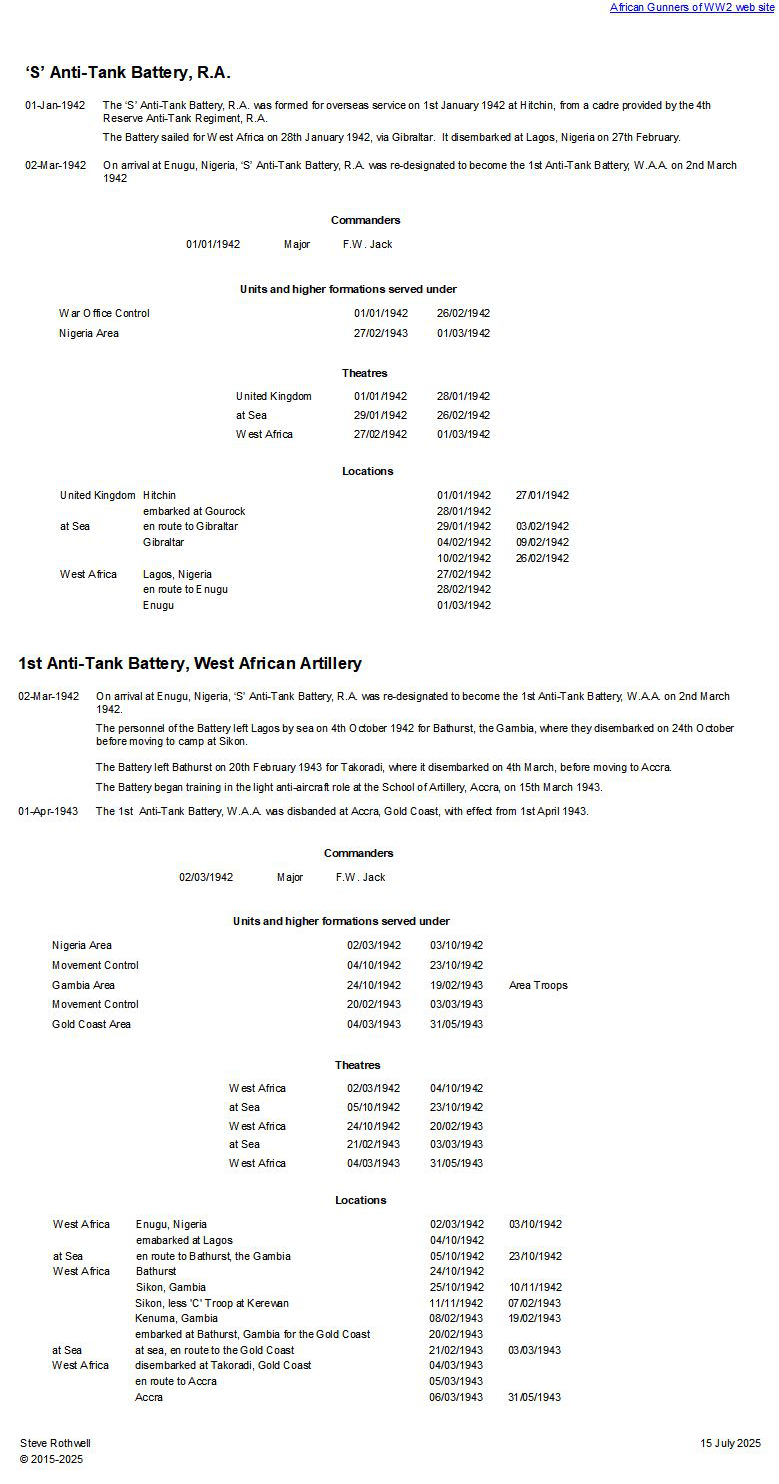
Summary history of 'S' Anti-Tank Battery, R.A. - 1st Anti-Tank Battery, W.A.A.
© Steve Rothwell
12 June 2025