2nd / 22nd Anti-Tank Regiment, W.A.A.
The 2nd L.A.A./Atk Regiment, W.A.A. began life by the redesignation of the 6th Heavy Anti-Aircraft Regiment, W.A.A. on 1st July 1943, before being redesignated first as the 2nd Anti-Tank Regiment, W.A.A. and then as the 22nd Anti-Tank Regiment, W.A.A. Here is a summary:
6th November 1942 formed at Accra, Gold Coast
1st July 1943 reorganised as the 2nd L.A.A./Anti-Tank Regiment, W.A.A.
2nd L.A.A./Anti-Tank Regiment, W.A.A.
1st July 1943 by reorganisation of the 6th Heavy Anti-Aircraft Regiment, W.A.A.
1st August 1944 reorganised and re-designated as the 2nd Anti-Tank Regiment, W.A.A.
2nd Anti-Tank Regiment, W.A.A.
1st August 1944 by reorganisation of the 2nd L.A.A./Anti-Tank Regiment, W.A.A.
21st October 1944 redesignated as the 22nd Anti-Tank Regiment, W.A.A.
22nd Anti-Tank Regiment, W.A.A.
21st October 1944 by redesignation of the 2nd Anti-Tank Regiment, W.A.A.
September 1945 converted to become the 22nd Light Regiment, W.A.A.
2nd Anti-Tank Regiment, W.A.A.
The H.Q.R.A., 82nd (W.A.) Infantry Division received on 24th July 1944 advanced copies of new war establishments for Divisional Artillery Units. Amongst these, the
2nd L.A.A./Atk Regiment was re-organised as an anti-tank unit of three batteries, known as the 2nd Anti-Tank Regiment, W.A.A. Regimented were the 63rd, 64th and 83rd Anti-Tank Batteries. The changes took effect from 1st August 1944.[6]
The 83rd L.A.A. Battery became an anti-tank battery, retaining its number for the time being. This re-organisation appears to have been completed by 1st August. The 83rd Anti-Tank Battery, W.A.A. was re-numbered to become the 66th Anti-Tank Battery, W.A.A. from 21st October 1944, the date on which the 2nd Regiment was re-designated to become the
22nd Anti-Tank Regiment, W.A.A. (with effect from 1st August 1944).[7]
The 84th L.A.A. Battery was disbanded and its personnel were posted to join with the mortar troops of the light batteries to form a new mortar unit – initially known as ‘X’ Mortar Regiment, W.A.A. This re-organisation appears to have been completed by 1st August. The 84th L.A.A. Battery remained in existence on paper until the ‘promulgation’ of the new war establishments which occurred on 1st September 1944.[8]
The 63rd Anti-Tank Battery went to Jhalida for training on 5th August, returning to Chas on 7th August. They were followed by the 83rd Battery and part of the 64th Battery between 18th and 20th August.[9]
Twenty-four guns were collected by the 2nd Regiment from Mohuda on 2nd September, followed by the collection of twelve guns from the 15th Anti-Tank Regiment, Indian Artillery at Potpoto on 6th September. Between 6th and 8th September, the Regimental H.Q., the 83rd, 63rd and 64th Batteries all moved to Potpoto before returning to Chas on 16th September. The Regiment went to Jhalida for infantry training on 4th October 1944 and then to Potpoto for anti-tank practice on 8th October. It returned to Chas on 20th October.[10]
On 21st October 1944, the Regiment was re-designated to become the 22nd Anti-Tank Regiment, W.A.A., Divisional Troops, 82nd (W.A.) Infantry Division, with effect from 1st August 1944.[11]
Note: The war diary H.Q.R.A. 82nd (W.A.) Infantry Division records that the 2nd L.A.A./Atk Regiment, W.A.A., was first repurposed and re-designated as the 2nd Anti-Tank-Regiment, W.A.A. between 24th July and 1st August 1944 (Joslen gives 1st August). However, the unit war diary continues to refer to the unit as the 2nd L.A.A./Atk Regiment, W.A.A. until re-designated on 21st October 1944. [12]
22nd Anti-Tank Regiment, W.A.A.
The 22nd Anti-Tank Regiment was formed on 21st October 1944 by the re-designation of the
2nd Anti-Tank Regiment, W.A.A., with effect from 1st August 1944. Regimented were the 63rd, 64th and 66th Anti-Tank Batteries, W.A.A. The Regiment was Divisional Troops, 82nd (W.A.) Infantry Division. The Commanding Officer was Lt. Colonel E.W.B. Jones.[13]
The Regiment was located at Chas until entraining for Calcutta on 16th November 1944. Arriving the next day, the Regiment de-trained and the following day embarked for Chittagong at Rajula. Sailing on 19th November, the Regiment disembarked at Chittagong on 21st November. On 22nd November, it moved to the 82nd (W.A.) Infantry Division area at Chiringa. Between 28th and 29th November, the Regiment moved to the Bawli area to relieve the 5th Battalion, The Nigeria Regiment. The Regiment now operated as infantry.[14]
[The war diary for December 1944 is missing]
Lt. Colonel T. Haighton took command of the Regiment on 5th December 1944.[15]
The 63rd Battery left Bawli for Taungbazar on 17th December and arrived the following morning and set up at Taung Keep. It left Taung Keep on 31st December to join the Regiment at Buthidaung.[16]
The 22nd Anti-Tank Regiment, W.A.A. arrived at Razabil from Goppe on 1st January 1945. Two days later, it came under the command of the 2nd (W.A.) Infantry Brigade. The 63rd Anti-Tank Battery was sent to Buthidaung. Less this battery, the Regiment left the next day for Buthidaung also, where it was to protect the base there by extensive patrolling. The Regiment left Buthidaung on 18th January, headed for Apaukwa on the Kaladan River. On 22nd January, it reverted to the command of the 82nd (W.A.) Infantry Division. The Regiment arrived at Apaukwa on 23rd January and the 63rd Battery was deployed to defend the Dakota airstrip. On 26th January, the Regiment left for Minzegyaung, arriving the next morning. That afternoon, a patrol from the 63rd Battery engaged a detachment of Japanese, killing four and capturing the fifth. The Regiment concentrated at Myihaung on 28th January before leaving the next day for Nawnar on the Lemro River, where it arrived on 30th January. A troop of the 66th Battery left at Apaukwa rejoined on 31st January.[17]
On 2nd February 1945, the Regiment occupied Minbya. It embarked on landing craft on 5th February to rejoin the 82nd (W.A.) Divisional Group, with the task of advance South on the West bank of the Min Chaung, acting as right flank protection to the main advance on Kangaw. Here, the Regiment reverted to the command of the 2nd (W.A.) Infantry Brigade. As the Regiment advanced, it clashed with isolated Japanese detachments and stragglers. Moving by way of Sangmatom and Gyethika, the Regiment reached Taungmaw on 21st February where the next day it embarked for the Kuywa beachhead. Here, the Regiment undertook the defence of the lines of communication between Ruywa and Kyauksalaung. It moved to the latter place on 28th February where it reverted to the command of the 82nd (W.A.) Infantry division with the task of protecting a 25-pounder troop of the 27th Field Regiment. Once again, the men of the Regiment were involved in frequent patrols. On 9th March, the Regiment came under the command of the 53rd Indian Infantry Brigade, 25th Indian Infantry Division. The Regiment moved to Ruywa on 11th March where it established a roadblock at Thangyo, coming under command of the 82nd (W.A.) Infantry Division once again.[18]
The Regiment moved to Letmauk on 22nd March 1945 where it was attached to the 1st (W.A.) Infantry Brigade. The next day, it set out to make contact with the 2nd (W.A.) Infantry Brigade, which it achieved the following day. The Regiment went to Thinchaung on 1st April but returned to Letmauk on 9th April. Leaving Letmauk on 13th April, the Regiment reached Mindaunggyi on 21st April, from where the 66th Battery went to Zale on 25th April. The Regiment, less this battery, went to Monchaung on 27th April. Between 2nd and 3rd May, the Regiment moved into monsoon quarters at Htaukchaing. The 66th Battery deployed at Monchaung on 12th May to interdict Japanese stragglers from Ramree Island and returned to Htaukchaing on 15th May.[19]
Lt. Colonel Haighton left on 11th July to return to the United Kingdom on compassionate grounds. He was succeeded by Major E.W.B. Jones. Lt. Colonel A.S. Jervis arrived on 1st August to assume command of the Regiment. The Regiment remained at Htaukchaing throughout this period.[20]
The 22nd Anti-Tank Regiment, W.A.A. was converted to become the 22nd Light Regiment, W.A.A. in September 1945 and was equipped with 3.7-inch howitzers.[21]
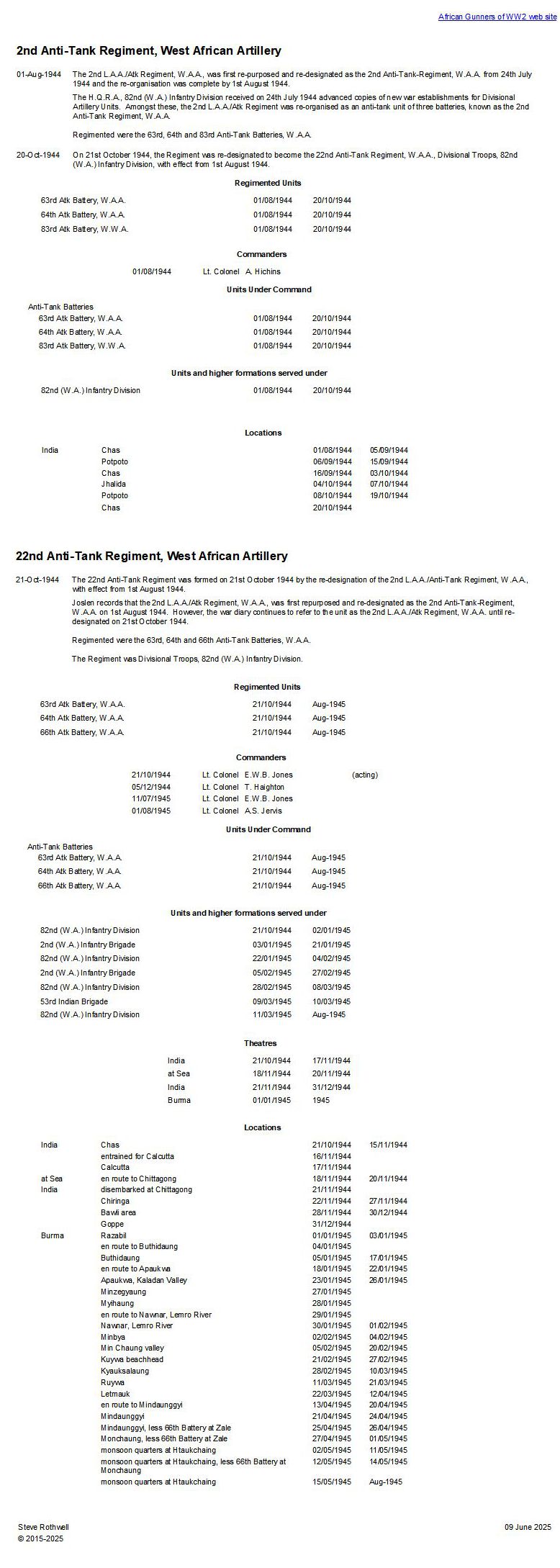
Summary history of the 2nd / 22nd Anti-Tank Regiment, W.A.A.
© Steve Rothwell
06
July 2025
[6] War diary H.Q.R.A. 82nd (W.A.) Infantry Division, WO 172/6612
[7] WO 172/6612
[8] WO 172/6612
[9] WO 172/6640
[11] WO 172/6640
[12] WO 172/6612; Joslen
[13] War diary 22nd Anti-Tank. Regiment, W.A.A., WO 172/6642
[14] WO 173/6642
[15] War diary 22nd Anti-Tank. Regiment, W.A.A., WO 172/9580
[16] WO 172/6640,
[17] WO 172/9580
[18] WO 172/9580
[19] WO 172/9580