103rd - 41st Mortar Regiment, W.A.A.
103rd Mortar Regiment, W.A.A.
At Chiringa, from 1st September 1944, the 82nd L.A.A. Battery, W.A.A. began forming within the 81st (W.A.) Infantry Division as the 103rd Mortar Regiment, W.A.A., with the 7th, 8th and 9th Mortar Batteries. The Regiment was equipped with the 3-inch mortar. The Commanding Officer was Major J.A. Macnabb. It was later confirmed that the 103rd Mortar Regiment had in fact been authorised to form with effect from 1st August 1944.[1]
On 20th September, the Regiment was placed under command of the 5th (W.A.) Infantry Brigade with effect from 15th September. The Regiment began to deploy inside Burma and by the end of September, the Advance R.H.Q. and the 8th Battery had reached Tukpui and the 7th Battery was at Sarataung. It appears that the 9th Battery remained at Chiringa.[2]
The 103rd Mortar Regiment, W.A.A. and the 7th, 8th and 9th Mortar Batteries were re-designated on 29th September 1944 to become the 41st Mortar Regiment, W.A.A. and the 101st, 102nd and 103rd Mortar Batteries respectively. The news of the re-titling of the Regiment, however, only reached the Regiment itself while in harbour at Tukpui, on 6th October 1944.[3]
41st Mortar Regiment, W.A.A.
The 103rd Mortar Regiment, W.A.A. and the 7th, 8th and 9th Mortar Batteries were re-designated on 29th September 1944 to become the 41st Mortar Regiment, W.A.A. and the 101st, 102nd and 103rd Mortar Batteries respectively. Authorisation for the change was received at Chiringa on 4th October 1944. The personnel of the 103rd Mortar Regiment, formerly of the 82nd L.A.A. Battery, W.A.A., were absorbed into the new regiment. A significant number of African Other Ranks were posted into the Regiment to bring it up to war establishment.[4]
Meanwhile, the R.H.Q with two batteries had been operating in support of the 5th (W.A.) Infantry Brigade preparing to advance down the Kaladan Valley. It was only while in harbour at Tukpui, India, on 6th October 1944, that the Regimental H.Q. was advised it had been re-designated, by letter dated 18th September. The 103rd Battery remained at Chiringa where ‘E’ Troop trained for active operations.[5]
The then 8th Battery had left Tukpui on 5th October 1944 to arrive at Singpa the next day where, now known as the 102nd Battery, it bombarded Japanese forces at Lalaroa. It returned to Tukpui on 7th October. From the middle of the month, the Regiment operated in the Nashu-Sepeo-Hnonbo area, on the west bank of the Kaladan River inside Burma. The Regiment went to Auklo, leaving Hnonbo on 4th November and arriving on 13th November. After a short stay, on 20th November, the Regiment was on the moved once again, arriving at Natarainggyaung on 30th November. Leaving the next day, the Regiment headed for Tinma, on the left (East) bank of the Kaladan River which was crossed on 10th December to reach Tinma. Here, the Regiment left the 5th (W.A.) Infantry Brigade to come under the command of the 6th (W.A.) Infantry Brigade. The 103rd Battery’s ‘E’ Troop now deployed as an independent troop, flying from Chiringa on 6th December to Kyingri airstrip. The next day, ‘E’ Troop came under the command of ‘HOLFORCE’, moving to positions on Longstop Hill on 8th December.[6]
From 19th December 1944, the Regiment supported the 6th (W.A.) Infantry Brigade in its advance eastwards and then southwards down the Yan Chaung Valley towards Myohaung. Arriving at Thandada on 27th December, the next day the Regiment came under the command of the C.R.A. 81st (W.A.) Infantry Division but remained in support of the 6th Brigade. Major Macnabb was evacuated sick on 29th December and Major G.T.M.De.M. Morgan assumed command of the Regiment in his place. The advance continued southwards into January 1945 until towards the end of the month, the Regiment headed West to cross the Kaladan once more to begin the long march back to Chiringa, India. Responsibility for operations by West African troops under the XV Corps passed to the 82nd (W.A.) Infantry Division on 26th January and the 81st Division was withdrawn to Chiringa.[7]
The 101st Battery, with ‘A’ and ‘B’ Troops, was on the move from 23rd January 1945, joined by the Regimental H. Q. and the 102nd Battery. ‘E’ Troop, 103rd Battery, meanwhile, left the operational area on 19th January and arrived at Chiringa on 25th January. Regimental H.Q., with the 101st and 102nd Batteries continued their withdrawal; Apaukwa was reached by 1st February and Taungmaw by 4th February. Chiringa was reached on 8th February 1945. Here a number of A.O.R.s were posted to the Regiment from the disbanding 4th H.A.A. Regiment, W.A.A.; most of these men were cross-posted to the 103rd Battery. Other African gunners left the Regiment for repatriation to West Africa. The Regiment left Chiringa on 10th March for Dohazari where it took the train to Chittagong where it embarked on the S.S. Egra for the journey to Chittagong. Major P.H.G. Stallard took command of the Regiment on 10th March. The ship sailed form Chittagong on 14th March to reach Madras on 17th March. Having disembarked, the Regiment went by train to Puttur, where it arrived in the 81st Division Artillery Area on 18th March. The men went to Ennur leave camp, near Madras for one week between 8th and 13th April before returning to Puttur. The Regiment remained at Puttur through to the year’s end. Lt. Colonel Stallard left on12th October under the ‘PYTHON’ scheme and was succeeded on 14th October by Lt. Colonel M.J. Boenisch, who had commanded the 82nd L.A.A. Battery, W.A.A. from which the 41st Mortar Regiment had been formed.[8]
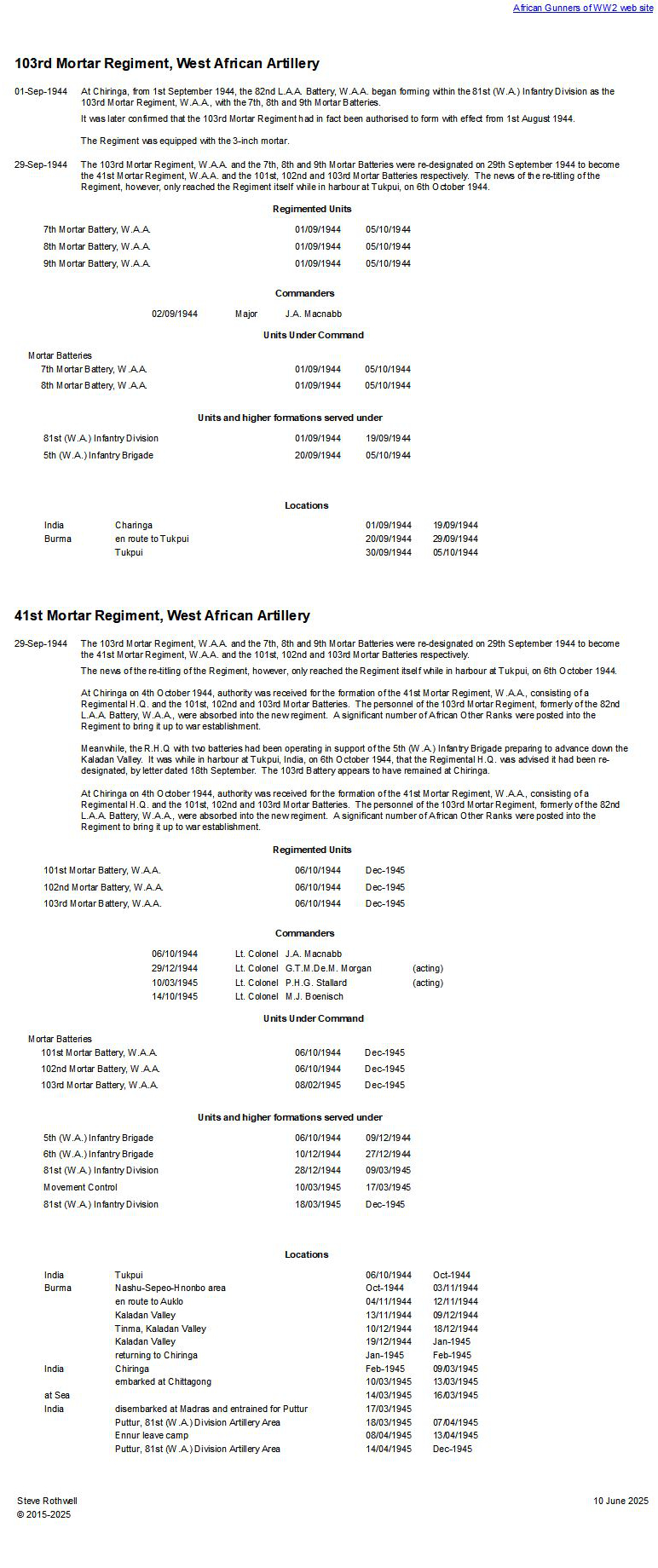
Summary history of the 103rd - 41st Mortar Regiment, W.A.A.
© Steve Rothwell
10 June 2025
[1] War diary 82nd L.A.A. Battery, W.A.A., WO 172/6651
[2] WO 172/6651
[3] War diary 41st Mortar Regiment, W.A.A., WO 172/6674; War diary H.Q.R.A. 81st (W.A.) Infantry Division, WO 172/6592
[4] War diary 41st Mortar Regiment, W.A.A., WO 172/6674
[5] WO 172/6674
[6] WO 172/6674
[7] WO 172/6674; War diary 41st Mortar Regiment, W.A.A., WO 172/9605; “War Bush, 81 (West African) Division in Burma, 1943-1945”, Hamilton A.L., Michael Russell (2001)
[8] WO 172/9605; War diary 101st Mortar Battery, W.A.A., WO 172/9607; War diary 102nd Mortar Battery, W.A.A., WO 172/9608; War diary 103rd Mortar Battery, W.A.A., WO 172/9609