The Anti-Aircraft Defence of West Africa
The fall of France in June 1940 left Britain and her Empire to stand alone against Germany. In the aftermath of the French surrender, a new state emerged, Vichy France. Under the terms of the armistice, France retained control over significant armed forces and of her overseas territories, notably those in North and West Africa. The British were forced rethink their strategy. One key area was the defence of Britain’s West African territories. Freetown on the coast of Sierra Leone was an essential refuelling stop for ships carrying British reinforcements to the Middle East, India and the Far East. Surrounded by previously friendly, now potentially hostile French territories, this vital facility was dangerously exposed. Now that the air reinforcement route over France had been closed, an alternative route was needed by which British aircraft might land and refuel on their way to the Middle East. The Takoradi air route, from West Africa to the Sudan, was developed to address this need. Until now a quiet backwater in the war, West Africa had become a major headache for British military planners who had to find the resources with which to defend key installations.
British colonial territories in West Africa
Freetown in Sierra Leone was a major naval base and port, vital to the support and protection of convoys headed from the United Kingdom to the Middle East, India and the Far East. Takoradi in the Gold Coast became the vital point in the air reinforcement route to the Middle East (see below). Gambia grew in importance due to its increased use by the Royal Navy and the R.A.F. and, for a time (early 1942), as a base for projected operations against Vichy French Senegal, particularly in the event of any German move against the French possession.[1]
The British were sensitive to any action which might antagonise the Vichy French to launch an air attack. An assessment made by the Commander Sierra Leone Area in January 1942 reported that Bathurst (Gambia) and Freetown (Sierra Leone) were vulnerable to air attack. ‘Even slight damage [to] naval and shipping facilities would hamper movements while serious damage would put these ports out of action for a considerable time. A few bombs would reduce labour available to [a] negligible quantity.’ [2]
Development of the Takoradi air route and associated airfields - the need to defend them
The development of the Takoradi air route arose from the need to find a safe route for aircraft reinforcements sent from the United Kingdom to the Middle East. The shortest, most direct route had been lost with the fall of France and the answer was a combined sea and air route. The Air Ministry decided on 20th June 1940 to begin transferring aircraft by sea to West Africa and thence by air to Khartoum and Egypt. A civil transport route had been developed before the war, from the Gold Coast town of Takoradi to Khartoum and thus there was a chain of airfields from Takoradi, through Nigeria and to the Sudan and Egypt. The Air Ministry chose to build on these existing facilities. Takoradi was selected as the port at which aircraft shipped in crates would be received. Here, they would be prepared for the long flight across Africa. Extensive facilities were to be prepared at Takoradi, sufficient to process 120 aircraft and more each month. All along the route, existing airfields were to be extended, new ones built, signal communications and weather forecasting facilities improved. This vital infrastructure had to be defended, especially from air attack. (As an expedient whilst this infrastructure was being put in place, between late 1940 and early 1941, on three occasions the aircraft carrier H.M.S. Furious ferried aircraft to West Africa. The aircraft were flown off to land at Takoradi before going on to the Middle East.)
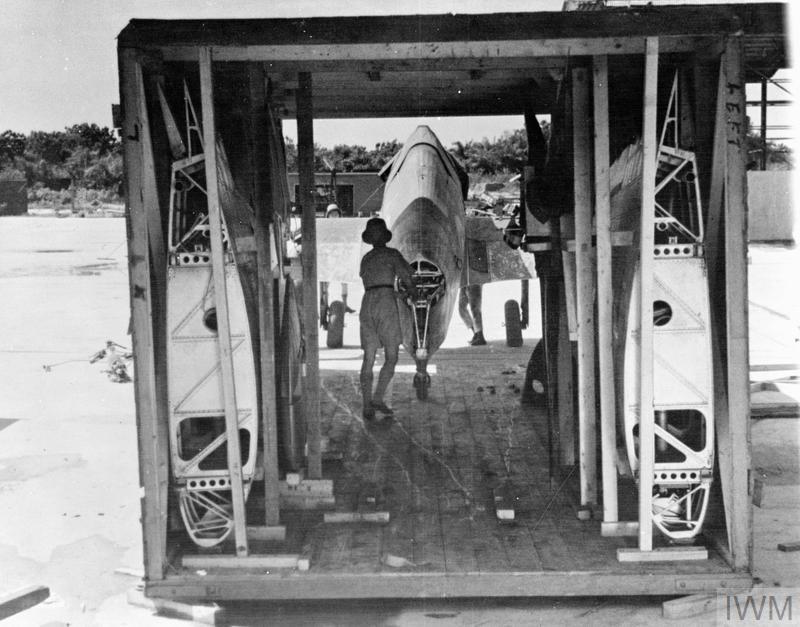
A crated Hurricane at Takoradi.
(Imperial War Museum)
In response to a War Office enquiry, in July 1940 the G.O.C. West Africa stated he could provide ground defence for the Nigerian airfields at Lagos, Kano and Maiduguri but that no anti-aircraft weapons or units were available to provide air defence. Four heavy and four light anti-aircraft guns were despatched from the United Kingdom but in September 1940, given the urgent needs of home defence and other theatres, it was decided that no additional guns would be sent to West Africa for the next six months. Then in November, the War Office signalled that additional anti-aircraft guns had now been allotted to West Africa: six 3.7-inch mobile guns; two 4.5-inch static dual-purpose guns and eight mobile 40mm Bofors guns. The 4.5-inch guns were allotted for the coast and anti-aircraft defence of Takoradi. Significantly, War Office asked to what extent these guns might be manned by African soldiers and suggested that the personnel of one complete British H.A.A. battery and one complete L.A.A. battery could be sent to both man the guns and to train African gunners. The G.O.C. West Africa accepted these proposals and requested that in addition to the 4.5-inch guns destined for Takoradi, that four Bofors guns be sent there also. The remainder of the guns were to be sent to Freetown, Sierra Leone. British personnel were to provide detachments for the guns at Takoradi, with the remainder going to Freetown. On 16th November, it was confirmed that the 197th H.A.A. Battery, R.A. and the 71st L.A.A. Battery, R.A. were being despatched. One H.A.A. section and one L.A.A. troop would be detached from these batteries to go to Takoradi, the remainder to Freetown. The two batteries sailed from the United Kingdom with Convoy WS 5A on 18th December. They arrived at Freetown on 6th January 1941; the Takoradi detachments sailing on to arrive there on 14th January.[3]
Plans were made to develop the anti-aircraft defences further. In April 1941, it was proposed that the airfield at Takoradi would be defended by six 4.5-inch coast defence/anti-aircraft guns, installed as three, two-gun batteries. For the time being, the vital West African airfields would have to be defended from air attack by light machine-gun detachments only, except for the Bofors section at Takoradi.
The Americans entered the war in December 1941 and almost immediately prepared to use the Takoradi air route. Eventually, they would ferry bomber aircraft to the Middle and Far East from Natal in Brazil to Sierra Leone and thence via Accra onto the R.A.F. reinforcement route. Other aircraft were sent by sea, in crates for assembly in West Africa.
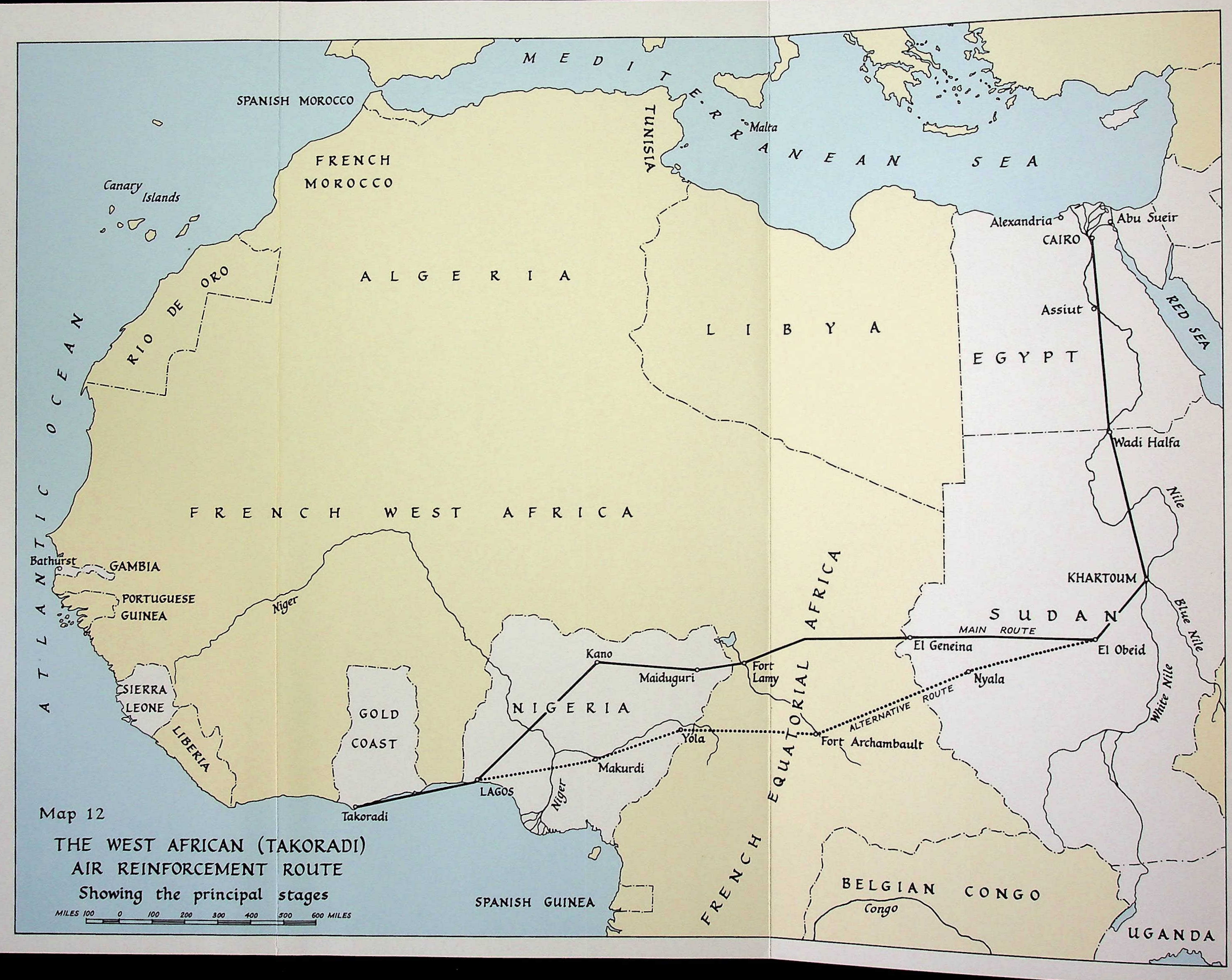
The Takoradi-air-route.
(H.M.S.O.)
The expansion and distribution of W.A.A. Anti-Aircraft Units
The main threat to the West African installations was attack from the air; either from Axis aircraft overflying or based on Vichy French territory or, possibly worse, from Vichy French aircraft. Britain did not have the manpower to meet in full the requirement for anti-aircraft defence in West Africa. Instead, the solution was to build new anti-aircraft units in situ, formed around cadres of British officers and N.C.O.s despatched from the United Kingdom and brought up to war establishment by the inclusion of African gunners. From late 1940, throughout 1941 and into 1942, both fully formed Royal Artillery anti-aircraft units, specially formed cadres and separate reinforcement drafts were despatched, together with all the necessary guns and equipment.
An anti-aircraft training centre was formed to train African gunners and when their training was complete, these men were posted to join both the Royal Artillery batteries and the new West African units. Referred to as ‘Africanisation’, when complete a unit would be brought up to strength based on a mixed War establishment of British Officers, British N.C.O.s and African gunners.
The R.A. batteries sent out from the United Kingdom retained their identity upon arrival in West Africa but were soon ‘Africanised’. In general, these batteries retained their numbered title, for example the 308th H.A.A. Battery, and continued to be referenced as R.A. units for some considerable time, even though now indistinguishable from locally formed West African Artillery batteries. In at least some instances, these former R.A. units later came to be designated as W.A.A., but no policy document has been found to define how and when this may have been done.
Cadres for West Africa were formed in the United Kingdom and designated with a temporary title, such as: H.Q. ‘T’ L.A.A. Battery or H.Q. ‘D’ H.A.A. Regiment. These consisted only of a few Officers, Warrant Officers and senior N.C.O.s. Immediately upon arrival in West Africa, these cadres were formed into new, West African Artillery regiments and batteries. In this way, for instance, upon arrival at Takoradi on 23rd October 1941, the H.Q. ‘T’ L.A.A. Battery formed the 2nd L.A.A. Battery, W.A.A. Similarly, the H.Q. ‘D’ H.A.A. Regiment was re-titled to become the 4th H.A.A. Regiment, W.A.A. when it arrived at Bathurst on 24th October 1941. Smaller detachments were absorbed into the new units, such as ‘Y’ and ‘Z’ L.A.A. Detachments which were taken into the 3rd L.A.A. Battery, W.A.A. at Freetown. Individual reinforcement drafts were posted to new units upon arrival.
For a brief period between 1st July 1941 and October that year, the West African anti-aircraft regiments omitted the word ‘Heavy’ or ‘Light’ from their titles. The rationale was that some regiments might be formed of both heavy and light batteries (composite regiments) while others were entirely formed of either heavy or light batteries. It was also decided that all anti-aircraft regiments would be numbered consecutively. As a result:
- 1st H.A.A. Regiment, W.A.A. became the 1st A.A. Regiment, W.A.A.,
- 1st L.A.A. Regiment, W.A.A. became the 2nd A.A. Regiment, W.A.A.
- the 4th A.A. Regiment, W.A.A. was formed on 15th September 1941, to become the 2nd H.A.A. Regiment, W.A.A on 8th October 1941.
(The 3rd H.A.A. Regiment, W.A.A. did not form until after this order had been rescinded.) [4]
This order was soon rescinded and by 8th October 1941, the regiments had reverted to their original titles and designations.
By 1st January 1942, the number of anti-aircraft guns received in West Africa and deployed for all purposes (harbour and airfield defence) was:[5]
|
Location |
Heavy A.A. |
Light A.A. |
|
Bathurst (Gambia) |
8 X 3.7inch |
8 X 40mm Bofors |
|
Freetown (Sierra Leone) |
8 X 4.5-inch CD/AA sited primarily for CD (two more guns due April |
24 X 40mm Bofors of which 21 in action |
|
Takoradi (Gold Coast) |
6 X 4.5-inch CD/AA sited primarily for CD |
12 X 40mm Bofors |
|
Lagos (Nigeria) |
8 X 3.7-inch guns of which none yet in action |
4 X 40mm Bofors |
A further eight 4.5-inch guns were allocated by the War Office in late January 1942: two for Takoradi; four for Bathurst; two for Lagos.[6]
In February 1942, the requirement for anti-aircraft defences was assessed for those airfields not protected as part of the defended ports. Airfields were classified as either: A) – requiring maximum protection and with both heavy and light anti-aircraft guns; B) – light anti-aircraft guns only. This resulted in the need for 48 heavy and 50 light guns. Given the growing use of Accra by American aircraft, four heavy and four light guns were to be diverted there from those allocated to Takoradi.[7] (The first of these to arrive at Accra was ‘A’ Troop, 2nd L.A.A. Battery, W.A.A. with four Bofors guns, arriving on 19th February 1942. The four 3.7-inch guns of the 405th H.A.A. Battery, R.A., arrived in May 1942, the guns being declared in action on 7th May.)
By March 1942, the West African portion of the Takoradi air route was defended by the following anti-aircraft guns:
|
Location |
Heavy A.A. |
Light A.A. |
|
Takoradi (Gold Coast) |
6 X 4.5-inch CD/AA sited primarily for CD (two more guns due April |
4 X 40mm Bofors |
|
Lagos (Nigeria) |
8 X 3.7-inch guns - 4 in action, 4 in action shortly (four additional guns due May) |
8 X 40mm Bofors (four more guns due May) |
|
Kano (Nigeria) |
nil |
8 X 40mm Bofors |
|
Maiduguri (Nigeria) |
nil |
4 x 40mm Bofors |
|
Accra (Gambia) |
4 X 3.7-inch guns (in action shortly) |
4 X 40mm Bofors |
|
Hastings, Freetown (Sierra Leone) |
8 X 3.7-inch guns |
8 X 40mm Bofors |
The passing of the threat and the emergence of new requirements
By January 1942, preparations were being made to include light anti-aircraft and anti-tank units in each West African infantry brigade then defending British territories in West Africa. The initial preference was for one battery of 40mm Bofors guns for each brigade, with the Bofors guns being operated in both the light anti-aircraft and anti-tank roles. Given a shortage of 2-pounder anti-tank guns, the G.O.C. West Africa proposed to form only one anti-tank battery equipped with this gun (twelve guns) and to form six mobile light anti-aircraft/anti-tank batteries, the latter in Nigeria. Formation of the six batteries was delayed, however, by the lack of an approved war establishment (as noted on 1st April1942) and the availability of guns for training (three guns allocated for this purpose were taken over at Freetown to bolster the anti-aircraft defences – earning the G.O.C. West Africa a rebuke from the War Office). [8]
The formation and equipping of the L.A.A./anti-tank batteries was dependent upon a considerable amount of equipment being shipped from the United Kingdom. To meet the needs of the new batteries and for the continuing defence of West African ports and airfields, a total of 156 Bofors were needed: 16 guns for each of the new batteries; 48 guns for the defence of Bathurst (six), Freetown (eighteen), Gold Coast (eighteen), Lagos (six). In January 1943, there were only eighty-six guns in West Africa, which left a deficit of seventy guns.[9]
West African Artillery in India and Burma
By October 1942, the threat of attack by Vichy units on British West Africa was deemed to have diminished considerably. Following the landings in French North Africa in November 1942 (Operation ‘Torch’) and the subsequent military and political developments, the situation in West Africa changed markedly. Soon, French West Africa joined the Free French and in December 1942, the British decided that major armed forces were no longer required in British West Africa.
The composition of H.A.A. batteries in October 1942 was:
|
Location |
Battery |
4.5-inch, two gun site |
4.5-inch four gun site |
3.7-inch two gun site |
3.7-inch four gun site |
|
Gambia |
7th H.A.A. Bty |
2 |
|
|
1 |
|
|
313th H.A.A. Bty |
|
|
|
2 |
|
Sierra Leone |
1st H.A.A. Bty |
2 |
|
2 |
|
|
|
2nd H.A.A. Bty |
|
|
|
2 |
|
|
5th H.A.A. Bty |
|
|
|
2 |
|
|
6th H.A.A. Bty |
|
1 |
|
1 |
|
|
197th H.A.A. Bty |
|
|
|
2 |
|
|
308th H.A.A. Bty |
|
|
|
2 |
|
Gold Coast |
3rd H.A.A. Bty |
4 |
|
|
|
|
|
4th H.A.A. Bty |
|
|
2 |
1 |
|
|
405th H.A.A. Bty |
|
|
4 |
|
|
Nigeria |
8th H.A.A. Bty |
1 |
|
1 |
1 |
|
|
251st H.A.A. Bty |
|
|
|
2 |
By January 1943, it was being proposed to reduce the anti-aircraft defences in West Africa, given the absence of any threat. Anti-aircraft guns and units were needed urgently elsewhere. The anti-aircraft requirements for the defence of India and Ceylon and for the reconquest of Burma were dependent upon British reinforcements arriving from the United Kingdom and on the expansion of the Indian anti-aircraft artillery, most notably through the so-called ‘Madrassi Scheme’. British manpower was both in great demand and in short supply, not only for India but for other theatres of war. By early 1943, India was asked to release British anti-aircraft units for transfer to the Middle East. As the Indian expansion programme would not be able to replace these in the short term, it was proposed that reductions in the West Africa defences would make available four heavy anti-aircraft regiments and some of the guns for one light anti-aircraft regiment (the latter in addition to the six L.A.A./anti-tank batteries being planned to serve with the two West African infantry divisions now being prepared for overseas service). The proposed retention for West Africa was: [10]
|
Location |
Heavy A.A. |
Light A.A. |
|
Bathurst (Gambia) |
4 |
4 |
|
Freetown (Sierra Leone) |
8 |
12 |
|
Takoradi (Gold Coast) |
4 |
4 |
|
Komenda, near Takoradi |
- |
4 |
|
Lagos (Nigeria) |
4 |
4 |
However, the War Office went further and ordered that the anti-aircraft defences in West Africa would be reduced to nil, save for a minimum of guns needed for training. This appears to have been approved by February 1943.
With some juggling of batteries, three trained heavy anti-aircraft regiments were available for service in India. Subsequently, a fourth regiment was found. It was proposed that an anti-aircraft brigade headquarters be sent with three of the heavy regiments. Six L.A.A./anti-tank batteries, each of eighteen guns, were to be sent to India, three each with the West African divisions. At the time of these proposals, February 1943, it was thought that it might not be possible to send an additional light anti-aircraft regiment. The 14th (W.A.) Anti-Aircraft Brigade arrived in India in July 1943 and was deployed in Assam by December 1943.
The L.A.A./anti-tank batteries allocated to the 1st (W.A.) Infantry Division (retitled the 81st (W.A.) Infantry Division from 4th March 1943.) were to be sent to India without guns, on the assumption that they would be equipped upon arrival. These batteries were to be attached one per infantry brigade within the division but this changed when a regimental headquarters was formed, the 1st L.A.A./Anti-Tank Regiment, W.A.A., to which were regimented the three batteries. The regiment was then attached to the division as Divisional Troops. The 81st (W.A.) Infantry Division was concentrated in Nigeria, with the 3rd, 5th and 6th Infantry Brigade Groups and with units assigned as Divisional Troops, such as artillery, engineers and signals. The 1st L.A.A./Anti-Tank Regiment, W.A.A. arrived in Nigeria to join the Division in early May 1942. The Division arrived in India in August 1943, followed by the 1st L.A.A./Atk Regiment in November. The Regiment was sent to Chittagong in January 1944 where two batteries were deployed to reinforce the anti-aircraft defences of the town.
The 2nd L.A.A./Atk Regiment was formed for service with the 82nd (W.A.) Infantry Division and arrived in India in July 1944. It was reorganised on 1st August 1944 as an anti-tank regiment but subsequently operated as infantry. Meanwhile, the 1st L.A.A./Atk Regiment had also been reorganised as an anti-tank regiment and it too saw action in Burma in the infantry role. Each regiment later spawned a mortar regiment.
Following the despatch of West African artillery to India, all reinforcements for these units were to be trained at the School of Artillery, Accra. All British personnel (Officers, N.C.O.s and Other Ranks) were to undergo three months training at Accra to become familiar with working with African troops, before being sent to India as reinforcements. The 71st L.A.A. Battery, being composed of Sierra Leonians, was also retained in West Africa to provide future reinforcements for the 1st H.A.A. Regiment in India, the limits of Sierra Leonian manpower having been reached.[11]
It was agreed by the Chiefs of Staff on 30th December 1942 that there would be no reduction in coast defences for West Africa, albeit with the idea that the shipping of a further 9.2-inch and seven 5.25-inch guns for Freetown was no longer required. The anti-aircraft defences were to be reduced to nil, with 3.7-inch and 40mm Bofors being retained only for training. Anti-aircraft defence in Nigeria ceased, at the instruction of G.H.Q. West Africa, on 22nd February 1943.[12] A number of the 4.5-inch dual purpose guns were to be retained only for coast defence.[13]
03 June 2025
[1] History of the Second World War, The Mediterranean and the Middle East, Vol. I, Playfair O., H.M.S.O.
[2] Telegram from Commander Sierra Leone to The War Office and others, 7th January 1942, contained within Defence of West Africa against Vichy France, WO 106/5201
[3] Defence of the Takoradi Air Route, WO 106/2878
[4] War diary C.R.A. Freetown Fortress, WO 173/132
[5] West Africa Anti-Aircraft, WO 106/2879
[6] WO 106/2879
[7] WO 106/2879
[8] WO 106/2879
[9] WO 106/2879
[10] WO 106/2879; A.A. Requirements, WO 106/4562
[11] West Africa Anti-Aircraft, WO 106/2879
[12] War diary H.Q. Lagos Fortress, WO 173/682
[13] West Africa Anti-Aircraft, WO 106/2879