1st / 21st Anti-Tank Regiment, W.A.A.
The origin of this regiment can be traced back through that of
the 1st L.A.A./Atk Regiment, W.A.A. which began life by the redesignation of the 1st Light Anti-Aircraft Regiment, W.A.A. on 6th March 1943.
The 1st L.A.A./Atk Regiment, W.A.A. was reorganised and redesignated first as the 1st Anti-Tank Regiment, W.A.A. and then as the 21st Anti-Tank Regiment, W.A.A. Here is a summary:
1st Light Anti-Aircraft Regiment, W.A.A.
1st May 1941 formed at Freetown, Sierra Leone
15th July 1941 redesignated as the 2nd Anti-Aircraft Regiment, W.A.A.
8th October 1941 redesignated as the 1st Light Anti-Aircraft Regiment, W.A.A.
6th March 1943 reorganised as the 1st L.A.A./Anti-Tank Regiment, W.A.A.
1st L.A.A./Anti-Tank Regiment, W.A.A.
6th March 1943 by reorganisation of the 1st Light Anti-Aircraft Regiment, W.A.A.
1st October 1944 reorganised and re-designated as the 1st Anti-Tank Regiment, W.A.A.
1st Anti-Tank Regiment, W.A.A.
1st October 1944 by reorganisation of the 1st L.A.A./Anti-Tank Regiment, W.A.A.
23rd October 1944 redesignated as the 21st Anti-Tank Regiment, W.A.A.
21st Anti-Tank Regiment, W.A.A.
23rd October 1944 by redesignation of the 1st Anti-Tank Regiment, W.A.A.
1946 disbanded in West Africa.
1st Anti-Tank Regiment, W.A.A.
At Chittagong, on 1st October 1944, the
1st L.A.A./Atk Regiment, W.A.A., was redesignated as the 1st Anti-Tank Regiment, W.A.A. It was formed with the
61st, 62nd and 65th Anti-Tank Batteries. The Commanding Officer was Lt. Colonel O.W. Holleyman, R.A. The 61st Battery had been at Alikadam since 16th September and the 62nd Battery at Ruma since 21st September. The 65th Battery, previously being the 81st L.A.A. Battery, had been at Banderban since late August. All batteries were operating in an infantry role. The Regiment was Divisional Troops, 81st (W.A.) Infantry Division. On 13th October 1944, twelve 6-pounder anti-tank guns were received but the Regiment appears never to have used them in action.[1]
21st Anti-Tank Regiment, W.A.A.
The Regiment was retitled the 21st Anti-Tank Regiment, W.A.A. on 23rd October 1944.[2]
It now formed part of the 81st (W.A.) Infantry Division’s return to the Kaladan Valley and operated throughout in the infantry role. The 65th Battery moved from Banderban to Singpa on 25th October. Then, on 4th November, the Regiment received orders to concentrate in the area of Mowdok. The R.H.Q. left Chittagong the next day and by the time it arrived at Mowdok and moved up to Frontier Hill, it had been joined by the 61st, 62nd and 65th Batteries. The Regiment was now under the command of the 4th Battalion, The Nigeria Regiment, part of the 6th (W.A.) Infantry Brigade. This arrangement was short-lived however, for the Regiment reverted to the command of the 81st Division on 17th November. The Regiment then moved forward again, heading for Auklo, which was reached on 1st December. Two days later, it was on the move again and on 8th December took over from the 8th Battalion, The Gold Coast Regiment at Kyingri. By this time, it had marched 250 miles in seventeen days since leaving the Chiringa area.[3]
At the beginning of 1945, with the successful conclusion of the second Kaladan campaign, the 81st (W.A.) Infantry Division was withdrawn to the Chiringa area. In January, the 21st Regiment returned to Chiringa, leaving Kyingri on 19th January to arrive at Chiringa on 26th January. Here the Regiment remained, beginning training with the 6-pounder anti-tank gun. It left Chiringa on 5th March to embark on the S.S. Ethiopia at Chittagong, from where it sailed the next day to disembark at Madras on 10th March. From Madras, the Regiment moved to nearby Puttur on 13th March, where it stayed throughout March and into early July. Thirty-six 6-pounder anti-tank guns were received on 23rd April. Training continued and there were many movements of personnel – British and some African, personnel being repatriated and reinforcement drafts arriving to fill gaps in the war establishment. Twenty of the anti-tank guns were returned to the Ordnance Depot at Jubbulpore on 12th June.[4]
The Regiment moved to the 81st (W.A.) Infantry Division at Ennur Camp for ten day’s leave on 6th July 1945 and returned to Puttur on 15th July. Training continued and during August all batteries were able to conduct field firing practice using full-charge ammunition. In October, twenty-four 6-pounder anti-tank guns were returned to the Ordnance Depot at Whitefields.[5]
The Regiment remained at Puttur into January 1946. Twelve anti-tank guns were returned to the Ordnance Depot, Whitefields on 6th January. There followed another spell of leave at the Ennur Camp, between 22nd and 29th January. The R.H.Q and the 65th Battery returned to Puttur, while the other two batteries stayed at Ennur. Finally, on 28th January, the eagerly awaited warning order was received for embarkation for West Africa.[6]
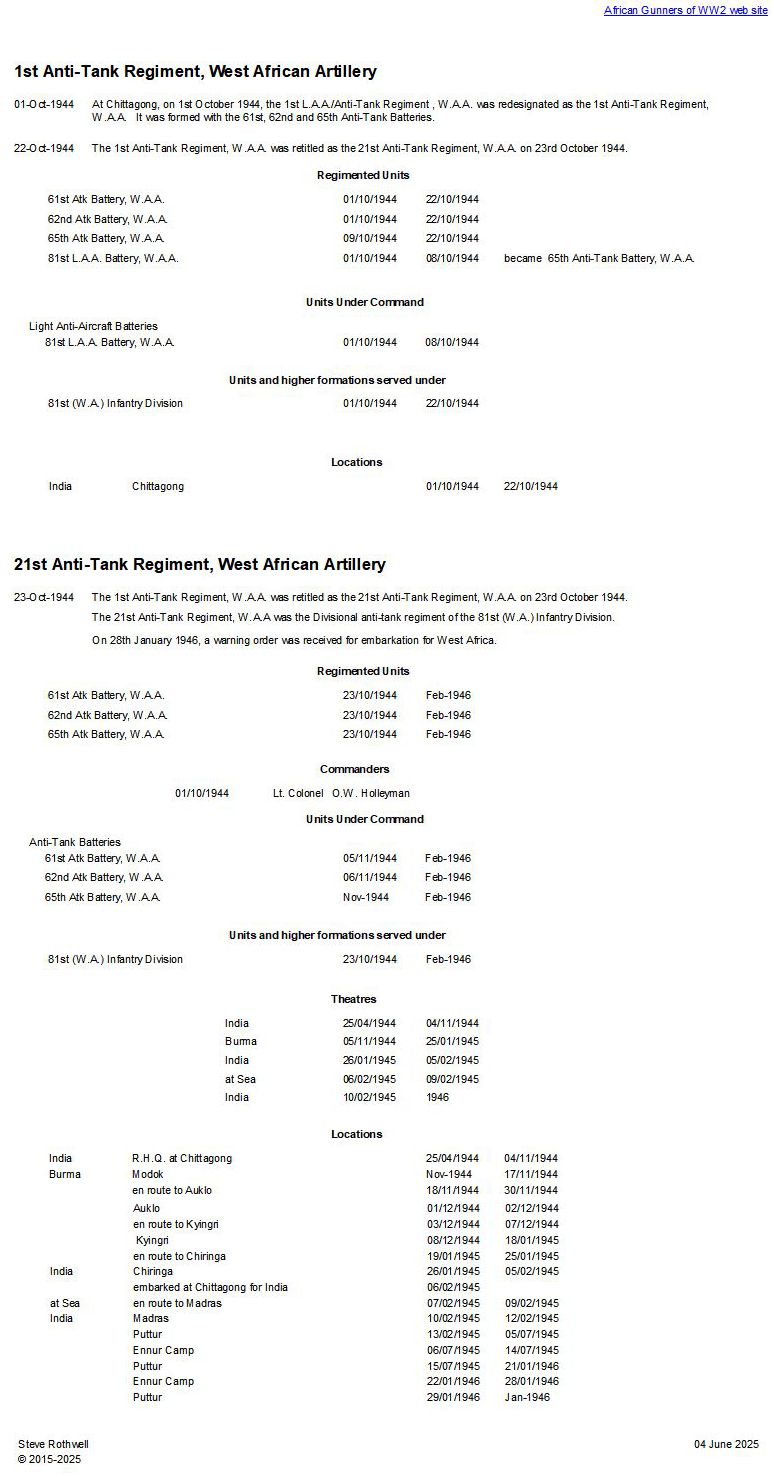
Summary history of the 1st / 21st Anti-Tank Regiment, W.A.A.
© Steve Rothwell
04 June 2025