1st Light Anti-Aircraft/Anti-Tank Regiment, W.A.A.
The 1st L.A.A./Atk Regiment, W.A.A. began life by the redesignation of the 1st Light Anti-Aircraft Regiment, W.A.A. on 6th March 1943, before being redesignated first as the 1st Anti-Tank Regiment, W.A.A. and then as the 21st Anti-Tank Regiment, W.A.A. Here is a summary:
1st Light Anti-Aircraft Regiment, W.A.A.
1st May 1941 formed at Freetown, Sierra Leone
15th July 1941 redesignated as the 2nd Anti-Aircraft Regiment, W.A.A.
8th October 1941 redesignated as the 1st Light Anti-Aircraft Regiment, W.A.A.
6th March 1943 reorganised as the 1st L.A.A./Anti-Tank Regiment, W.A.A.
1st L.A.A./Anti-Tank Regiment, W.A.A.
6th March 1943 by reorganisation of the 1st Light Anti-Aircraft Regiment, W.A.A.
1st October 1944 reorganised and re-designated as the 1st Anti-Tank Regiment, W.A.A.
1st Anti-Tank Regiment, W.A.A.
1st October 1944 by reorganisation of the 1st L.A.A./Anti-Tank Regiment, W.A.A.
23rd October 1944 redesignated as the 21st Anti-Tank Regiment, W.A.A.
21st Anti-Tank Regiment, W.A.A.
23rd October 1944 by redesignation of the 1st Anti-Tank Regiment, W.A.A.
1946 disbanded in West Africa.
1st L.A.A./Anti-Tank Regiment, W.A.A.
The Regiment was formed on 6th March 1943 by the reorganisation and redesignation of the 1st L.A.A. Regiment, W.A.A. as the 1st L.A.A./Anti-Tank Regiment, W.A.A., to become a divisional unit of the 81st (W.A.) Infantry Division. The 1st L.A.A./Anti-Tank Battery, W.A.A., which had formed from the 1st L.A.A. Battery, W.A.A., was retained. However, the 71st L.A.A. Battery, R.A. and the 3rd L.A.A. Battery, W.A.A. left on 28th March to come under the command of the 1st and 2nd H.A.A. Regiments, W.A.A. respectively. The original plan had been to form independent batteries assigned on a basis of one battery per West African infantry brigade group.[1]
Lt. Colonel O.W. Holleyman, R.A. assumed command of the Regiment on 1st May 1943. The Regiment transferred to Lagos, Nigeria, on board the H.M.S.T. Hai Lee, disembarking on 5th May, with the Regimental H.Q. and the 1st Battery. From there, the personnel went by train to the Awba Hills Camp, where they arrived the next day and came under command of the 81st (W.A.) Infantry Division. That same day, with effect from 1st May, the
2nd and 4th L.A.A./Anti-Tank Batteries, W.A.A. joined the Regiment, until this date having been independent batteries (tbc). The 1st Battery was organised with three troops: ‘A’ - ‘C’. Intensive training in all aspects began immediately.[2]
On 15th July 1943, the Regiment began mobilisation for overseas service. On 12th August, twenty-four Bofors guns were sent from Lagos by road for packing for shipping overseas. That same day, a draft of 113 African Other Ranks joined the Regiment as reinforcements. On 14th August, a further eighteen Bofors were despatched from Lagos, followed by predictors and other equipment on 16th August. Additional reinforcements joined later that month.[3]
The Regiment left Awba for Lagos, arriving on 17th September 1943 where it embarked for Freetown, Sierra Leone. Having arrived the previous day, the Regiment disembarked on 25th September and was billeted in the Freetown area. The Regiment embarked at Freetown on 8th October (The war diary for October 1943 is missing).[4]
At sea on 1st November 1943, sailing via Port Suez and Aden, the ship carrying the Regiment, the S.S. Volendam, arrived at Bombay on 17th November. The personnel disembarked and entrained in two groups on 19th and 20th November. The first group arrived at Calcutta on 23rd November and went into Alipore Transit Camp. The second group arrived at Calcutta on 24th November and the complete Regiment embarked on the S.S. Santhia for Chittagong. However, the ship caught fire the following day, forcing the Regiment to disembark followed by a move to Deula, arriving on 26th November.[5]
An advance party left Deula on 1st December 1943 for Chittagong to take over motor transport for the Regiment. The main body of the Regiment left Deula on 4th January 1944 and the next day embarked at Calcutta for Chittagong. Leaving on 6th January, the Regiment disembarked at Chittagong two days later. The personnel of the Regiment were now re-organised on the basis of two L.A.A. (1st and 4th L.A.A./Atk Batteries) and two anti-tank batteries (the 2nd and an improvised
‘X’ Batteries). The first Bofors guns, nine of American manufacture, were received on 22nd January and between 5th and 7th February, the Regiment brought a total of 17 guns into action, manned by the 1st and 4th L.A.A./Atk Batteries, the latter less ‘B’ Troop. The Regimental H.Q and the batteries deployed in the L.A.A. role now operated under the command of the 13th A.A. Brigade (which recorded 18 guns being deployed on 5th February). On 9th February, ‘B’ Troop, 4th Battery left for Paletwa and with six Bofors guns and a skeleton detachment, was flown into ‘Wizard’ airstrip on 22nd February in support of the 81st (W.A.) Infantry Division at Kaladan. This troop was to defend the airstrip and cover any attempted attacks by Japanese river craft. During the month, the Regiment began exchanging its American Bofors for British models.[6]
On 1st March 1944, the Regimental H.Q., Workshop and ‘X’ Battery moved into more permanent quarters, followed by the 2nd and 4th Batteries the next day. One L.A.A. troop of the Regiment was ordered by the 13th A.A. Brigade to Fazilpur airfield; this appears to have been ‘A’ Troop, 4th Battery. The Troop arrived at Fazilpur airfield on or shortly after 25th March. Meanwhile, on 18th March, twenty-four 2-pounder anti-tank guns were received and gunnery training for the 2nd and ‘X’ L.A.A./Atk Batteries began on 24th March, led by two Officers and six N.C.O.s of the 24th L.A.A./Atk Regiment, R.A. The guns of ‘B’ Troop, 4th Battery were evacuated by air from Kaladan on 27th March, but the personnel remained behind in an infantry role.[7]
In April 1944, a troop of six guns from the 4th Battery was deployed to Hathazari airfield, coming into action upon arrival on 12th April (according to a later entry in the 13th A.A. Brigade war diary, this was ‘B’ Troop, 4th Battery). With the agreement of the R.A.F., the defences at Fenny (Feni) and Fazilpur were reduced from 14th April and four guns of ‘A’ Troop, 4th Battery, W.A.A. left Fazilpur to come into action at Chittagong on 16th April.[8]
A letter received on 25th April 1944 contained orders for the reorganisation and re-designation of the Regiment, which was now to be formed of
- 61st and 62nd Anti-Tank Batteries,
- 81st and 82nd L.A.A. Batteries.
The 1st Battery was re-designated to become the 81st L.A.A. Battery, W.A.A. on 2nd May 1944. Training for the anti-tank batteries continued. On 12th May, ‘A’ Troop, 81st L.A.A. Battery moved from Hathazari to Ramu, to join ‘A’ Troop, 82nd Battery and where both were joined by the Battery H.Q., 82nd L.A.A. Battery from Chittagong. On 17th May, ‘B’ Troop of the 81st Battery was relieved in Chittagong by a troop from the 8th (Sikh) L.A.A. Regiment, I.A. By 26th May, according to the H.Q. 13th A.A. Brigade, the Regimental H.Q. was at Chittagong with the Battery H.Q. and ‘B’ Troop, 81st L.A.A. Battery (not in action); and with the Battery H.Q. and ‘A’ Troop, 82nd L.A.A. Battery and ‘A’ Troop, 81st L.A.A. Battery at Ramu.[9]
The 61st
and 62nd Anti-Tank Batteries were formed on 2nd May 1944 at Chittagong, taking the place of the 2nd L.A.A. and ‘X’ Anti-Tank Batteries respectively.
Then, on 30th May, provisional orders were received for yet another reorganisation – this time for the Regiment to become an anti-tank unit, with three anti-tank batteries and one battery to become independent mortar battery. Four 3-inch mortars and six Jeeps were taken on loan from the 101st Light Regiment, W.A.A. on 5th June and handed to the 82nd L.A.A. Battery, which had been earmarked to become the independent mortar unit. The 82nd Battery, less one troop, together with a troop of the 81st Battery which had been defending Ramu airstrip, was withdrawn on or just before 6th June, following the departure of the R.A.F. An Officer and five N.C.O.s of the 160th Field Regiment, R.A. arrived on 18th June to give training to the 82nd Battery in the use of the 3-inch mortar. The Regimental H.Q. appears to have remained under command of the 13th A.A. Brigade until the end of June, but the batteries are not listed by the latter H.Q.[10]
The Regiment began handing over Bofors tractors and other trucks to the 81st (W.A.) Infantry Division and units of the 13th A.A. Brigade. The 82nd Battery moved to Chiringa on 13th July where it soon began re-organising as a mortar regiment. The 81st L.A.A. Battery moved to join elements of the 81st (W.A.) Infantry Division at Banderban, leaving Chittagong on 27th August. The Regiment returned twenty-four Bofors guns to the ordnance depot on 11th September and began drawing 6-pounder anti-tank guns between 12th and 14th September. However, before the would-be gunners could familiarise themselves with these new weapons, they were sent forward to join the 81st (W.A.) Infantry Division as it returned to the Kaladan Valley. The 61st Battery moved to Alikadam on 16th September, to act in an infantry role. This was followed by the 62nd Battery moving to Ruma on 21st September, also in an infantry role.[11]
At Chittagong, on 1st October 1944, the Regiment was redesignated as the
1st Anti-Tank Regiment, W.A.A.[12]
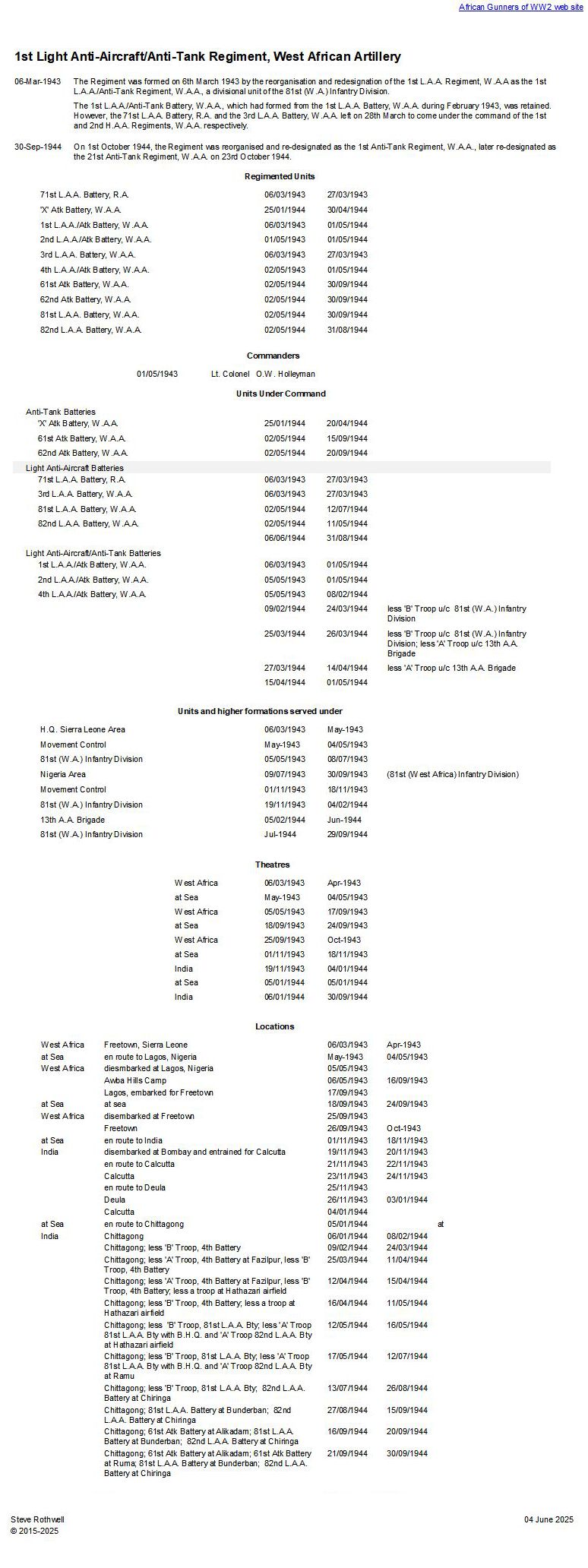
Summary history of the 1st Light Anti-Aircraft/Anti-Tank Regiment, W.A.A.
© Steve Rothwell
6
July 2025
[1] War diary 1st L.A.A./Atk Regiment, W.A.A., WO 173/725
[2] WO 173/725; War diary 1st L.A.A./Atk Battery, W.A.A., WO 173/727
[3] WO 173/725
[4] WO 173/725; War diary H.Q. Sierra Leone Area, WO 173/750
[5] War diary 1st L.A.A./Atk Regiment, W.A.A., WO 172/4074; War diary 1st L.A.A./Atk Battery, W.A.A., WO 172/4075
[6] War diary 1st L.A.A./Atk Regiment, W.A.A., WO 172/6639; War diary 13th A.A. Brigade, WO 172/4471
[7] WO 172/6639; WO 172/4471
[8] Having previously recorded the move of ‘A’ Troop, 4th Battery to Fazilpur on or around 25th March 1944, the 13th A.A. Brigade war diary records that it was a troop of the 1st Battery that was withdrawn from Fazilpur to Chittagong on 16th April. However, this single entry appears to have been an error and subsequent entries agree with the earlier deployment (WO 172/4471).
[9] WO 172/6639; WO 172/4471
[10] WO 172/6639; WO 172/4471
[11] WO 172/6639; War diary 82nd L.A.A. Battery, W.A.A., WO 172/6651
[12] War diary 21st Anti-Tank Regiment, W.A.A., WO 172/6641