‘Z’ – 106th Mortar Battery, W.A.A.
The H.Q.R.A., 82nd (W.A.) Infantry Division received on 24th July 1944 advanced copies of new war establishments for Divisional Artillery Units. Amongst these, was the formation of a Divisional 3-inch mortar regiment of three batteries, each of two troops each quipped with four 3-inch mortars. The new regiment was formed from the mortar troops of the light batteries, augmented with personnel from the 84th L.A.A. Battery, which was to be disbanded.[1]
‘Z’ Mortar Battery, W.A.A.
'Z' Mortar Battery, West African Artillery was authorised to be formed on 24th July 1944, and would have formed on 1st August to be regimented with 'X' Mortar Regiment, W.A.A. However, due to manpower issues, the Battery was not formed.
Although yet to be formed, on 1st September 1944, the Battery was re-titled to become the 106th Mortar Battery, W.A.A., regimented with the 42nd Mortar Regiment, W.A.A.[2]
106th Mortar Battery, W.A.A.
The 106th Mortar Battery, W.A.A. was authorised to be formed by the re-designation of 'Z' Mortar Battery, W.A.A. on 1st September 1944, and was regimented with the 42nd Mortar Regiment, W.A.A. In fact, due to manpower shortfalls, the 106th Battery did not form until the arrival of 330 reinforcements (African Other Ranks – mainly from the Gold Coast) on 22nd October 1944.[3]
The Regiment moved to East Bengal in November 1944 before moving to the Arakan. Having arrived in the Bawli area, the Regimental H.Q. with the 105th and 106th Batteries was ordered to Goppe and the 104th Battery to Razabil, leaving on 2nd December.[4]
The Regimental H.Q. and 106th Battery reached Goppe on 10th December and came under the command of the 82nd (W.A.) Reconnaissance Regiment.[5]
The Regiment advanced with the 82nd Division into the Kaladan Valley and southwards. The Myohaung area was reached by 22nd January 1945. The mortars had been in action against the Japanese several times. The Regimental H.Q. was at the Dakota airstrip, Myohuang, together with the 106th Battery.[6]
The 82nd (W.A.) Infantry Division was directed to advance southwards along the coast towards An. The 106th Battery reverted to Regimental command on 28th March. The Regimental H.Q. and the 106th Battery moved to Kindaunggyi, part way down the coast towards Taungup, on 12th April. The R.H.Q was joined by the 105th Battery on 20th April and the 106th Battery by 25th April.[7]
By the end of April 1945, the Japanese had withdrawn from the Arakan. There was little now for the 82nd (W.A.) Infantry Division to do and on 1st May it came under direct command of H.Q. ALFSEA. The 42nd Mortar Regiment, W.A.A. prepared monsoon accommodation to the north of Taungup, in the Kindaunggyi area, where the 82nd Divisional Artillery was gathering, and by 5th May, the Regimental H.Q. and the 104th and 105th Batteries had moved into their monsoon quarters. They were joined there by the 106th Battery on 15th May.[8]
The Regiment remained in the monsoon quarters until December 1945, As part of a general move of the 82nd (W.A.) Infantry Division to the Prome area, the 42nd Mortar Regiment left Kindaunggyi for the new area on 14th December. The Regiment was complete in the new area near Prome by 24th December.[9]
The 106th Mortar Battery, W.A.A. returned to West Africa in around July 1946 whereafter it is presumed to have disbanded. The remainder of the Regiment is thought to have followed shortly after.[10]
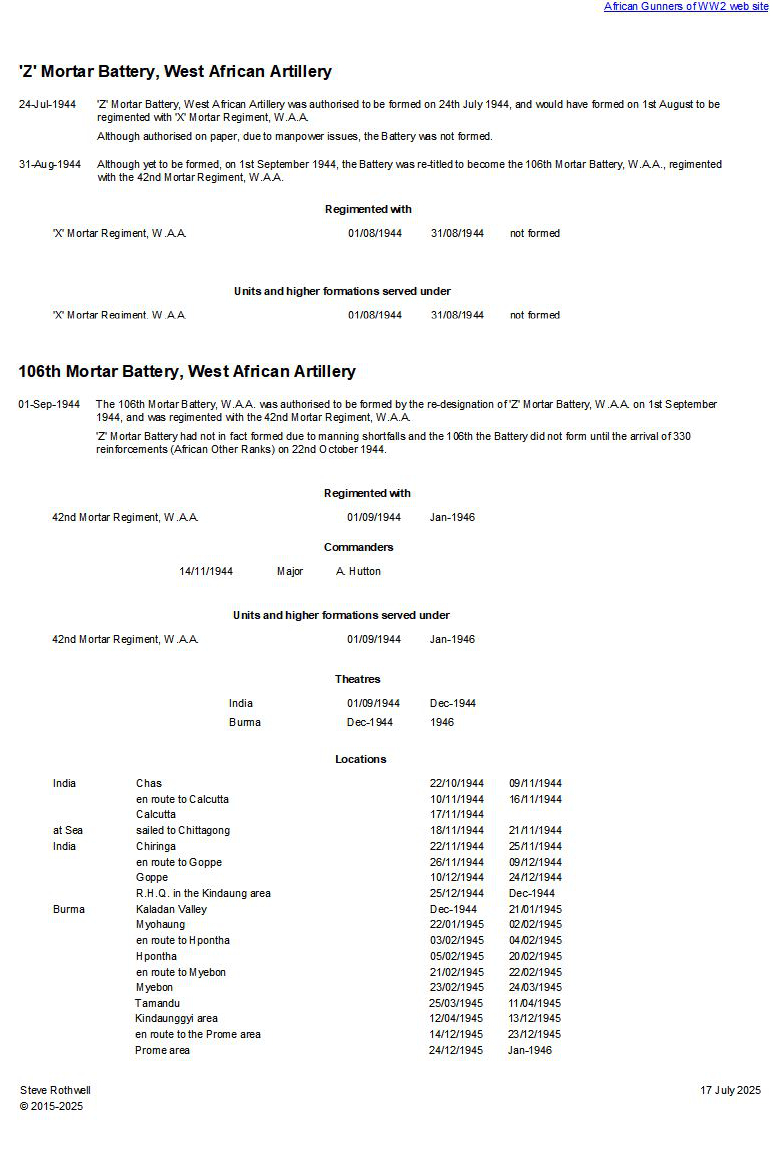
Summary history of ‘Z’ – 106th Mortar Battery, W.A.A.
© Steve Rothwell
17 July 2025
[1] War diary H.Q.R.A. 82nd (W.A.) Infantry Division, WO 172/6612
[2] WO 172/6612
[3] WO 172/6612
[4] WO 172/6675; WO 172/6612
[5] WO 172/6675
[6] WO 172/6675
[7] War diary 42nd Mortar Regiment, W.A.A., WO 172/9606
[8] WO 172/9606
[9] WO 172/9606
[10] National Archives of India, Abilekh Patel, NAIDLF00886148