61st Anti-Tank Battery, W.A.A.
The 61st Anti-Tank Battery, W.A.A. was formed by the reorganisation of
the
2nd L.A.A./Anti-Tank Battery, W.A.A.
2nd Light Anti-Aircraft Battery, W.A.A.
23rd/24th Sept. 1941 formed
at Takoradi, Gold Coast
9th March 1943
reorganised as the 2nd L.A.A./Anti-Tank Battery, W.A.A.
2nd L.A.A./Anti-Tank Battery, W.A.A.
9th March 1943
by reorganisation of the 2nd Light
Anti-Aircraft Battery, W.A.A.
2nd May1944
reorganised and
re-designated as the 61st Anti-Tank Battery, W.A.A.
61st Anti-Tank Battery, W.A.A.
2nd May 1944
by redesignation of the
2nd L.A.A./Anti-Tank Battery, W.A.A.
1946
disbanded in West Africa.
61st Anti-Tank Battery, W.A.A.
Orders were received on 25th April 1944 for the batteries of the
1st L.A.A./Atk Regiment, W.A.A. to be reorganised to form the 61st
and 62nd Anti-Tank Batteries and the
81st and 82nd L.A.A. Batteries.
The 2nd L.A.A. Battery W.A.A. was re-designated at Chittagong
to become the 61st Anti-Tank Battery, W.A.A. on 2nd May.
The Battery was regimented with the 1st L.A.A./Atk Regiment,
W.A.A. and the Commanding Officer was Major A.J. Bark.[1]
The Battery continued training and practice firing with the
2-pounder anti-tank guns issued to its predecessor, the 2nd
L.A.A./Atk Battery, W.A.A. Major M.J. Boenish
assumed command of the Battery on 12th June 1944.
The war establishment for a 6-pounder anti-tank battery was received
on 18th July.[2]
The 61st Battery left Chittagong on 15th September 1944, arriving
at Chiringa on 17th September. The next day, the
Battery left for Alikadam by march route, arriving on 21st
September. Here, the Battery, to act in the
infantry role, was under the command of the 5th (W.A.) Infantry
Brigade, and was given the duty of the defence of Alikadam on the
Sangu River, near Bandarban. On 28th September,
‘E’ Troop crossed to the opposite bank of the river.
The Battery conducted many patrols in the area.
Meanwhile, at Chittagong, on 1st October 1944, the 1st
L.A.A./Atk Regiment, W.A.A. was redesignated as the
1st Anti-Tank
Regiment, W.A.A. It became the
21st Anti-Tank
Regiment, W.A.A. on 23rd October. On 5th
November, the Battery was ordered to Frontier Hill where it arrived
on 11th November. It left here for Satpaung on
24th November, arriving the next day. On 28th
November it began the march to Auklo, arriving on 1st December.
However, the next day it was ordered to
move again, this time to Kyingri, on the Pi Chaung, to the West of
the Kaladan River.[3]
At the beginning of 1945, with the successful conclusion of the
second Kaladan campaign, the 81st (W.A.) Infantry Division was
withdrawn to the Chiringa area. In January, the
21st Regiment returned to Chiringa, leaving Kyingri on 19th January
to arrive at Chiringa on 26th January. The 61st
Battery arrived at Chiringa on 25th January.
Here the Regiment remained, beginning training with the
6-pounder anti-tank gun. Major J.W. Calver
assumed command o the Battery on 3rd February.[4]
With the Regiment, the Battery left Chiringa on 5th March to
embark on the S.S. Ethiopia at Chittagong, from where it
sailed the next day to disembark at Madras on 10th March.
From Madras, the Regiment moved to nearby Puttur on 13th
February, where it stayed throughout March and into early July.
Major A.H. French assumed command of the Battery on 17th
April. Thirty-six 6-pounder anti-tank guns were
received on 23rd April.[5]
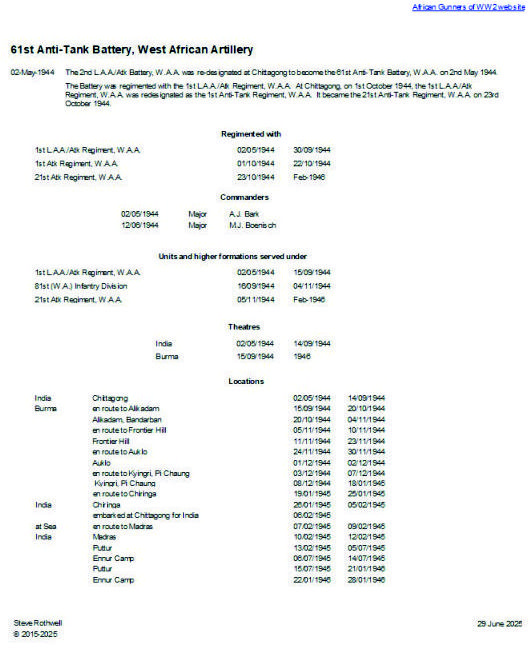
Summary history of the 61st Anti-Tank Battery, W.A.A.
© Steve Rothwell
6
July 2025
[1] War diary 61st Anti-Tank
Battery, W.A.A., WO 172/6646
[2] WO 172/6646
[3] WO 172/6646; War diary
21st Anti-Tank Regiment, W.A.A., WO 172/6641
[4] War diary 21st Anti-Tank
Regiment, W.A.A., WO 172/9579; War diary 61st Anti-Tank
Battery, W.A.A., WO 172/9581
[5] War diary 21st Anti-Tank
Regiment, W.A.A., WO 172/9579