'X' - 42nd Mortar Regiment, W.A.A.
The H.Q.R.A., 82nd (W.A.) Infantry Division received on 24th July 1944 advanced copies of new war establishments for Divisional Artillery Units. Amongst these, was the formation of a Divisional 3-inch mortar regiment of three batteries, each of two troops each quipped with four 3-inch mortars. The new regiment was formed from the mortar troops of the light batteries, augmented with personnel from the 84th L.A.A. Battery, which was to be disbanded.
‘X’ Mortar Regiment, W.A.A.
The H.Q.R.A., 82nd (W.A.) Infantry Division received on 24th July 1944 advanced copies of new war establishments for Divisional Artillery Units. Amongst these, was the formation of a Divisional 3-inch mortar regiment of three batteries, each of two troops each quipped with four 3-inch mortars. The new regiment was formed from the mortar troops of the light batteries, augmented with personnel from the 84th L.A.A. Battery, which was to be disbanded.[1]
The Regimental H.Q., ‘X’ Mortar Regiment, W.A.A. was formed in cadre at Jhalida on 1st August 1944, together with ‘X’ and ‘Y’ Mortar Batteries. Both batteries were incomplete and a third battery, ‘Z’ Battery, yet to be formed. The new Regiment was initially administered by the 102nd Light Regiment, W.A.A. until sufficient staff were received to allow the mortar regiment to conduct its own administration. ‘X’ Mortar Regiment was without a Commanding Officer and was temporarily commanded by the Adjutant, Captain R. Bishop until the appointment of Lt. Colonel L.A. Liddell later in the month. The Battery Commanders were: ‘X’ Battery – Captain R. de Glanville; ‘Y’ Battery – Major M.C. Lucas. The Regiment began training and practice firing immediately.[2]
42nd Mortar Regiment, W.A.A.
The ‘X’ Mortar Regiment was re-designated on 1st September to become the 42nd Mortar Regiment, W.A.A. with the 104th, 105th and 106th Mortar Batteries. The 42nd Mortar Regiment, W.A.A. was Divisional Troops, 82nd (W.A.) Infantry Division.[3]
The Regiment was visited by the Emir of Katsina on 10th October 1944; the visit was much appreciated by the Nigerian troops. By 11th October, all but one battery of the Regiment was declared to be fit for war. One battery, presumed to be the 106th Battery, had yet to be formed. The Regiment completed the move to Chas on 14th October. The Regiment was brought to near war establishment on 22nd October with the arrival of 330 reinforcements from the 55th (W.A.) Base. Nearly all of these men were from the Gold Coast and were infantry trained. The majority were posted to the 106th Battery; the 104th and 105th Batteries being nearly up to strength. Major Lucas relinquished command of the 105th Mortar Battery on 2nd November, being succeeded by Major A.G. Reekie. Major R. DeGlanville was the commander of the 104th Battery.[4]
The Regiment began moving to the operational area, with the motor transport leaving for Calcutta on 10th November 1944. Major A. Hutton assumed command of the 106th Mortar Battery on 14th November. The Regiment left Chas on 15th November and detrained at Calcutta on 17th November. The next day, it embarked on the H.M.T. Rajula which sailed for Chittagong, arriving on 21st November. The Regiment entrained on 22nd November to arrive at Dohazari later that day, from where the men were carried to Chiringa.[5]
On 26th November 1944, Captain R.A. Danford, Battery Captain, 105th Battery, was charged with striking an African Other Rank, placed under open arrest and subsequently sent for general court martial.[6]
On 26th November, the Regiment, less the Tactical H.Q., left by march route for the operational area. The 82nd (W.A.) Infantry Division was now going into action as flank protection for the 25th Indian Infantry Division, the latter advancing down the Mayu Peninsula. The Tactical H.Q. proceeded to the Bawli area by motor transport on 1st December. Having arrived in the Bawli area, the Regimental H.Q. with the 105th and 106th Batteries was ordered to Goppe and the 104th Battery to Razabil, leaving on 2nd December. The 104th Battery arrived at Razabil on 5th December and came under the command of the 1st (W.A.) Infantry Brigade. The 105th Battery was at Taung Keep on 8th December in support of the 5th Battalion, The Nigeria Regiment, 4th (W.A.) Infantry Brigade. The Regimental H.Q. and 106th Battery reached Goppe on 10th December and came under the command of the 82nd (W.A.) Reconnaissance Regiment. Captain F. Boyd was appointed Battery Commander, 105th Battery on 16th December, following the death in action of the previous commander, Major Reekie. The Regimental H.Q. moved to the Kindaung area, leaving via the Buthidaung ferry on 25th December.[7]
The Regiment advanced with the 82nd Division into the Kaladan Valley and southwards. The Myohaung area was reached by 22nd January 1945. The mortars had been in action several times against the Japanese. The Regimental H.Q. was at the Dakota airstrip, Myohuang, with the 104th Battery under the 1st (W.A.) Infantry Brigade, the 105th also under that brigade but due to come under the 4th (W.A.) Infantry Brigade when that formation reached Kyweguseik and the 106th Battery at Myohaung. The Regiment moved to Hpontha, leaving on 3rd February and arriving two days later. Lt. Colonel Lidell left on 5th February to take up the post of C.R.A., 82nd (W.A.) Division. He was succeeded temporarily by Major A.I. Hutton, pending the arrival of the new C.O. The Regimental H.Q. moved to Myebon by kisti (sampan) on 21st February, arriving two days later.[8]
The 82nd (W.A.) Infantry Division was directed to advance southwards along the coast towards An, The Regimental H.Q. moved to Tamandu (codenamed ‘Devonshire’) on 25th March 1945. The 106th Battery reverted to Regimental command on 28th March. That day, Lt. Colonel V.F. Northcott assumed command of the Regiment. The 105th Battery was placed under command on the 1st (W.A.) Infantry Brigade on 31st March. The 4th (W.A.) Infantry Brigade was now sent to Taungup. The Regimental H.Q. and the 106th Battery moved to Kindaunggyi, part way down the coast towards Taungup, on 12th April, the 104th Battery leaving to join the 4th (W.A.) Infantry Brigade on 13th April. The R.H.Q was joined by the 105th Battery on 20th April and the 106th Battery by 25th April.[9]
By the end of April 1945, the Japanese had withdrawn from the Arakan. There was little now for the 82nd (W.A.) Infantry Division to do and on 1st May it came under direct command of H.Q. ALFSEA. The 42nd Mortar Regiment, W.A.A. prepared monsoon accommodation to the north of Taungup, in the Kindaunggyi area, where the 82nd Divisional Artillery was gathering, and by 5th May, the Regimental H.Q. and the 104th and 105th Batteries had moved into their monsoon quarters. They were joined there by the 106th Battery on 15th May.[10]
The Regiment remained in the monsoon quarters until December 1945. Lt. Colonel Northcott left on release on 13th September 1945; Major R. Bishop assumed command of the Regiment. As part of a general move of the 82nd (W.A.) Infantry Division to the Prome area, the 42nd Mortar Regiment left Kindaunggyi for the new area on 14th December. The Regiment was complete in the new area near Prome by 24th December. During the month, Lt. Colonel W.S. Crane assumed command of the Regiment.[11]
The 105th Mortar Battery, W.A.A. returned to West Africa during June 1946 whereafter it is presumed to have disbanded. The remainder of the Regiment is thought to have followed shortly after.[12]
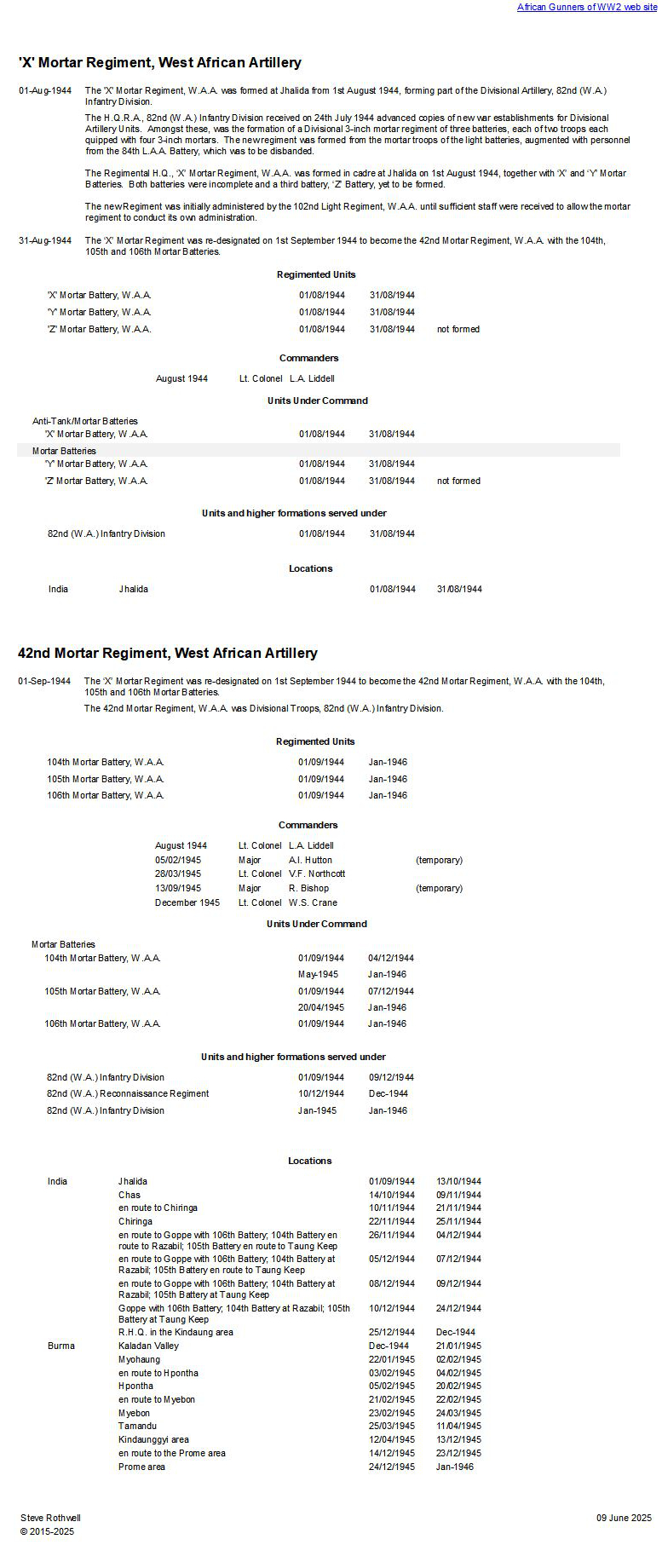
Summary history of the 'X' - 42nd Mortar Regiment, W.A.A.
© Steve Rothwell
09 June 2025
[1] War diary H.Q.R.A. 82nd (W.A.) Infantry Division, WO 172/6612
[2] WO 172/6612
[3] WO 172/6612
[4] War diary 42nd Mortar Regiment, W.A.A., WO 172/6675; WO 172/6612
[5] WO 172/6675
[6] WO 172/6675
[7] WO 172/6675
[8] War diary 42nd Mortar Regiment, W.A.A., WO 172/9606
[9] WO 172/9606
[10] WO 172/9606