102nd (East Africa) Anti-Tank Battery, E.A.A.
5th (E.A.) Anti-Tank Regiment, E.A.A.
The 102nd (E.A.) Anti-Tank Battery began forming from 15th October 1942. Major F.W. Ward assumed command of the Battery on 23rd December.[1]
The Battery was regimented with the 5th (E.A.) Anti-Tank Regiment, E.A.A. which began forming at Gilgil on 15th February 1943.[2]
By now equipped with 2-pounder anti-tank guns, on 13th March 1943, the Battery went to the Naivasha artillery ranges for practice firing.[3]
305th (E.A.) Anti-Tank Regiment, E.A.A.
On 9th May 1943, the Regiment received notification that it had been re-designated as the 305th (East Africa) Anti-Tank Regiment, E.A.A., with effect from 1st April 1943. The Regiment and batteries remained at Gilgil.[4]
The 101st and 102nd Batteries were earmarked to move to Ceylon as part of the third flight of the 11th (E.A.) Infantry Division. These two batteries undertook additional training at Naivasha during September 1943. On 27th September, the 101st and 102nd Batteries left Gilgil Station for Mariakani, then to Mombasa where between 2nd and 3rd October they embarked for Ceylon.[5]
304th (E.A.) Anti-Tank Regiment, E.A.A.
On 4th October 1943, the 305th (E.A.) Anti-Tank Regiment, E.A.A. was re-designated to become the 304th (East Africa) Anti-Tank Regiment, E.A.A.[6]
The 101st and 102nd Batteries arrived at Colombo on 12th October 1943 and disembarked the next day. The two Batteries went to Richard’s Rest, Kelaniya but moved to Peradeniya at the end of the month. By December, the Battery was located at Katugahahena. The Battery moved to Hambantota in January 1944 but returned to at Katugahahena on 1st February. However, by the end of the month, the Battery was back at Hambantota.[7]
304th (E.A.) Anti-Tank/Light Anti-Aircraft Regiment, E.A.A.
On 1st February 1944, the 304th Regiment combined with the 305th (E.A.) L.A.A. Regiment, E.A.A. to form the 304th (E.A.) Anti-Tank/L.A.A. Regiment, E.A.A. The 101st and the 102nd Anti-Tank Batteries, then serving in Ceylon, were also regimented.[8]
The R.H.Q. with the 203rd and 204th L.A.A. Batteries disembarked at Colombo on 5th March 1944 and moved to Illimbe Camp, Horana, coming under the command of the 11th (E.A.) Infantry Division. The 101st and 102nd Anti-Tank Batteries, meanwhile, were at Hambantota. They were joined there by the R.H.Q. and the two L.A.A. batteries on 5th April. On arrival, the Regiment left by march route to reach the Divisional concentration area at Dambulla on 9th April. Between 16th and 25th April, the Regiment participated in Exercise ‘Tayari’. The two L.A.A. batteries left on 9th May for Trincomalee for training, returning to Dambulla on 31st May. Meanwhile, the anti-tank troops had been practicing at Mannar with the 6-pounder anti-tank gun and 3-inch mortar, before returning to rejoin the Regiment on 1st June.[9]
Between 14th and 18th June 1944, the Regiment moved by march route and rail to Colombo where on 18th June it embarked on board the S.S. Rajula for India. The ship left on 20th June and the Regiment disembarked at Chittagong on 26th June, before moving to Dohazari the next day.[10]
The Regiment left Dohazari by train on 10th August, arriving at Kakching village, near Palel, Imphal on 20th August.[11]
102nd (E.A.) Anti-Tank/Mortar Battery, 304th (E.A.) Anti-Tank/Mortar Regiment, E.A.A.
At Kakching, on 26th August 1944, the Regiment re-organised as an anti-tank/mortar regiment and was re-designated as the 304th (E.A.) Anti-Tank/Mortar Regiment, E.A.A. on 3rd September.[12]
The 101st and 102nd Anti-Tank Batteries, were now organised and titled as the 101st and 102nd Anti-Tank/Mortar Batteries and were joined by the 103rd Anti-Tank/Mortar Battery. The anti-tank/mortar batteries were equipped with the 6‑pounder anti-tank gun and the 3-inch mortar.[13]
On 12th October 1944, the R.H.Q. and the 102nd Battery which left Kakching for Khampat, Burma. The following day, owing to the state of the roads, the anti-tank guns of the 102nd Battery were returned to Imphal for forward transportation by air. However, the guns of the 101st Battery, left en route as the battery moved forward, were collected and moved with the R.H.Q. and the 102nd Battery column. The column reached Khampat on the morning of 18th October, having covered forty-two miles in six days over a very bad road. One anti-tank gun of the 102nd Battery landed at Khampat by glider on 21st October. On 22nd October, the R.H.Q. and 102nd Battery, with the anti-tank guns of the 101st Battery, left Khampat for Yazagyo which was reached on 24th October. By now, it seems that the 101st Battery was allocated to the mortar role and the 102nd to the anti-tank role (from late October, the war diary refers to the batteries as the 101st Mortar and the 102nd Anti-Tank). Three anti-tank guns delivered to Khampat by glider reached the 102nd Anti-Tank Battery at Yazagyo on 29th October. The Battery moved forward with fifteen guns on 30th October and the next day came under the command of the 25th (E.A.) Infantry Brigade.[14]
The 11th (E.A.) Infantry Division resumed its offensive down the Kabaw Valley but the 26th (E.A.) Infantry Brigade became held up north of Indainggyi and the 21st (E.A.) Infantry Brigade was similarly held in the Mawlaik area. The reserve brigade, the 25th (E.A.) Infantry Brigade, was ordered to bypass Indainggyi and move directly to Kalemyo on the Myittha River. The batteries of the 340th (E.A.) Atk/Mortar Regiment gave invaluable support to the infantry throughout. The infantry reached Kalewa on 2nd December. Elements of the Regiment began arriving at Kalewa from 2nd December. The R.H.Q. arrived at Kalewa on 5th December, to join the 102nd Anti-Tank Battery. The mortars fired in support of the bridgehead across the Chindwin and on 10th December, the R.H.Q. crossed the Chindwin, but re-crossed to the Kalewa side on 13th December. On 16th December, both the 101st and the 102nd Batteries joined the R.H.Q. On 18th December, the Regiment began leaving the front for the Divisional Rest Area near Bokajan, to the north of Dimapur, arriving on 22nd December.[15]
The Regiment reverted to the war establishment of an anti-tank regiment on 2nd February 1945, becoming known once again as the 304th (E.A.) Anti-Tank Regiment, E.A.A.[16]
102nd (E.A.) Anti-Tank Battery, 304th (E.A.) Anti-Tank Regiment, E.A.A.
On 2nd February 1945, the 102nd Battery reverted to being an anti-tank battery. It remained at Bokajan before going to Dhansirmukh between 23rd and 26th March for anti-tank firing.[17]
The Regiment left Bokajan for Chas on 17th April 1945, arriving on 21st April. Between 21st-29th May, the Regiment moved to Ranchi. Training and practice firing at the nearby Piska ranges continued throughout the month.[18]
During January and February 1946 preparations began for demobilisation. In February, the 6-pounder anti-tank guns were handed in to the Ordnance Depot at Jubbulpore. The 3-inch mortars were transferred to the 306th (E.A.) Field Regiment, E.A.A.[19] Personnel of the 304th Regiment may have returned to East Africa during March 1946 and been disbanded shortly thereafter.[20]
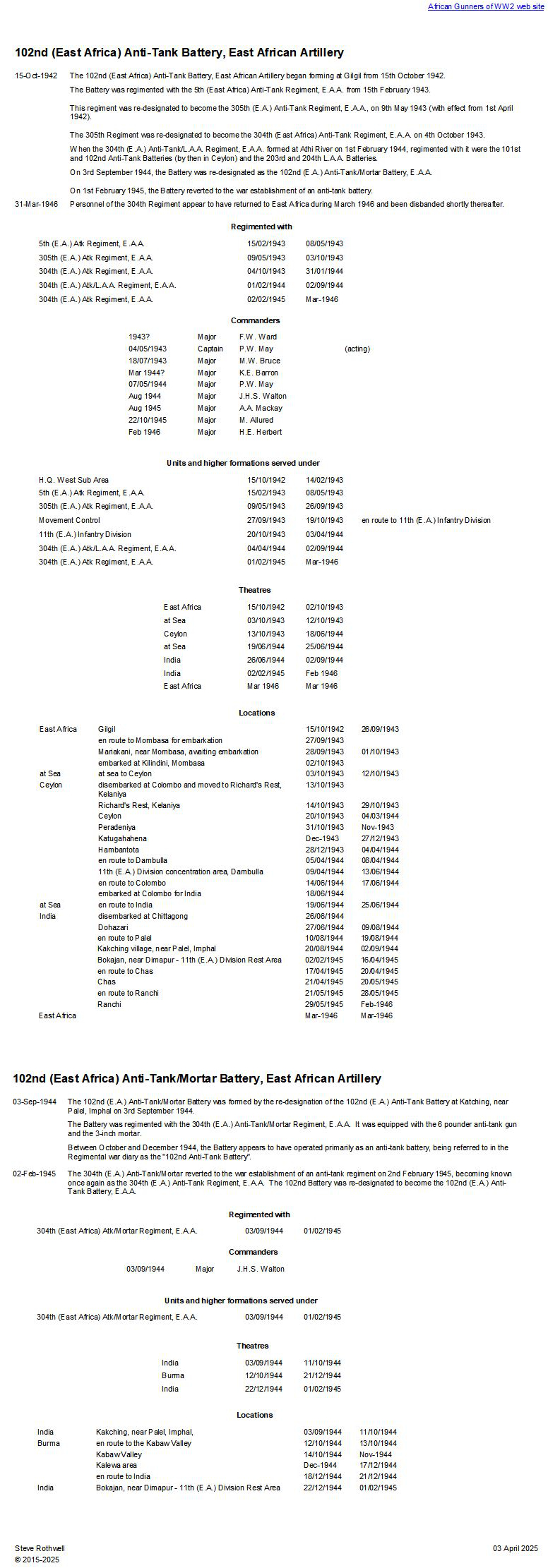
Summary history of the 102nd (East Africa) Anti-Tank- Anti-Tank/Mortar Battery
© Steve Rothwell
03 April 2025
[1] War diary 5th (E.A.) Anti-Tank Regiment, WO 169/14076
[2] WO 169/14076
[3] War diary 305th (E.A.) Anti-Tank Regiment, WO 169/14077
[4] WO 169/14077
[5] WO 169/14077
[6] WO 169/14077
[7] War diary 11th (E.A.) Infantry Division, WO 169/3985, WO 172/6484
[8] War diary 304th (E.A.) Atk/L.A.A. Regiment, WO 172/6522
[9] WO 172/6522
[10] WO 172/6522
[11] WO 172/6522
[12] WO 172/6522
[13] WO 172/6522; 304th (East Africa) Anti-Tank/Mortar Regiment, E.A.A., WO 172/6523
[14] WO 172/6523
[15] WO 172/6523
[16] WO 172/9470
[17] War diary 304th Anti-Tank Regiment, E.A.A., WO 172/9470
[18] WO 172/9470
[19] War diary 304th Anti-Tank Regiment, E.A.A., WO 172/11263
[20] War diary E.A. Artillery Depot & Training Centre, WO 172/24353