57th (East Africa) Field Battery, East African Artillery
57th (Dar-es-Salaam) Light Battery
Officers and personnel were first posted to form a new light battery at Larkhill on 30th March 1942. On 11th April, the Battery was advised that it was to be known as the 57th (Dar-es-Salaam) Light Battery, according to an order from the R.A. Depot dated 11th April 1942. Using guns borrowed from the R.A. Depot at Larkhill, training in gun drill began at the end of April. [1]
Six 3.7-inch howitzers were taken on strength in early May 1942. The Battery Commander, Major J.A. Stevens assumed command on 13th May. Major Stevens relinquished command of the Battery on 16th July on being posted to command of the 1st (E.A.) Field Regiment, E.A.A., under which the Battery was now regimented. Captain A. Cadbury assumed command of the Battery.[2]
The designation “Dar-es-Salaam” was apparently dropped from the Battery title at this time, coinciding with regimentation with the 1st (E.A.) Field Regiment, E.A.A.[3]
57th (E.A.) Light Battery, E.A.A.
During August 1942, the Battery, now at Gilgil, received the first 25-pounder field guns; four for ‘J’ Troop on 10th August; four for ‘I’ Troop on 25th August. The Battery continued to train and undertake fire practice using both the 3.7-inch and the new 25-pounder field guns. [4]
57th (E.A.) Field Battery, E.A.A.
In December 1942, the Battery was redesignated to become a field battery, coinciding with its despatch to Madagascar. On 14th December 1942, it left Gilgil for Madagascar. Together with the Regimental H.Q., it embarked the next day at Mombasa on board the S.S. Takliwa. It arrived at Joffreville on the island on 19th December. Two days later, the Battery took over the Joffreville area from the 55th (Tanganyika) Light Battery. The Battery became part of the 27th (Northern Rhodesia) Infantry Brigade Group. However, on 12th February 1943, the 56th (U) and 57th Field Batteries came under the direct command of the 1st (E.A.) Field Regiment and not as previously under the 27th (N.R.) Infantry Brigade.[5]
The Battery moved from Joffreville to Adrafiabe on 23rd April 1943. From 1st May, the Regiment was officially re-designated as the 301st (E.A.) Field Regiment, E.A.A. The Battery embarked for Mombasa on board the S.S. Kutsang on 29th May and went to Gilgil on arrival in Kenya. It moved to Naivasha on 22nd July. The Battery returned to Regimental command following the arrival at Gilgil in August of a skeleton R.H.Q. from Madagascar. The Battery remained at Naivasha under the 301st (E.A.) Field Regiment throughout the remainder of 1943.[6]
The 301st (E.A.) Field Regiment left Mombasa for Ceylon on board the ill-fated Khedive Ismail on 5th February 1944. The ship was sunk by a Japanese submarine on 12th February 1944 and most of the Regiment’s personnel were lost. The Regiment was not reformed and redesignated on 1st June 1944 to become the 309th (E.A) Field Regiment, E.A.A. - the 56th, 57th and 62nd batteries, were redesignated to become the 72nd, 73rd and 74th Field Batteries respectively.[7]
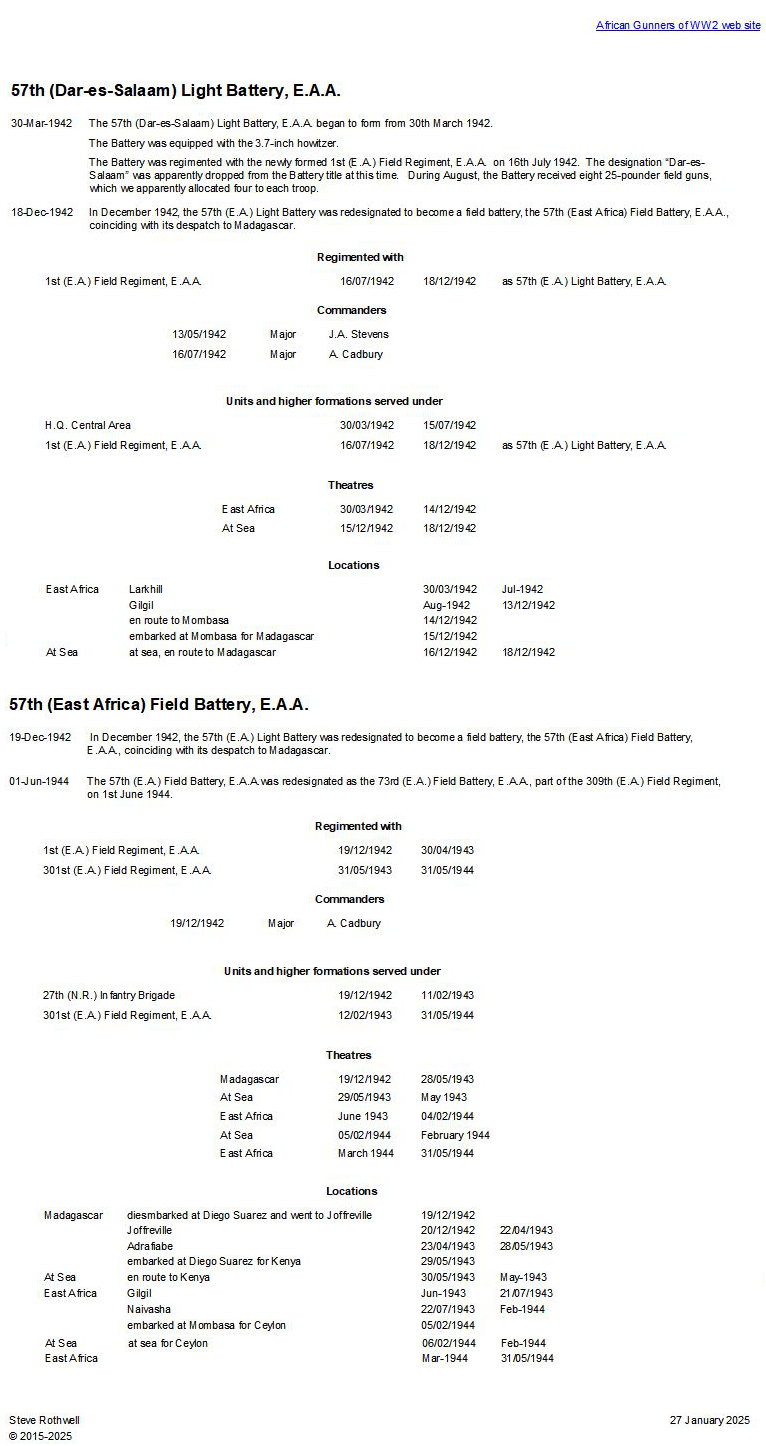
Summary history of the 57th (East Africa) Field Battery, E.A.A.
© Steve Rothwell
27 January 2025
[1] War diary 57th Light Battery, E.A.A., WO 169/7003; War diary 1st (E.A.) Field Regiment, E.A.A., WO 169/6995
[2] WO 169/7003
[3] WO 169/7003
[4] WO 169/7003
[5] WO 169/7003; WO 169/6995
[6] War diary 57th Light Battery, E.A.A., WO 169/14072; War diary 301st (E.A.) Field Regiment, E.A.A., WO 169/14067; War diary H.Q. Islands Area, WO 169/14038
[7] War Diary East Africa Command, WO 169/18210