60th (East Africa) Field Battery, E.A.A.
The 60th (East Africa) Field Battery, E.A.A. was formed at the E.A. Artillery Training Depot, Larkhill on 7th November 1942. British Officers and N.C.O.s were posted to the new unit that same day. Major P.E.G. Selby was the Commanding Officer. On 20th December, three hundred and seventy African recruits from Nyasaland arrived at the Training Depot to be posted to the 60th Battery.[1]
The Battery appears to have remained at Larkhill to continue formation and training until moving to Gilgil on 16th March 1943 to join the 2nd (E.A.) Field Regiment, E.A.A. (The Battery had been regimented with the 2nd Field Regiment on or just after 1st March 1943).[2]
The 2nd Field Regiment was re-titled on 1st May 1943 to become the 302nd (E.A.) Field Regiment, E.A.A. The Regiment, less the 60th Battery which remained at Gilgil to continue training, moved to Moshi on 31st May 1943, arriving on 3rd April, and by now under the command of the 11th (East Africa) Infantry Division.[3]
The 60th Battery arrived to join the Regiment at Moshi on 3rd September 1943. Between 27th and 29th September, the Regiment moved to Mariakani and then for Kilindini for embarkation for Ceylon between 2nd and 3rd October. The 302nd Regiment disembarked at Colombo on 12th October and moved to Mankulam. Here, on 19th October, Major J.S. Thompson assumed command of the Battery.[4]
The 60th Battery moved to Mulaittivu where it arrived on 11th November 1943. Having left Mulaittivu on 24th November, the Battery rejoined the Regiment at Hambantota on 28th November. The Regiment participated in several Exercises during December, returning to camp at Hambantota on 18th December. In May 1944, the 60th Battery was trained in the use of the 3-inch mortar.[5]
The Regiment embarked at Colombo for India on 31st May 1944 and disembarked at Chittagong on 8th June and moved to Dohazari. In August, the 11th (E.A.) Infantry division was ordered to pursue the Japanese down the Kabaw Valley. The Regiment was assigned to support the 25th (E.A.) Infantry Brigade whose task was to advance eastwards along the Sittaung track, and moved off on 5th August, less the 60th Battery. High waters on the Yu River held up the general advance for two days and during this time, the 60th Battery and the Rear R.H.Q. moved forward to join the Regiment near Moreh which was reached on 17th August. The next day, the Regiment moved onto the Sittaung track but it was 4th September before infantry of the Brigade reached Sittaung on the West bank of the Chindwin.[6]
The 302nd Regiment was now ordered to withdraw to support operations elsewhere, leaving the 60th Battery under command of the 25th Brigade. These orders took effect from 12th September 1944. There was now a pause in operations for the Regiment. The 60th Battery returned on 6th October and the Regiment prepared to join the main advance of the 11th (E.A.) Infantry Division down the Kabaw Valley to Kalemyo. The R.H.Q. with the 55th and 59th Batteries set off down the Tamu-Kalemyo Road on 13th October. The R.H.Q. and the 59th Battery were at Yazagyo on 23rd October. Here, the 54th Battery, 303rd (E.A.) Field Regiment, E.A.A. was placed under command of the 302nd Regiment due to the 60th Battery being delayed to the North by a ten-day road closure to allow for the rebuilding of the road following the cessation of the monsoon rains. The Regiment continued to move forward, and it was not until 12th November that the 60th Battery rejoined the Regiment. The Regiment crossed the Chindwin at Kalewa on 9th December and remained on the East bank until 22nd December when it recrossed the river to begin its return to India. Camp at Bokajan, near Dimapur, was reached on 29th December.[7]
The Regiment moved to the Chas area on 11th April 1945 before moving to Ranchi on 17th June. On 19th July, the 302nd Regiment became a holding unit and the 60th Battery was designated as the holding unit for European personnel eligible for East Africa leave until shipping became available. The 60th Battery was disbanded by 30th November 1945, on which date the R.H.Q., 302nd Regiment was absorbed within the H.Q.R.A., 11th (East Africa) Division, awaiting final disbandment.[8]
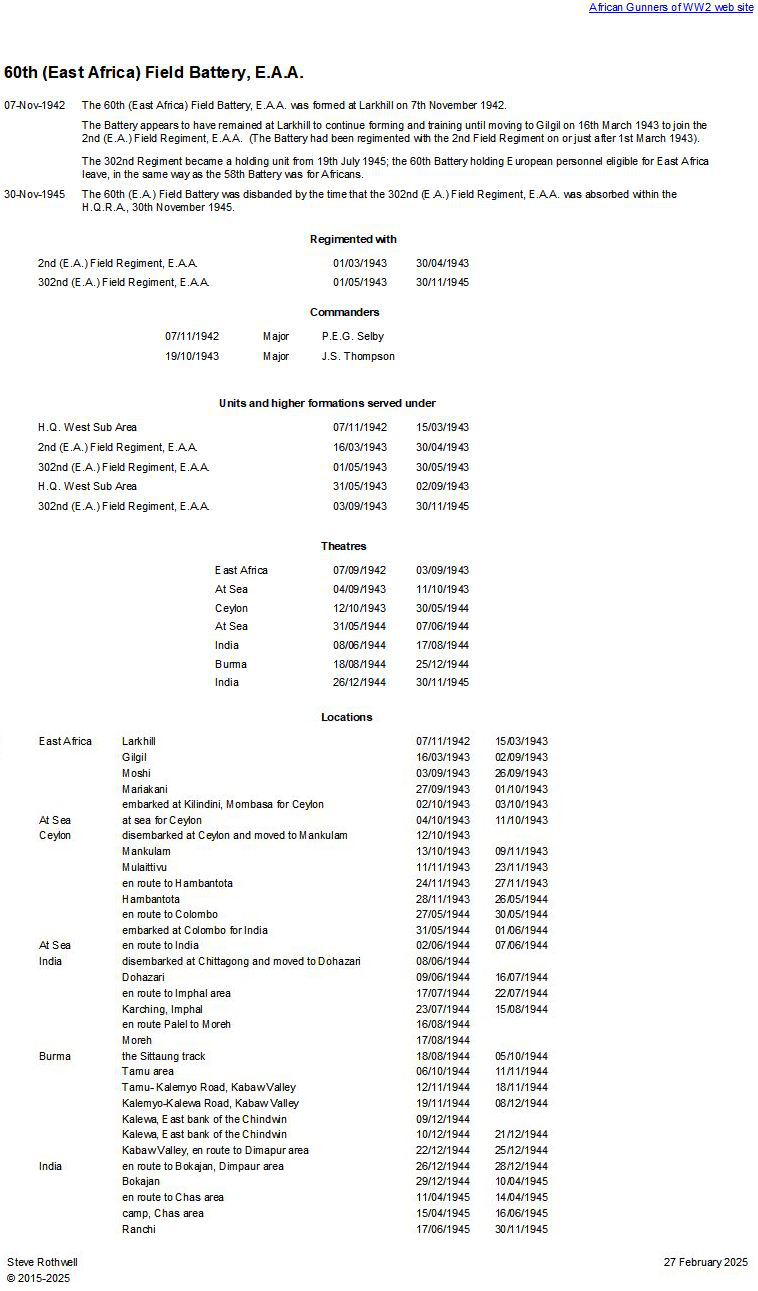
Summary history of the 60th (East Africa) Field Battery, E.A.A.
© Steve Rothwell
27 February 2025
[1] War diary 60th (E.A.) Field Battery, WO 169/7005; War diary East Africa Command, WO 169/6873
[2] WO 169/6873; War diary 2nd (E.A.) Field Regiment, E.A.A., WO 169/14068
[3] WO 169/14068
[4] War diary 2nd (E.A.) Field Regiment, E.A.A., WO 169/14068; War diary 11th (E.A.) Infantry Division, WO 172/3985; H.Q. Divisional Troops, Moshi, WO 169/14425
[5] War diary 2nd (E.A.) Field Regiment, E.A.A., WO 169/14068; War diary 11th (E.A.) Infantry Division, WO 172/3985; H.Q. Divisional Troops, Moshi, WO 169/14425; War diary 302nd (E.A.) Field Regiment, E.A.A., WO 172/4019; War diary 11th (E.A.) Infantry Division 'G' Branch, WO 172/6484
[6] WO 172/6625; “The War Against Japan, vol. IV”, Woodburn Kirby, S., H.M.S.O. (1965)
[7] WO 172/6625; Official History
[8] Official History; War diary 302nd (E.A.) Field Regiment, E.A.A., WO 172/9473; War diary 303rd (E.A.) Field Regiment, E.A.A., WO 172/9474