308th (East Africa) Field Regiment, E.A.A.
The 308th (E.A.) Field Regiment, E.A.A. converted from the 305th (E.A.) Anti-Tank Regiment, E.A.A. on 1st March 1944 at Gilgil. Regimented were the 70th and 71st Field Batteries converted from the 103rd and 104th (E.A.) Anti-Tank Batteries, and the 69th (East Africa) Field Battery, E.A.A. The Commanding Officer was Lt. Colonel J.C. Alexander.[1]
The Regiment soon moved to Larkhill where it remained until 14th July 1944 when it moved to Camp 20, Gilgil, the batteries arriving on subsequent consecutive days: the 69th on 15th July; the 70th on 16th July; the 71st on 17th July. Lt. Colonel Alexander relinquished command on 27th July and was succeeded by Lt. Colonel P.G.N. T-C-Worsley. During August, motor transport was received from the 306th (E.A.) Field Regiment, E.A.A. and the 69th and 70th Batteries undertook small arms practice firing at Naivasha.[2]
On 28th September 1944, a composite troop undertook at practice shoot with 25-pounders at Naivasha Artillery Ranges. This was the first time the Regiment had fired the 25-pounder. While the 69th and 70th Batteries underwent further practice firing with their 25-pounders in October, the 71st Battery undertook practice firing also but with its 3.7-inch howitzers. Lt. Colonel T-C-Worsley appears to have left during October and was replaced by Major F.G. Thompson.[3]
On 31st October 1944, the 71st Battery, now designated as a light battery, was regimented with the newly formed 310th (E.A.) Light Regiment, E.A.A. The 308th Regiment converted to a new war establishment of only two batteries. [4]
In January 1945, the Regiment remained at Gilgil, with regular visits to the ranges at Naivasha. On 8th February, the R.H.Q. and 69th Battery went to Moshi for exercises with the 29th (East African) Training Brigade. The 70th Battery followed on 14th February. The Regiment left Moshi on 5th March for Gilgil which was reached on 8th March. Major H.B. Folliott assumed command on 1st April and he was replaced on 11th May by Major T.St.G. Caulfield. However, this Officer was himself succeeded on 15th May by Major A.C.B. Hopewell. Lt. Colonel E.H.A. Jackson was posted to the Regiment on 15th June but did not take up the post, Major Hopewell remaining in temporary command.[5]
With the disbandment of the 310th (E.A.) Light Regiment, on 15th June 1945, the 71st (E.A.) Light Battery was redesignated as the 71st (E.A.) Field Battery and rejoined the Regiment. Lt. Colonel P.H.J. Tuck assumed command on 15th July.[6]
The Regiment prepared for disbandment during August 1945, handing over guns, stores and equipment to the Ordnance Depot and vehicles to the V.R.D.[7]
On 15th September 1945, the 308th (E.A.) Field Regiment, E.A.A. converted to become the 308th General Transport Battery and was attached to the 43rd (E.A.) General Transport Company for duty.[8]
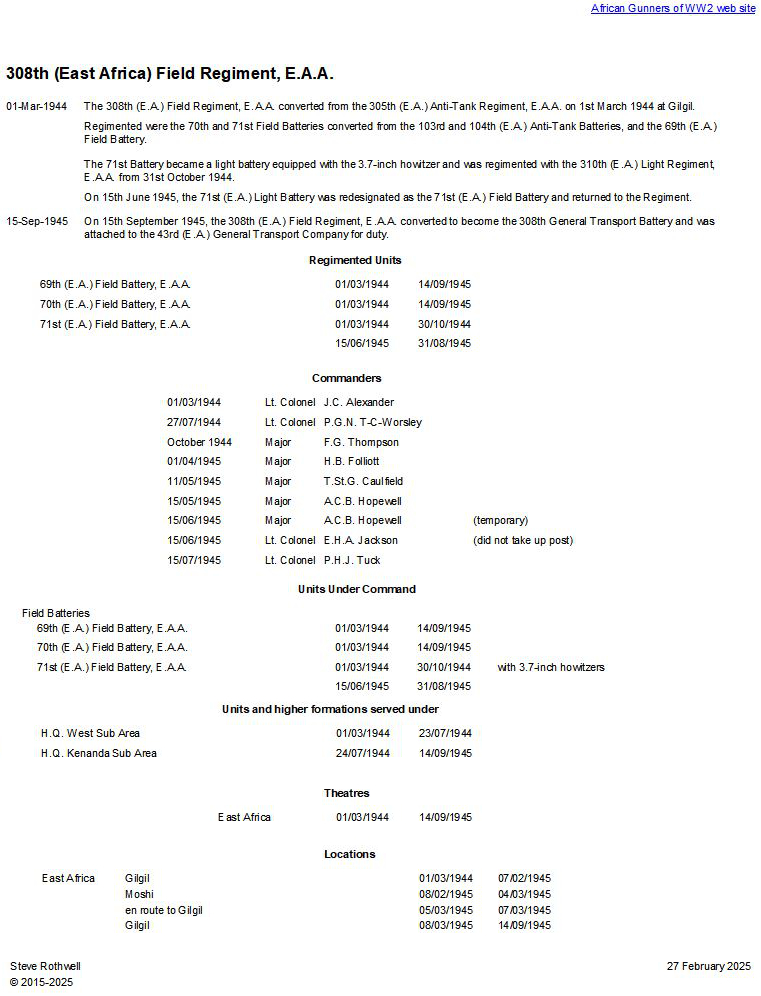
Summary history of the 308th (East Africa) Field Regiment, E.A.A.
© Steve Rothwell
27 February 2025
[1] War diary 105th (E.A.) Anti-Tank Battery, WO 169/18304; War diary 308th (E.A.) Field Regiment, WO 169/18302
[2] WO 169/18302
[3] WO 169/18302
[4] War diary 310th (E.A.) Field Regiment, WO 169/21786; War diary HQ RA East Africa Command, WO 169/21696
[5] War diary 308th (E.A.) Field Regiment, WO 169/21784
[6] WO 169/21784
[7] WO 169/21784
[8] War diary HQ RA East Africa Command, WO 169/21696