54th (Nyasaland) Field Battery - 54th (East Africa) Field Battery, E.A.A.
The 54th Field Battery was formed on 31st August 1941 and designated ‘Nyasaland’ given that many of the African gunners came from that country. This title was forever lost when the 162nd (East Africa) Field Regiment, R.A. was retitled to become the 303rd (E.A.) Field Regiment, E.A.A. on 30th April 1943. In India, on return from operations in Burma where it had been equipped with the 3.7-inch howitzer, the Battery became the 54th (East Africa) Light Battery, E.A.A. on 14th January 1945. It reverted to being a field battery on 19th July 1945, when it re-equipped with the 25-pounder gun.
54th (Nyasaland) Field Battery, E.A.A.
The 54th (Nyasaland) Field Battery, E.A.A. was formed on 31st August 1941 at the R.A. Depot, Larkhill, near Nairobi. Fifty-five Askaris from Zomba Training Centre, Nyasaland (Malawi) arrived at Larkhill on 29th August. The Commanding Officer, Captain Bingham, two other British Officers and two British N.C.O.s, together with three African N.C.O.s from the 53rd (E.A.) Light Battery were posted on 30th August. Individual training of the gun layers began on 1st September. During September, Lieutenant Powis collected stores and equipment for a four-gun 3.7-inch howitzer battery but on 30th September the Battery was instructed that it would expand to an eight-gun battery. However, when it went into action in Abyssinia, it was equipped with 25-pounder guns.[1]
Training continued and additional personnel were posted. In October 1941, fifty-one Askari from the 13th (Nyasaland) Battalion, King’s Africa Rifles joined the Battery. Major MacCarthy was attached to the Battey on 8th October. The Battery left Larkhill on 13th October to arrive at Kilindini, Mombasa on 14th October, where it embarked immediately and sailed for Mogadishu. Here, a British Sergeant and seventeen African gunners from the 53rd (E.A.) Light Battery joined before the ship sailed on, reaching Aden on 23rd October. Leaving Aden the next day, the ship went on to Massawa in Eritrea on 29th October where the personnel disembarked and moved to Asmara, to come under the command of the 12th (African) Infantry Division.[2]
At Asmara, the Battery trained, collected equipment and drew ammunition. A party took the gun tractors to Massawa on 11th November to collect the guns, which arrived the next day. The guns, 25-pounders, were unloaded on 12th November and taken to Asmara where they were made ready for active service. The Battery left Asmara on 14th November to take part in the action against the Italians at Gondar. On 18th November, the Battery was in action in support of the 26th (E.A.) Infantry Brigade. The main attack on Gondar went in on 27th November and the Battery fired seventy-six rounds in six minutes, after which the Italian defenders were seen to abandon their entire position. By the evening the battle was over.[3]
The Battery remained in the Gondar area and on 4th December 1941, Major MacCarthy left to return to Nairobi. On 16th December, the Battery left for embarkation at Massawa which was reached on 20th December. Part of the Battery embarked on H.M.T. Dunera on 22nd December, which sailed later that day, with the rest boarding H.M.T. Landaff Castle the next day. The ships reached Berbera on 26th December, where eight hundred Italian ‘political’ refugees were embarked, guarded by the Battery. The Dunera arrived at Mombasa on 31st December and Landaff Castle on 2nd January 1942. The personnel disembarked here and returned to Larkhill.[4]
The 54th Battery was attached to the 21st (E.A.) Infantry Brigade Group in January 1942, and by February had moved to Yatta Camp, Kenya, to join the Brigade Group. On 8th March, the Battery entrained with the Brigade Group for Kilindini, Mombasa where it embarked the next day for Ceylon. Sailing on 10th March, the personnel disembarked at Colombo on 21st March and went by rail to Anaradhapura. The Battery moved to a jungle camp on the Mullaitivu-Mankulam Road on 6th April. The Battery was regimented with the 162nd (East Africa) Field Regiment, R.A., formed on 20th April 1942.[5]
The Battery was equipped with 18/25-pounder guns at this time, given that on 2nd May these weapons were handed over to the 53rd (E.A.) Field Battery at Vavuniya and eight 25-pounders were taken over from the 51st Field Regiment, R.A. This resulted in a boost in morale, for it was the 25-pounder gun that the Battery had used at Gondar. The Battery went to the practice camp at Mannar on 11th May before returning to the jungle camp on 16th May.[6]
By 1st September, the Regiment was located near Elephant Pass, Mankulam. From here, the Regiment undertook training and took part in exercises for the remainder of the year and into 1943.[7]
On 30th April 1943 (with effect from 1st April 1943), the Regiment was redesignated as the 303rd (E.A.) Field Regiment, E.A.A. The 54th (Nyasaland) Field Battery, E.A.A. appears to have lost the title 'Nyasaland' with the redesignation of its parent regiment.[8]
54th (East Africa) Field Battery, E.A.A.
The 303rd (E.A.) Field Regiment, E.A.A. remained at Mankulam, Ceylon, as part of the 21st (E.A.) Infantry Brigade Group, with the 53rd and 54th Field Batteries. The Regiment came under command of the 11th (E.A.) Infantry Division, as Divisional Troops, on 4th July 1943.[9]
On 11th July 1943, the Regiment moved to Practice Camp at Mannar for training and fire practice. Returning to Mankulam on 16th August, it then left for Hambantota on 24th August to arrive on 26th August. The Regiment moved to Horana on 21st December.[10]
The Regiment moved to Hambantota for training on 6th February 1944. During the month, the 11th (E.A.) Infantry Division set out its intentions for amending the organisation, equipment and role of the Divisional Artillery to conform to the latest developments on the Burma front; the theatre of war which the Division was earmarked to enter in the future. The 303rd (E.A.) Field Regiment, at that time equipped with the 25-pounder field gun, would in future operate two Jeep-towed batteries of 3.7-inch howitzers (eight per battery) and one battery equipped with the 3-inch mortar. Then, at a conference with the H.Q. R.A. of the 11th (E.A.) Infantry Division on 6th May 1944, it was confirmed that the 302nd and 303rd Regiments were to be 25-pounder regiments with a reduced scale of transport, using 15cwt trucks as tractors. In the event, however, after arrival in India the Regiment was re-equipped with the 3.7-inch howitzer.[11]
Leaving Hambantota on 7th April, the Regiment arrived at the Divisional Concentration Area near Dambulla on 11th April to participate in exercises. [12]
The Regiment went to Colombo on 17th June 1944 to embark for India, sailing on 20th June, having handed in its 25-pounder guns and limbers prior to leaving camp. The men disembarked at Chittagong on 27th June and the next day moved to Dohazari. The Regiment moved to the Imphal area between 2nd and 9th August, the 11th (E.A.) Infantry Division now part of the XXXIII Indian Corps. Upon arrival at Kaching, near Palel on 10th August, the Regiment took receipt of twenty-four 3.7-inch howitzers. However, the Regiment continued to be designated a field regiment until January 1945.[13]
The 11th (E.A.) Infantry Division was now ordered to pursue the retreating Japanese down the Palel-Tamu Road to the Chindwin, and down the Kabaw Valley which runs North-South parallel to the Chindwin to the East. The 303rd Regiment began leaving Kaching on 11th September 1944 to reach Tamu by 26th September. The Regiment moved to Moreh on 2nd October. The Regiment moved to Yazagyo, leaving Khampat on 12th October and arriving on 14th October, with the 54th Battery arriving on 16th October. The Regiment now came into action in support of the infantry of the 25th and 26th (E.A.) Infantry Brigades.[14]
On 31st October 1944, the Regiment moved forward, with the 58th Battery coming into action just North of Nanhannwe. The R.H.Q. with the 53rd Battery arrived there the next day and on 2nd November, the 53rd and 58th Batteries moved to the Honnaing area where they were soon joined by the 54th Battery. On 9th November, the Regiment switched to support the attack on Indainggyi. This was followed by the capture of Kalemyo on 14th November and the Regiment moved to Indainggyi on 21st November and on to the Kalemyo-Kalewa road. Moving along the road, the Regiment came into action at Natkyigon on 24th November as it continued to support the advance on Kalewa, reaching Chaunggyin on 30th November and Thitchauk on 4th December. The infantry entered Kalewa later that day.[15]
Later that month, The Regiment prepared to withdraw with the 11th (E.A.) Infantry Division into 14th Army reserve and left Kalewa on 19th December. The rest camp at Bokajan, near Dimapur, was reached on 23rd December.[16]
54th (East Africa) Light Battery, E.A.A.
At Bokajan on 14th January 1945, the title of the Regiment was amended and it became the 303rd (E.A.) Light Regiment, E.A.A., with effect from 1st January. The 54th Battery became a light battery.[17]
On 9th April 1945, the Regiment left Bokajan for Chas by rail, arriving on 13th April. It moved to Dhipatoli, near Ranchi, arriving on 24th May. The Regiment left Chas in May 1945 on 23rd May to arrive at the new camp at Dhipatoli, near Ranchi, the next day.
On 19th July 1945 the 303rd Regiment was redesignated as a field regiment, equipped with 25-pounder guns. The 54th Battery became a field battery once again.[18]
54th (East Africa) Field Battery, E.A.A.
On 19th July 1945 the 303rd Regiment was redesignated as a field regiment, equipped with 25-pounder guns. The 54th Battery became a field battery once again.[19]
On 2nd September 1945, the Regiment moved to Chas.[20]
The Regiment left for Bombay for embarkation to East Africa on 9th January 1946. Arriving on 13th January, the men went to a transit camp at Kalyan before embarking on a ship on 21st January and sailing later that day. The men disembarked at Mombasa on 29th January and entrained for Athi River, arriving the next day. During February, the African Other Ranks were released from service and the Regiment was disbanded on 31st March 1946.[21]
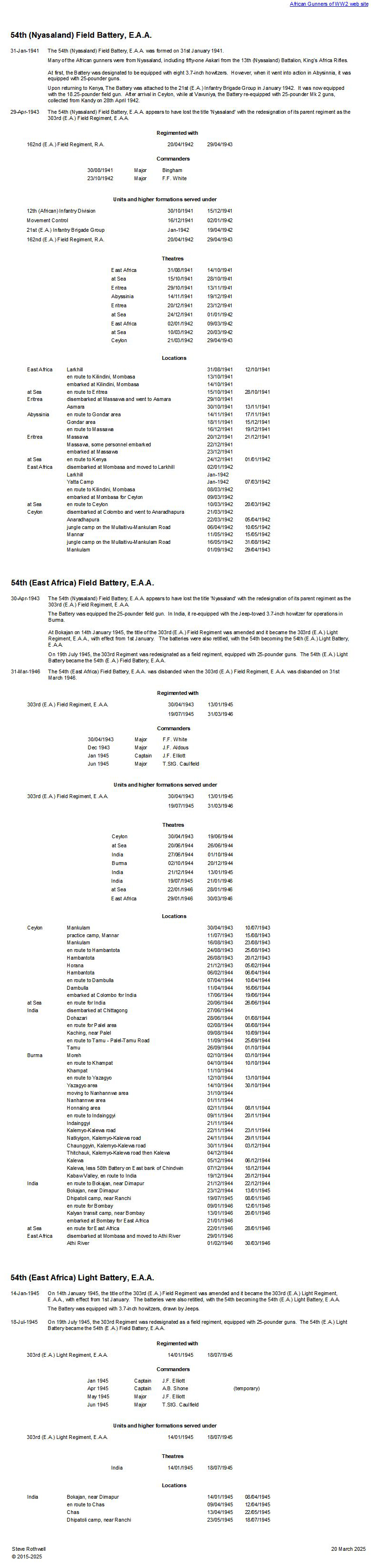
Summary history of the 54th (Nyasaland) Field Battery - 54th (East Africa) Field/Light Battery, E.A.A.
© Steve Rothwell
14 March 2025
[1] War diary 54th (Nyasaland) Light Battery, E.A.A., WO 169/2980
[2] WO 169/2980
[3] WO 169/2980
[4] WO 169/2980; http://www.convoyweb.org.uk/; War diary East Africa Command, WO 169/6872
[5] War diary 54th (Nyasaland) Light Battery, E.A.A., WO 172/1680; War diary 162nd (E.A.) Field Regiment, R.A., WO 172/1679
[6] WO 172/1680; WO 172/1679
[7] WO 172/1679; War diary 162nd (E.A.) Field Regiment, R.A., WO 172/4018
[8] WO 172/4018
[10] WO 172/4020
[11] War diary 303rd (E.A.) Field Regiment, E.A.A., WO 172/6526; War diary 11th (E.A.) Infantry Division 'G' Branch, WO 172/6484
[12] WO 172/6526
[13] WO 172/6526
[14] WO 172/6526; Official History
[15] WO 172/6526; Official History
[16] WO 172/6526; Official History
[17] War diary 303rd (E.A.) Field Regiment, E.A.A., WO 172/9474
[18] WO 172/9474
[19] WO 172/9474
[20] WO 172/9474
[21] War diary 303rd (E.A.) Field Regiment, E.A.A., WO 172/11264, WO 169/24350