1st – 301st (East Africa) Field Regiment, E.A.A.
The 301st (E.A.) Field Regiment, E.A.A. began life as the 1st (E.A.) Field Regiment, E.A.A. When the 1st Regiment was allocated to the Divisional Artillery of the 11th (E.A.) Infantry Division in May 1943, it was renumbered to become the 301st Regiment.
1st (East Africa) Field Regiment, E.A.A.
The 1st (East Africa) Field Regiment, E.A.A. formed at the Royal Artillery Depot at Larkhill, Kenya on 16th July 1942. Regimented was the 57th (Dar-es-Salaam) Field Battery, E.A.A. The commanding Officer was Lt. Colonel J.A. Stevens.[1]
The Regimental H.Q. together with the 57th Battery moved to Gilgil on 5th August 1942. At this time, the 57th Battery was equipped with 3.7-inch howitzers (one troop) but on 20th August it took over a troop of 25-pounders. The 58th (E.A.) Battery arrived at Gilgil to join the Regiment on 6th September.[2]
Between 27th April and 26th December 1942, the 56th (Uganda) Battery formed part of the 22nd (East Africa) Infantry Brigade Group. It moved to Madagascar with the Brigade Group, arriving in June.[3]
Orders were received from the H.Q. R.A. East Africa Command on 21st November 1942 concerning the regimentation of batteries between the 1st and 2nd (E.A.) Field Regiments:
- 1st (E.A.) Field Regiment 56th and 57th Batteries,
- 2nd (E.A.) Field Regiment 55th, 58th and 59th Batteries.[4]
The 58th (U) Field Battery left Gilgil on 16th December 1942 and arrived at Moshi three days later. Upon arrival, the Battery appears to have come under the command of the 25th (East Africa) Infantry Brigade. The Battery appears to have been de-regimented from the 2nd (E.A.) Field Regiment from 1st February 1943.[5]
The 57th Battery was ordered to relieve the 55th Battery at Diego Suarez, Madagascar between 1st and 7th December, with the R.H.Q., 1st (E.A.) Field Regiment to follow shortly after. In preparation for the move, the R.H.Q. moved to Larkhill on 27th November where it was brought up to establishment in terms of personnel and equipment. Motor transport would not be issued to the R.H.Q. until its arrival in Madagascar. The R.H.Q. entrained for Mombasa at Larkhill on 14th December, joining the 57th Battery which had entrained at Gilgil. The R.H.Q. with the 57th Battery embarked at Mombasa on board the S.S. Takliwa on 15th December and sailed later that day. The ship arrived at Deigo Suarez on 19th December where the 57th Battery disembarked. With the 55th Battery embarked on the Takliwa for the return to Kenya, the ship sailed on 23rd December and arrived at Tamatave two days later where the R.H.Q. disembarked and came under the command of H.Q. Islands Area. On 4th December, the 56th Battery was regimented with the 1st (E.A.) Field Regiment.[7]
On 1st January 1943, the Regimental H.Q. was at Tamatave. The 56th (E.A.) Field Battery at Fianarantsoa, as part of the 22nd (E.A.) Infantry Brigade Group, and the 57th (E.A.) Field Battery at Joffreville, south of Diego Suarez as part of the 27th (Northern Rhodesia) Infantry Brigade Group. The R.H.Q. moved to Ambatolampy between 11th and 18th January.[8]
The Regiment was informed on 27th January 1943, that its third battery would be the 62nd (E.A.) Field Battery, E.A.A., at that time forming at the E.A.A. depot in Kenya. On 12th February, the 56th (U) and 57th Field Batteries came under the direct command of the 1st (E.A.) Field Regiment and not as previously under the 27th (N.R.) Infantry Brigade. The 56th Battery moved to Ricemills Camp, Ambatolampy on 12th April.[9]
The Regiment was now allocated to become part of the Divisional Artillery of the 11th (E.A.) Infantry Division and appears to have been redesignated as the 301st (E.A.) Field Regiment, E.A.A. from 1st May 1943 [but was still referred to as the 1st (E.A.) Field Regiment when on 17th May it was listed as forming part of the Divisional Artillery, 11th (E.A.) Infantry Division].[10]
301st (East Africa) Field Regiment, E.A.A.
The Regiment moved to the area of Tamatave (Taomasina), arriving on 16th June 1943. It remained here, with elements at Andrafiabe, Diego Suarez until July when elements left for Kenya. Meanwhile, the 62nd Battery, formed on 20th January 1943, completed training at Larkhill, Kenya and moved to Naivasha on 22nd July.[11]
The 57th Battery moved from Joffreville to Andrafiabe on 23rd April 1943 and embarked for Mombasa on board the S.S. Kutsang on 29th May, moving to Gilgil on arrival in Kenya and later, on 22nd July, moving to Naivasha. On 19th July 1943, at Tamatave, the “Sea Parties” of the R.H.Q. and 56th Battery embarked for Mombasa and sailed for Kenya. The 56th Battery “sea party” arrived at Mombasa on 24th July and went to Naivasha, arriving on 27th July. Lt. Colonel Stevens ran a ‘skeleton’ H.Q. at Gilgil while the R.H.Q. proper remained in Madagascar until August. On 4th August the “road parties” of the R.H.Q. and the 56th Battery embarked at Diego Suarez, arriving at Mombasa on 10th August and disembarked the next day. These elements moved to Naivasha on 12th August, coming under the command of H.Q. West Sub Area (for administration and intelligence). Here the Regiment came under the command of the 11th (E.A.) Infantry Division, or at least of the Division’s rear headquarters – the Division itself having moved to Ceylon in June. The Regiment remained at Naivasha throughout the remainder of 1943, with occasional forays to training or exercise camps.[12]
Under the command of the H.Q. Divisional Troops, in December 1943 the Regiment began finalising preparations for departure to Ceylon as the 11th Division’s “fourth flight”.[13]
The 301st (E.A.) Field Regiment left Mombasa for Ceylon on board the ill-fated Khedive Ismail on 5th February 1944. En route the ship was sunk by a Japanese submarine on 12th February 1944. The regiment lost most of its personnel and was not reformed, the survivors being absorbed into other regiments. The Headquarters, 301st (E.A.) Field Regiment, E.A.A. was redesignated to become the H.Q. 309th (E.A.) Field Regiment, E.A.A. on 1st June 1944. The 301st Regiment’s batteries, the 56th, 57th and 62nd, were redesignated to become the 72nd, 73rd and 74th Field Batteries respectively. The 301st Field Regiment was replaced in the division’s order of battle by the: 306th (E.A.) Field Regiment, E.A.A. (H.Q., 63rd (East Africa), 64th (East Africa) and 65th (East Africa) Field Batteries, E.A.A.). The 306th Field Regiment joined the division on 7 October 1944.[14]
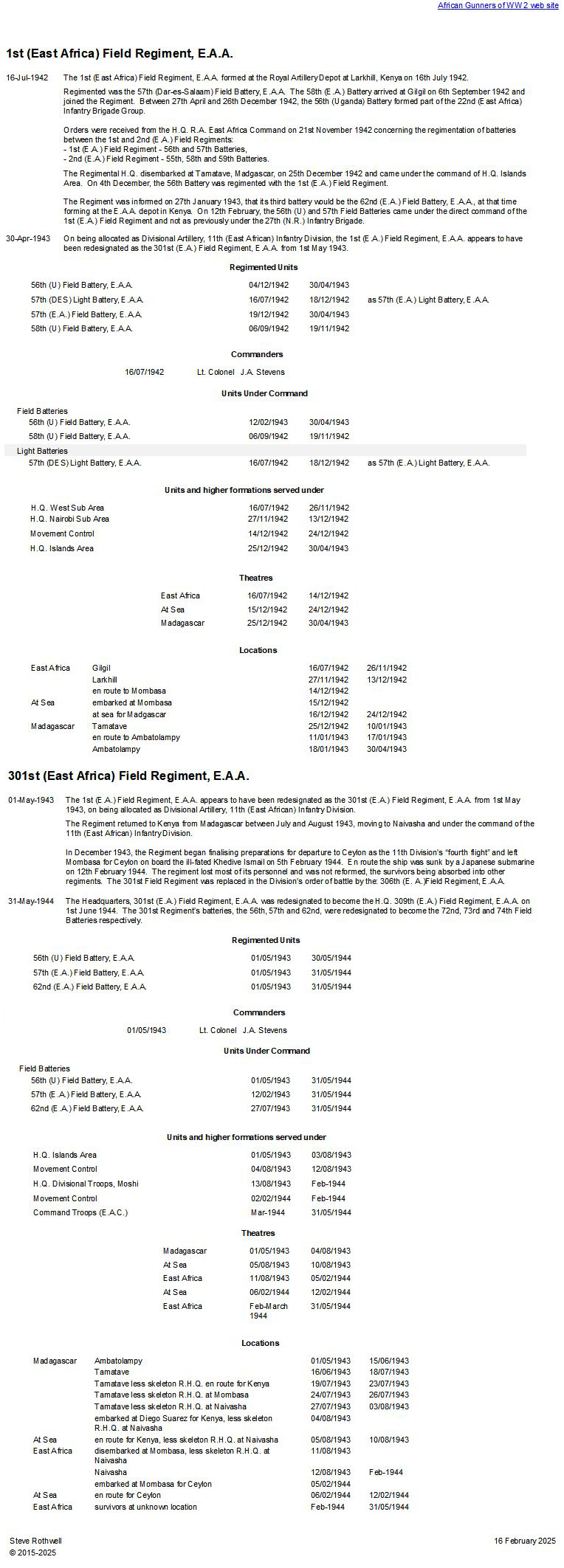
Summary history of the 1st-301st (E.A.) Field Regiment, E.A.A.
© Steve Rothwell
15 February 2025
[2] WO 169/6995
[3] Joslen
[4] WO 169/6995
[5] War diary 58th (U) Field Battery, E.A.A., WO 169/7004; War diary 58th (U) Field Battery, E.A.A., WO 169/14073; War diary 2nd (E.A.) Field Regiment, E.A.A., WO 169/6996
[6] Joslen; War diary 2nd (E.A.) Field Regiment, E.A.A., WO 169/14068
[7] WO 169/6995; War diary H.Q. Islands Area, WO 169/6955; War diary 56th (Uganda) Field Battery, E.A.A., WO 169/7002
[8] War diary 301st (E.A.) Field Regiment, E.A.A., WO 169/14067; War diary H.Q. Islands Area, WO 169/14036
[9] WO 169/14067
[10] WO 169/14067; War diary 11th (E.A.) Infantry Division, WO 172/3985; War diary H.Q. Islands Area, WO 169/14038
[11] WO 169/14067
[12] WO 169/14067; WO 169/14038
[13] War diary H.Q. Divisional Troops, Moshi; WO 169/14425
[14] War Diary East Africa Command, WO 169/18210