55th (Tanganyika) Light Battery - 55th (East Africa) Field Battery, E.A.A.
The 55th Field Battery was formed as a light battery equipped with the 3.7-inch howitzer on 3rd August 1941 and designated ‘Tanganyika’ given that many of the African gunners came from that country. The Battery became a field regiment when it re-equipped with the 25-pounder gun on 8th January 1943 and lost the title ‘Tanganyika’ from 1st July 1943, becoming the 55th (East Africa) Field Battery, E.A.A.
55th (Tanganyika) Light Battery
The 55th (Tanganyika) Field Battery, E.A.A. was formed at the R.A. Depot, Larkhill, Kenya on 3rd August 1941. Major G.B. Loveluck was the Battery Commander, however he relinquished command on 31st August.[1]
During September and October 1941, the Battery was brought up to war establishment and began training during December.[2]
Captain A.F. Morrison joined on 19th January 1942 and assumed temporary command of the Battery. Training continued and on 16th February, Major Loveluck returned from leave and attachment to East Africa Command Headquarters to reassume command. The Battery moved to Lusaka, within the area controlled by H.Q. Southern Area, leaving Larkhill on 7th April and arriving on 29th April. The Battery came under the command of the 27th (Northern Rhodesia) Infantry Brigade from 24th April. Between 16th and 19th May the Battery was once again on the move, to the Mrewa training area, near Salisbury, Southern Rhodesia. From 2nd June, the Battery undertook training with the 27th (Northern Rhodesia) Infantry Brigade. It left for Lusaka on 18th June, arriving on 21st June. [3]
The Battery moved with the Brigade by rail to Pietermaritsurg, South Africa between 5th and 11th July 1942. On 18th July, ‘H’ Troop and the Battery Signallers left to embark at Durban and disembarked at Diego Suarez on 29th July, moving to camp at Orangea. On 2nd August, Battery H.Q. with ‘G’ Troop left for Durban where it embarked on the H.M.T. Nieuw Amsterdam and sailed the next day for Madagascar.[4]
The Battery H.Q. and ‘G’ Troop arrived at Diego Suarez on arrival of the ship on 8th August 1942 and disembarked the next day. Moving to Orangea, where ‘H’ Troop was encamped, the Battery was complete. The Battery moved to Joffreville on 18th September. The Battery remained in the Joffreville area until 23rd December when it embarked at Antsirane on board the H.M.T. Takliwa for Kenya. The ship docked at Mombasa on 29th December and the personnel disembarked the next day to move to Nyali Details Camp.[5]
The Battery entrained at Mombasa for Gilgil on 2nd January 1943, arriving at its destination the following day where it came under command of its parent unit, the 2nd (E.A.) Field Regiment, E.A.A. The Battery had been regimented with the 2nd Field Regiment from 21st November 1942 whilst on operations in Madagascar.[6]
On 8th January 1943, the Battery exchanged its 3.7-inch howitzers for new 25-pounder field guns and from this date was referred to as the 55th (Tanganyika) Field Battery, E.A.A.[7]
55th (Tanganyika) Field Battery, E.A.A.
From mid-May 1943, the 2nd Field Regiment was redesignated to become the 302nd (E.A.) Field Regiment, E.A.A., part of the Divisional Artillery of the 11th (E.A.) Infantry Division. The 55th Battery trained at Gilgil, moving to Naivasha on 28th March, returning to Gilgil on 2nd April. The Battery was back at Naivasha between 5th-8th April and again between 12th April-1st May.[8]
On 2nd May 1943, Major D.P. Castell assumed command of the Battery. The Battery left Gilgil with the 302nd Field Regiment on 31st May for the 11th (E.A.) Division concentration area at Moshi, Tanganyika where it arrived on 3rd June.
55th (East Africa) Field Battery, E.A.A.
From 1st July 1943, the Battery lost the title ‘Tanganyika’ and became the 55th (East Africa) Field Battery, E.A.A.[9]
The Battery trained at Moshi until late-September 1943. On 28th September, it left with the Regiment for the transit camp at Marikani on the first leg of the journey to Ceylon.[10]
The Regiment moved to Kilindini, Mombasa by rail on 3rd October 1943 and boarded the H.M.T. Ascania. The ship sailed later that day and arrived at Colombo in the early evening of 12th October. The 55th Battery disembarked the next day and with the R.H.Q. and the 59th Battery moved to camp at Mankulam. The Regiment left for Hambantota on 9th November which was reached on 12th November. Here, the Battery took part in several exercises with the infantry of the 11th (E.A.) Infantry Division.[11]
By May 1944, the Regiment was at Dambulla. It left the area on 27th May to arrive at Colombo for embarkation on board the S.S. Navasa on 31st May. The ship sailed for Chittagong on 2nd June where the personnel disembarked on 8th June, moving to camp at Dohazari that evening. The Regiment left for Assam on around 14th June, to arrive at Karching (Kakching) on 23rd June. From 1st August, the Regiment was briefly attached to the 23rd (Indian) Infantry Division before returning to the 11th (E.A.) Infantry Division on 7th August. The Division was now in pursuit of the retreating Japanese into the Kabaw Valley. The 302nd Regiment was assigned in support of the 25th (E.A.) Infantry Brigade whose task was to advance eastwards along the Sittaung track. The 55th Battery moved to the Palel-Tamu Road on 15th August and was in the Tamu-Sittaung area by the Chindwin River by 1st September. On 19th September, Major R.A. English assumed command of the Battery.[12]
The 302nd Regiment next joined the main advance of the 11th (E.A.) Infantry Division down the Kabaw Valley to Kalemyo. The R.H.Q. with the 55th and 59th Batteries set off down the Tamu-Kalemyo Road on 13th October 1944 and reached Khampat on the evening of 17th October. A further advance saw the Regiment reach Yazagyo on 23rd October. From here, on 31st October it moved further South, still in support of the 25th (E.A.) Infantry Brigade. The Regiment provided support for the capture of Kalemyo and then the advance by the 25th Brigade to Kalewa, which was taken on 2nd December. The 55th Battery crossed the Chindwin on 10th December, joining the Regiment which had crossed the previous day.[13]
Its task complete, the 11th (E.A.) Infantry Division was now withdrawn into 14th Army reserve. The 302nd Regiment withdrew from Burma to India to camp at Bokajan, near Dimapur from 29th December 1944. Major English left on repatriation on 11th March, being succeeded as Battery commander by Major D.E.A. Pettit. On 11th April 1945, the 55th Battery moved with the Regiment to the Chas-Purulla area, arriving on 15th April. The Regiment moved to Ranchi on 17th June where on 19th July, the 55th Battery was transferred to the 303rd (E.A.) Field Regiment, E.A.A. upon the redesignation of the 302nd Regiment as a holding unit. The 303rd Regiment had served as a light regiment from 1st January 1945 and on 19th July reverted to being a field regiment. Exchanging its 3.7-inch howitzers for 25-pounders received from the 302nd Regiment.[14]
The 55th Battery remained at Dhipatoli Camp, Ranchi, undertaking training and on exercise. It moved with the Regiment to Chas on 2nd September 1945 and returned to Ranchi, to Kojatoli Camp on 20th October. On 9th January 1946, the 303rd Regiment left Ranchi for embarkation at Bombay. Arriving on 13th January, the men detrained at Kalyan and went to the transit camp. Embarkation at Bombay took place on 21st January and the ship sailed for East Africa the next day.[15]
The Regiment disembarked at Mombasa on 29th January 1946 and moved to the E.A. Artillery Depot at Athi River, arriving the next day. During February, many African gunners left on leave or on release from service. The 55th Battery is assumed to have disbanded with the 303rd Regiment by 30th April 1946.[16]
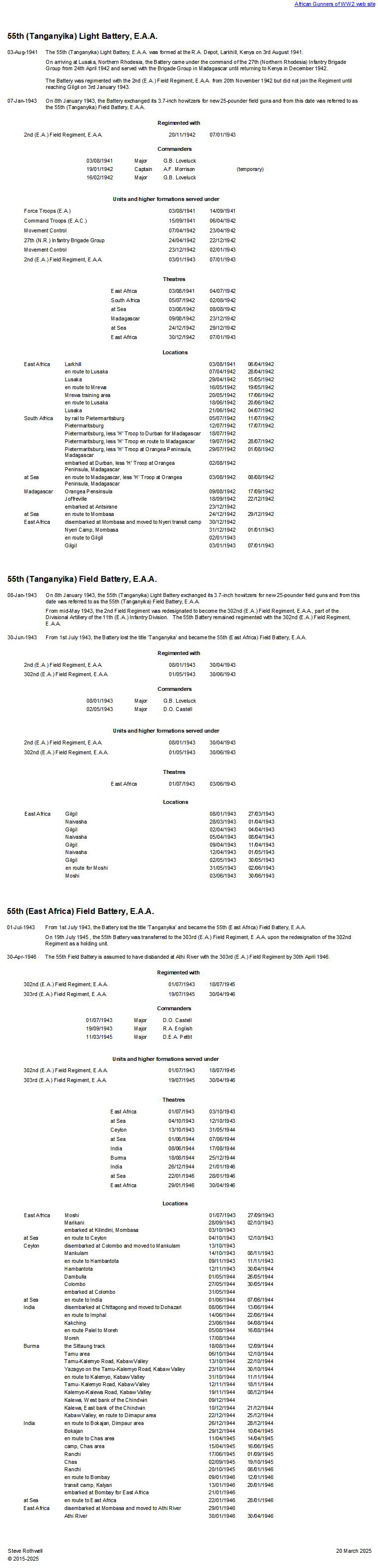
Summary history of the 55th (Tanganyika) Light Battery - 55th (East Africa) Field Battery, E.A.A.
© Steve Rothwell
20 March 2025
[1] War diary 55th (Tanganyika) Field Battery, E.A.A., WO 169/2981
[2] WO 169/2981
[3] War diary 55th (Tanganyika) Field Battery, E.A.A., WO 169/7000
[4] WO 169/7000
[5] War diary 55th (Tanganyika) Field Battery, E.A.A., WO 169/7000
[6] War diary 55th (Tanganyika) Field Battery, E.A.A., WO 169/14070
[7] WO 169/14070
[8] WO 169/14070
[9] WO 169/14070
[10] WO 169/14070; War diary 302nd (E.A.) Field Regiment, E.A.A., WO 169/14068; War diary 302nd (E.A.) Field Regiment, E.A.A., WO 172/4019
[11] WO 172/4019
[12] War diary 302nd (E.A.) Field Regiment, E.A.A., WO 172/6625; “The War Against Japan, vol. IV”, Woodburn Kirby, S., H.M.S.O. (1965)
[13] WO 172/6625; Official History
[14] Official History; War diary 302nd (E.A.) Field Regiment, E.A.A., WO 172/9473; War diary 303rd (E.A.) Field Regiment, E.A.A., WO 172/9474
[15] WO 172/9473; WO 172/9474; War diary 303rd (E.A.) Field Regiment, E.A.A., WO 172/11264
[16] WO 172/11264