56th (Uganda) Field Battery, E.A.A.
The 56th (Uganda) Field Battery was authorised on 3rd August 1941 and commenced formation at the R.A. Depot at Larkhill, Kenya. Captain D.C. MacGrath was posted to command the Battery on 10th September but relinquished command on 7th October, being succeeded by Major W.W. MacKinlay. During this time the Battery was took on African gunners, signallers and drivers, achieving a total of 184 African all ranks by 3rd November. Six junior British Officers and eleven British N.C.O.s joined the Battery on 31st December.[1]
Eight 25/18-pounder field guns arrived with the Battery by rail from Kijabe on 8th January 1942 and were taken over by the Battery for training. However, the guns were sent for overhaul on 13th January. Four 25-pounder Mk II guns were then issued for training on 20th January. An addition four 25-pounders were received on 11th February. By now, the Battery was formed on ‘E’ and ‘F’ Troops.[2]
The Battery moved to Nakuru on 25th February 1942 for practice firing. The Battery returned to Larkhill on 2nd March and continued training until moving to Yatta Camp on 27th April where it was attached to the 22nd (E.A.) Infantry Brigade Group. The Battery was confirmed as being under command of the Brigade Group on 16th May and made preparations for deployment to Madagascar.[3]
The Battery left Yatta on 1st June 1942 and the next day embarked upon the Polish ship Sobieski. The ship sailed on 3rd June and arrived in Diego Suarez Bay on 6th June. The Battery disembarked at Orangea Peninsula on 8th June, with a total strength of 315 all ranks.[4]
By 14th June 1942, the Battery was ready for action at Orangea. On 22nd June, four French 75mm guns were handed to the Battery to form a third troop for defensive fire. The Battery was placed under the command of the 9th Field Regiment, R.A. for operational purposes and the 22nd (E.A.) Infantry Brigade Group for administration on 2nd July. The 9th Field Regiment was itself under the command of the Brigade Group.[5]
The Advance Party of the 55th (Tanganyika) Light Battery arrived on 30th July 1942 and the French 75mm guns were handed over to the incoming battery the next day. The 56th Battery left Orangea for Joffreville on 7th August, arriving the next day.[6]
On 10 September 1942, the 29th Infantry Brigade and the 22nd (E.A.) Infantry Brigade Group made an amphibious landing at Majunga, a port on the west coast of Madagascar. The 56th Battery left Joffreville on 3rd September for the embarkation port at Antsirane, which was reached the next day. Embarkation took place on 8th September and the next day the ship carrying the Battery joined the convoy carrying the 29th Brigade. This brigade conducted an assault landing on 9th September but the 56th Battery personnel did not disembark until 13th September and began to disembark its vehicles. However, only one gun was disembarked, on 23rd September, and this for training purposes only. Finally, all guns and vehicles were disembarked on 25th September. The Battery moved forward from Majunga on 30th September to reach Tananarive on 4th October.[7]
The Battery moved to Antsirabe on 6th October 1942 to support the 22nd (E.A.) Infantry Brigade Group. It moved to Ilaka on 10th October and on to Ambositra between 14th and 15th October. It was at Amparihimah Itsy from 24th October until 27th October when it left the next day for Ambatavao. Fianarantsoa was reached on 30th October where the Battery remained throughout November and December until, less ‘F’ Troop, it moved to a jungle warfare camp on 16th December. On 4th December, the 56th Battery was regimented with the 1st (E.A.) Field Regiment, E.A.A. Battery H.Q. and ‘E’ Troop returned to Fianarantsoa on 31st December. ‘F’ Troop, which had been detached to Tananarive to fire a salute in honour of the Governor-General, General Legentilhomme, returned to the Battery on 14th January 1943.[8]
On 12th February 1943, the 56th (U) and 57th Field Batteries came under the direct command of the 1st (E.A.) Field Regiment and not as previously advised under the 27th (N.R.) Infantry Brigade.[9]
On 16th February 1943, the Battery left Fianarantsoa for the range at Ambatolampy which was reached the next day. Leaving on 21st February, the Battery arrived once again at Fianarantsoa on 25th February. The two Troops were renamed as ‘A’ and ‘B’ Troops on 10th March. The Battery returned to Ambatolampy, staying at Ricemills Camp, on 12th April and left there on 1st May for the Jungle Warfare Camp which was reached two days later. Leaving the Camp on 8th May, the Battery made its way back to Ambatolampy, arriving on 13th May. The 1st Regiment was retitled on 1st May 1943 to become the 301st (E.A.) Field Regiment, E.A.A.[10]
The Battery began preparations for the return to Kenya from late May 1943. The vehicles of ‘A’ Troop, the “road party”, left for Diego Suarez on 13th June, followed the next day by those of Battery H.Q. and ‘B’ Troop. Personnel left by rail for Tamatave on 15th June where they remained, awaiting embarkation, until July.[11]
On 19th July 1943, at Tamatave, the “Sea Parties” of the R.H.Q. and 56th Battery embarked for Mombasa and sailed for Kenya. The 56th Battery “sea party” arrived at Mombasa on 24th July and went to Naivasha, arriving on 27th July. Lt. Colonel Stevens ran a ‘skeleton’ H.Q. at Gilgil while the R.H.Q. proper remained in Madagascar until August. On 4th August the “road parties” of the R.H.Q. and the 56th Battery embarked at Diego Suarez, arriving at Mombasa on 10th August and disembarked the next day. These elements moved to Naivasha on 12th August, coming under the command of H.Q. West Sub Area (for administration and intelligence). Here the Regiment remained throughout the remainder of 1943, with occasional forays to training or exercise camps.[12]
The 56th Battery left Mombasa with the 301st (E.A.) Field Regiment on board the ill-fated Khedive Ismail on 5th February 1944. On 12th February, while en route to Ceylon the ship was sunk by a Japanese submarine. The regiment lost most of its personnel and was not reformed, the survivors being absorbed into other regiments. The Headquarters, 301st (E.A.) Field Regiment, E.A.A. was redesignated to become the H.Q. 309th (E.A.) Field Regiment, E.A.A. on 1st June 1944. The 301st Regiment’s batteries, the 56th, 57th and 62nd, were redesignated to become the 72nd, 73rd and 74th Field Batteries respectively.[13]
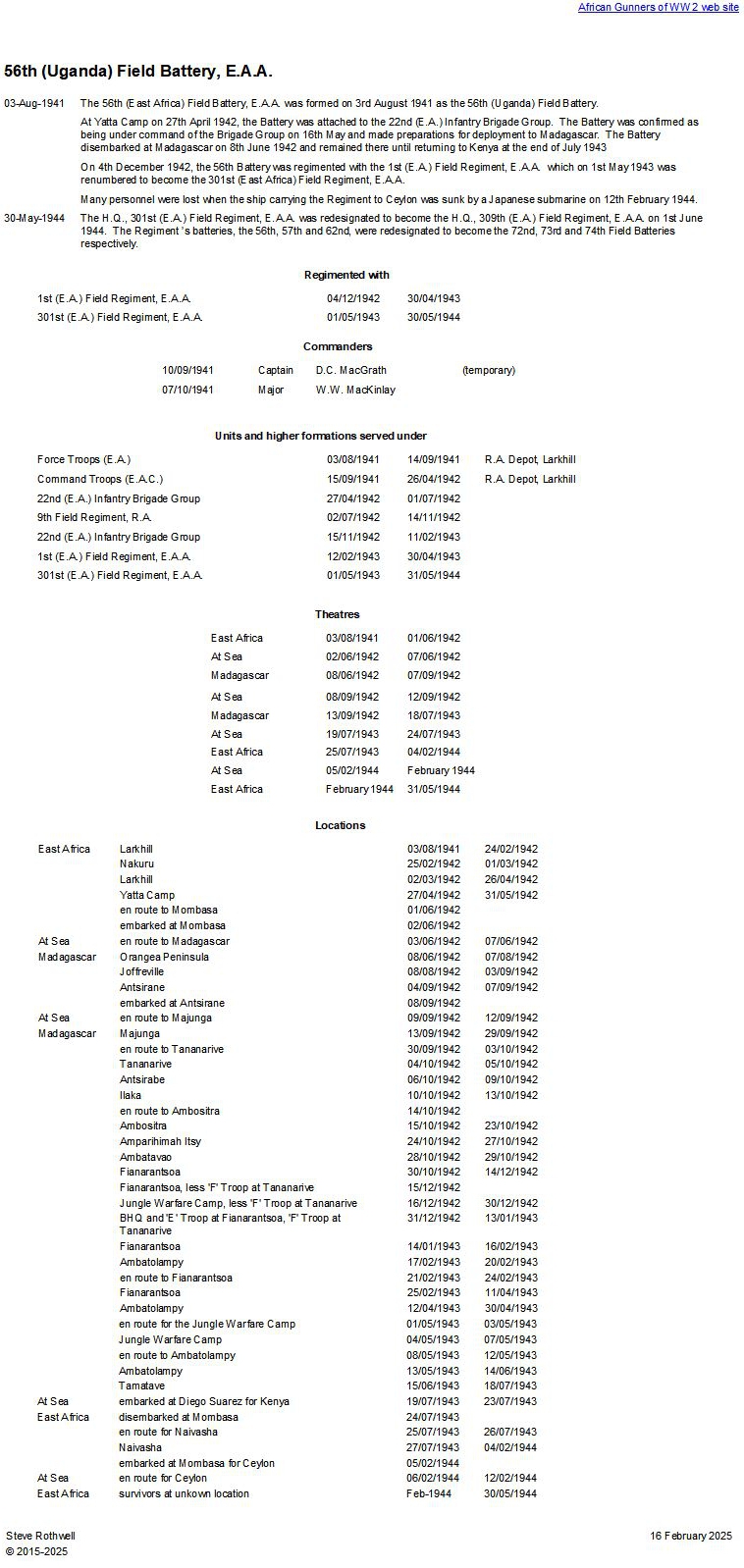
Summary history of the 56th (Uganda) Field Battery, E.A.A.
© Steve Rothwell
15 February 2025
[1] War diary 56th (Uganda) Field Battery, E.A.A., WO 169/2982
[3] WO 169/7002
[4] WO 169/7002
[5] WO 169/7002
[6] WO 169/7002
[7] WO 169/7002
[8] WO 169/7002; War diary 56th (Uganda) Field Battery, E.A.A., WO 169/14071
[9] War diary 301st (E.A.) Field Regiment, E.A.A., WO 169/14067
[10] WO 169/14071; WO 169/14067
[11] WO 169/14071
[12] WO 169/14067; WO 169/14038
[13] War Diary East Africa Command, WO 169/18210