58th (Uganda) Field Battery, E.A.A.
When first formed in June 1942, the Battery included the designation ‘Uganda’ in its title. This was apparently lost when the Battery joined the 303rd (E.A.) Field Regiment, E.A.A. on 1st July 1943. In India on 14th January 1945, the title of the Regiment became the 303rd (E.A.) Light Regiment, E.A.A. and the 58th Battery became a light battery.
58th (Uganda) Field Battery, E.A.A.
The 58th (Uganda) Field Battery, E.A.A. formed at Larkhill during June 1942. The Commanding Officer was Major J.K. McCarthy.[1]
The Battery undertook training at Larkhill before moving to Gilgil on 6th September 1942 where it joined the 1st (E.A.) Field Regiment, E.A.A. Here, the Battery practiced with both the 3.7-inch howitzer and the 25-pounder field gun.[2]
On 20th November 1942, orders were received allotting the Battery to the 2nd (E.A.) Field Regiment, E.A.A., also located at Gilgil at that time.[3]
The Battery left Gilgil on 16th December 1942 and arrived at Moshi three days later. Upon arrival, the Battery appears to have come under the command of the 25th (East Africa) Infantry Brigade.[4]
The Battery appears to have been de-regimented from the 2nd (E.A.) Field Regiment from 1st February 1943.
Orders were received on 8th February 1943 to send all African personnel on leave (embarkation leave). The Battery moved to a new camp, 16 miles West of Moshi on the Mosh-Arusha Road on 9th March 1943. Here, the Battery trained in jungle warfare with the 25th (E.A.) Infantry Brigade. During the month, African gunners returned from leave.[5]
The 58th Battery appears to have been regimented from 1st May 1943 with the 303rd (E.A.) Field Regiment, E.A.A., at that time serving in Ceylon.[6]
The Battery left Moshi on 11th June to camp at Marikani the next day. The Advance Party left for Kilindini on 13th June to board the H.M.T. City of Paris; followed by the main body the next day. On 15th June, the ship sailed for Ceylon, arriving at Colombo on 27th June. The Battery personnel disembarked three days later and went to Richard’s Rest camp. The following day, the Battery moved to join the 303rd (E.A.) Field Regiment at Mankulam.[7]
58th (East Africa) Field Battery, E.A.A.
On joining the 303rd Regiment, the Battery appears to have lost the title ‘Uganda’ and become the 58th (East Africa) Field Battery, E.A.A. On 11th July 1943, the Regiment moved to Practice Camp at Mannar for training and fire practice. Returning to Mankulam on 16th August, it then left for Hambantota on 24th August to arrive on 26th August. Captain S.T. Mambre assumed temporary command of the Battery in September when Major McCarthy went on leave; before Major J.F.C. Powis arrived on 26th October to take command. The Regiment moved to Horana on 21st December.[8]
The 58th Battery left Mankulam to return to the Regiment at Horana on 28th January 1944, arriving the next day; having left on 3rd December to train with the 25th (E.A.) Infantry Brigade. The Regiment moved to Hambantota for training on 6th February. In February 1944, it was thought that the 303rd (E.A.) Field Regiment, at that time equipped with the 25-pounder field gun, would in future operate two Jeep-towed batteries of 3.7-inch howitzers (eight per battery) and one battery equipped with the 3-inch mortar. The 58th Battery fired the 3-inch mortar for the first time on 4th April and practiced with the weapon again in early May. Then, at a conference with the H.Q. R.A. of the 11th (E.A.) Infantry Division on 6th May 1944, it was confirmed that the 302nd and 303rd Regiments were to be 25-pounder regiments with a reduced scale of transport, using 15cwt trucks as tractors.[9]
Leaving Hambantota on 7th April, the Regiment arrived at the Divisional Concentration Area near Dambulla on 11th April to participate in exercises. During May, the 58th Battery undertook mortar practice. The Batteries undertook firing practice in turn at Trincomalee.[10]
The Regiment went to Colombo on 17th June 1944 to embark for India, sailing on 20th June, having handed in its 25-pounder guns and limbers prior to leaving camp. It disembarked at Chittagong on 27th June and the next day moved to Dohazari. The Regiment moved to the Imphal area between 2nd and 9th August, the 11th (E.A.) Infantry Division now part of the XXXIII Indian Corps. Upon arrival at Kaching, near Palel on 10th August, the Regiment was surprised to learn that it would now be equipped with the 3.7-inch howitzer; sixteen 3.7-inch howitzers arriving on 11th August and the remaining eight on 16th August. However, the Regiment continued to be designated a field regiment, and its batteries as field batteries, until January 1945.[11]
The 11th (E.A.) Infantry Division was now ordered to pursue the retreating Japanese down the Palel-Tamu Road to the Chindwin, and down the Kabaw Valley. The 303rd Regiment began leaving Kaching on 11th September 1944 to reach Tamu by 26th September. The 58th Battery played a full part in the Kabaw Valley operation. By mid-October, the Regiment was in the Yazagyo area and on 31st October, it moved forward, with the 58th Battery coming into action just North of Nanhannwe. On 2nd November, the 53rd and 58th Batteries moved to the Honnaing area where they were soon joined by the 54th Battery. After the capture of Kalemyo on 14th November, the Regiment moved to Indainggyi on 21st November and on to the Kalemyo-Kalewa road. The infantry entered Kalewa later that day and on 7th December the 58th Battery ferried itself across the Chindwin into the bridgehead on the East bank, with the R.H.Q. and other batteries supporting from the West bank at Kalewa.[12]
Major Powis left in November 1944 and was replaced by Captain Mambre.[13]
The 11th (E.A.) Infantry Division was now withdrawn into 14th Army reserve and the 303rd Regiment left Kalewa on 19th December, arriving at the rest camp at Bokajan, near Dimapur, India, on 23rd December.[14]
58th (East Africa) Light Battery, E.A.A.
At Bokajan on 14th January 1945, the title of the Regiment was amended and it became the 303rd (E.A.) Light Regiment, E.A.A., with effect from 1st January. The 58th Battery became a light battery. Major A.A. Mackay returned from leave on 8th February to reassume command of the Battery.[15]
On 9th April 1945, the Regiment left Bokajan for Chas by rail, arriving on 13th April. It moved to Dhipatoli, near Ranchi, arriving on 24th May.[16]
On 19th July, the 58th Battery, became a light battery of the 302nd Regiment. The 302nd was now a holding unit for men awaiting shipping to return to Africa, and others who were surplus and awaiting posting to other units of the 11th (E.A.) Infantry Division. The 58th Battery became a holding unit for African gunners eligible for East Africa leave until shipping became available.[17]
With nearly all Officers and Other Ranks returned to East Africa or posted to other regiments, on 30th November 1945, the 302nd (E.A.) Field Regiment, E.A.A. was absorbed within the H.Q.R.A., 11th (East Africa) Division, awaiting final disbandment. The Regiment’s batteries were disbanded by this date.[18]
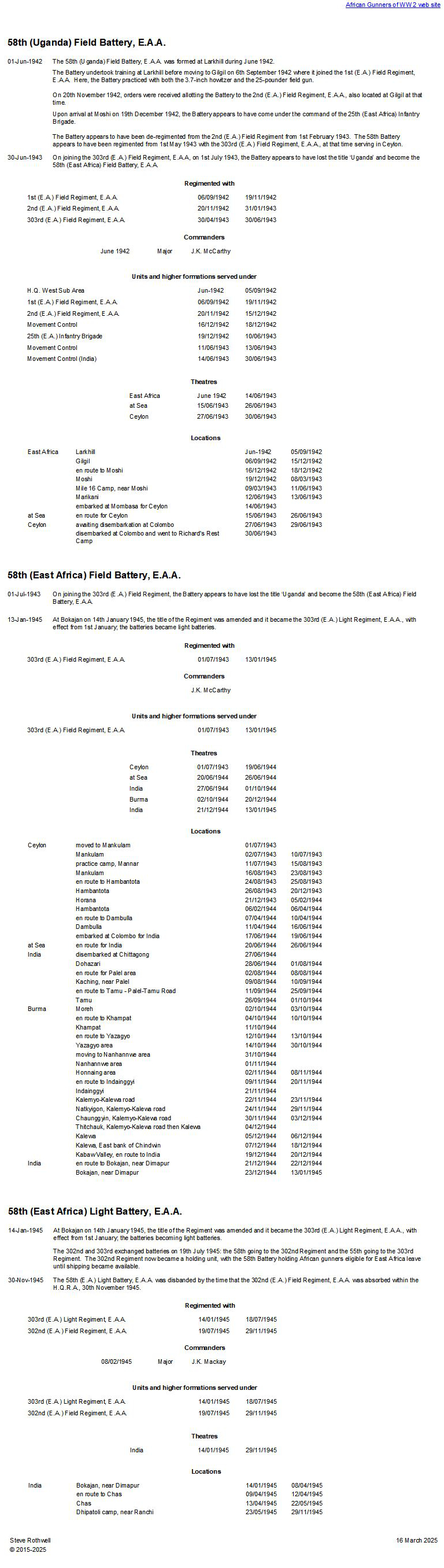
Summary history of the 58th (East Africa) Field Battery, E.A.A.
© Steve Rothwell
16 March 2025
[1] War diary 58th (U) Field Battery, E.A.A., WO 169/7004
[2] WO 169/7004
[3] War diary 2nd (E.A.) Field Regiment, E.A.A., WO 169/6996
[4] WO 169/7004; War diary 58th (U) Field Battery, E.A.A., WO 169/14073
[5] WO 169/7004; WO 169/14073
[6] War diary 11th (E.A.) Infantry Division, WO 172/3985
[7] War diary 58th (U) Field Battery, E.A.A., WO 172/4023; War diary 303rd (E.A.) Field Regiment, E.A.A., WO 172/4020
[8] WO 172/4020
[9] War diary 303rd (E.A.) Field Regiment, E.A.A., WO 172/6526; War diary 11th (E.A.) Infantry Division 'G' Branch, WO 172/6484
[10] WO 172/6526
[11] WO 172/6526
[12] WO 172/6526; Official History
[13] WO 172/6526
[14] WO 172/6526; Official History
[15] War diary 303rd (E.A.) Field Regiment, E.A.A., WO 172/9474
[16] WO 172/9474
[17] WO 172/9474; War diary 302nd (E.A.) Field Regiment, E.A.A., WO 172/9473;
[18] WO 172/9473