59th (East Africa) Field Battery, E.A.A.
The 59th (East Africa) Field Battery, E.A.A. was formed on 7th September 1942 at Larkhill.[1]
British Officers and N.C.O.s were posted to the Battery within days and on 29th October seven 25-pounder field guns were received. On 4th November, 261 African recruits were posted to the Battery from the Depot Pool, Royal Artillery Depot, Larkhill. Captain J.M. Hepburn arrived on 11th November to assume command of the Battery from Captain D.C. Halton. Motor transport was received between 24th and 25th November.[2]
The Battery moved to Gilgil on 16th December 1942 where it was regimented with the 2nd (E.A.) Field Regiment, E.A.A. Training continued, with visits to Nakuru and Naivasha for practice firing. During April most of the African personnel were on leave, together with nearly three-quarters of the British N.C.O.s. The Regiment was re-titled on 1st May 1943 to become the 302nd (E.A.) Field Regiment, E.A.A. Together with the Regiment, the Battery moved to Moshi, leaving Gilgil on 31st May 1943, arriving on 3rd April. With the departure of the Divisional H.Q., 11th (E.A.) Division for Ceylon, the Regiment, less the 60th Battery, came under the command of O.C. Divisional Troops, Moshi, on 13th August 1943. Between 27th and 29th September, the Regiment moved to Mariakani and then for Kilindini for embarkation for Ceylon between 2nd and 3rd October. The 302nd Regiment disembarked at Colombo on 12th October and moved to Mankulam.[3]
With the Regiment, the Battery moved to the 11th (E.A.) Infantry Division concentration area at Hambantota between 10th and 15th November 1943. The Regiment remained at Hambantota into 1944 until, on 27th May, it moved on foot for embarkation, finishing the last of the journey by rail. Arriving at Colombo on the morning of 31st May, the personnel embarked on board the S.S. Navasa. The ship sailed for India on 2nd June, where the men disembarked by assault craft on 8th June and entrained for Dohazari.[4]
The Regiment stayed at Dohazari until 17th July 1944, when it moved to Karching at Imphal, arriving on 23rd July. The 11th (E.A.) Infantry Division was ordered to pursue the Japanese down the Palel-Tamu Road to the Chindwin, and down the Kabaw Valley which runs North-South parallel to the Chindwin to the East. The 302nd Regiment was assigned in support of the 25th (E.A.) Infantry Brigade whose task was to advance eastwards along the Sittaung track. The Regiment moved off on 5th August, less the 60th Battery. Sittaung on the West bank of the Chindwin, was entered by soldiers of the 25th Brigade on 4th September.[5]
The Regiment withdrew on 13th September 1944 to the Tamu area. The 11th (E.A.) Infantry Division was by now advancing down the Kabaw Valley and the R.H.Q. with the 55th and 59th Batteries set off down the Tamu-Kalemyo Road on 13th October to reach Khampat on the evening of 17th October. The R.H.Q. and the 59th Battery left there on 21st October to reach Yazagyo on 23rd October. Further moves South followed towards Kalemyo and then on to Kalewa where the Regiment crossed the Chindwin River on 9th December.[6]
As part of the withdrawal of the 11th (E.A.) Infantry Division to India following the conclusion of operations in the Kabaw Valley, on 22nd December 1944 the Regiment recrossed the river to begin its return to India where on 29th December it arrived in camp at Bokajan, near Dimapur.[7]
The Regiment moved to the Chas area on 11th April 1945 before moving to Ranchi on 17th June. Major Hepburn left the Battery on 25th June, to be succeeded by Captain P.A. Roberts. On 19th July, the 302nd Regiment became a holding unit and the 59th Battery was designated as the holding unit for British and African personnel not due for leave in East Africa and surplus to the requirements of the Divisional Artillery. Major Roberts left on ‘PYTHON’ on 22nd October. The 59th Battery was disbanded by 30th November 1945, on which date the R.H.Q., 302nd Regiment was absorbed within the H.Q.R.A., 11th (East Africa) Division, awaiting final disbandment.[8]
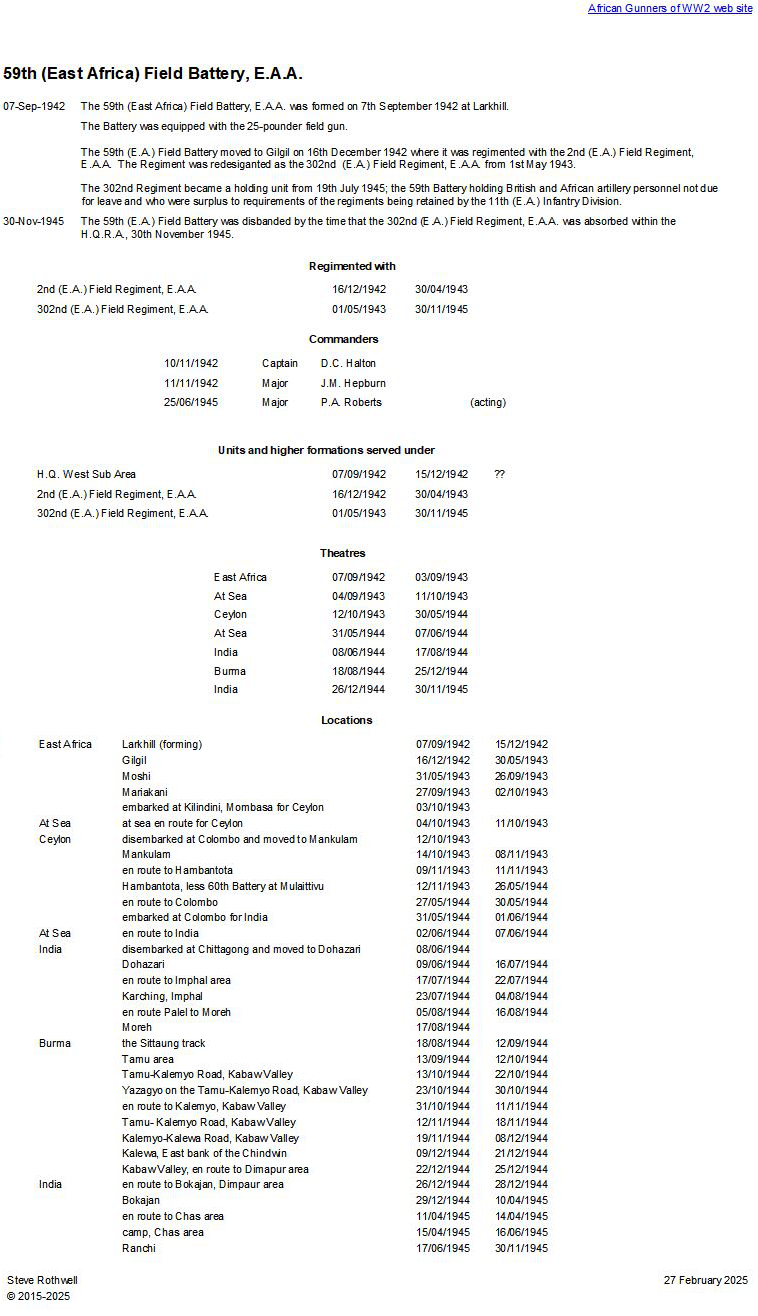
Summary history of the 59th (East Africa) Field Battery, E.A.A.
© Steve Rothwell
27 February 2025
[1] War diary 59th (E.A.) Field Battery, WO 169/7005; War diary East Africa Command, WO 169/6873
[2] WO 169/7005
[3] War diary 2nd (E.A.) Field Regiment, E.A.A., WO 169/14068; War diary 11th (E.A.) Infantry Division, WO 172/3985; H.Q. Divisional Troops, Moshi, WO 169/14425; War diary 59th (E.A.) Field Battery, WO 169/14074
[4] War diary 302nd (E.A.) Field Regiment, E.A.A., WO 172/6625; War diary 11th (E.A.) Infantry Division 'G' Branch, WO 172/6484
[5] WO 172/6625; “The War Against Japan, vol. IV”, Woodburn Kirby, S., H.M.S.O. (1965)
[6] WO 172/6625; Official History
[7] WO 172/6625; Official History
[8] Official History; War diary 302nd (E.A.) Field Regiment, E.A.A., WO 172/9473; War diary 303rd (E.A.) Field Regiment, E.A.A., WO 172/9474