103rd (East Africa) Anti-Tank Battery, E.A.A.
5th (E.A.) Anti-Tank Regiment, E.A.A.
Recruits for the 103rd (East Africa) Anti-Tank Battery, E.A.A. arrived at Gilgil on 1st January 1943 and the Battery formed on 29th January.[1]
The Battery was regimented with the 5th (E.A.) Anti-Tank Regiment, E.A.A. which began forming at Gilgil on 15th February 1943.[2]
305th (E.A.) Anti-Tank Regiment, E.A.A.
On 9th May 1943, the Regiment received notification that it had been re-designated as the 305th (East Africa) Anti-Tank Regiment, E.A.A., with effect from 1st April 1943. The Regiment and batteries remained at Gilgil.[3]
The 103rd Battery moved to Naivasha on 22nd May 1943, followed by the Regimental H.Q. on 12th June and the 104th Battery on 18th June. The Regiment returned to Gilgil on 21st July after completing exercises. On 27th September, the 101st and 102nd Batteries left Gilgil Station for Mariakani, from where they subsequently embarked at Mombasa for Ceylon, joining the 11th (E.A.) Division as Divisional Troops on 20th October 1943. Regimental H.Q. and the 103rd and 104th Batteries remained at Gilgil.[4]
304th (E.A.) Anti-Tank Regiment, E.A.A.
On 4th October 1943, the 305th (E.A.) Anti-Tank Regiment, E.A.A. was re-designated to become the 304th (East Africa) Anti-Tank Regiment, E.A.A. with the 103rd and 104th (E.A.) Anti-Tank Batteries in Kenya and the 101st and 102nd Batteries in Ceylon.[5]
The 104th Battery went to practice camp at Naivasha on 23rd November 1943, returning to Gilgil on 30th November, on which date the 103rd Battery took its turn at Naivasha until around 5th December.[6]
305th (E.A.) Anti-Tank Regiment, E.A.A.
On 1st February 1944, the 304th (E.A.) Anti-Tank Regiment combined with the 305th (E.A.) L.A.A. Regiment, E.A.A. to form the 304th (E.A.) Anti-Tank/L.A.A. Regiment, E.A.A. The 101st and the 102nd Anti-Tank Batteries, then serving in Ceylon, were regimented with this regiment.[7]
It appears that it was also intended to form the 305th (E.A.) Anti-Tank Regiment, E.A.A. at Gilgil on 1st February 1944. The 103rd, 104th and 105th Anti-Tank Batteries appear to have been regimented with this short-lived regiment.[8]
The 305th Regiment converted on 1st March 1944 to become a field regiment: the 308th (E.A.) Field Regiment, E.A.A. with the 70th and 71st Field Batteries converted from the 103rd and 104th Batteries.[9]
[A new 103rd Battery, the 103rd (E.A.) Anti-Tank/Mortar Battery, was formed on 3rd September 1944 by the reorganisation of the 204th (E.A.) L.A.A. Battery at Katching, near Palel, Imphal. On 2nd February 1945, it was redesignated to become the 103rd (E.A.) Anti-Tank Battery, E.A.A.]
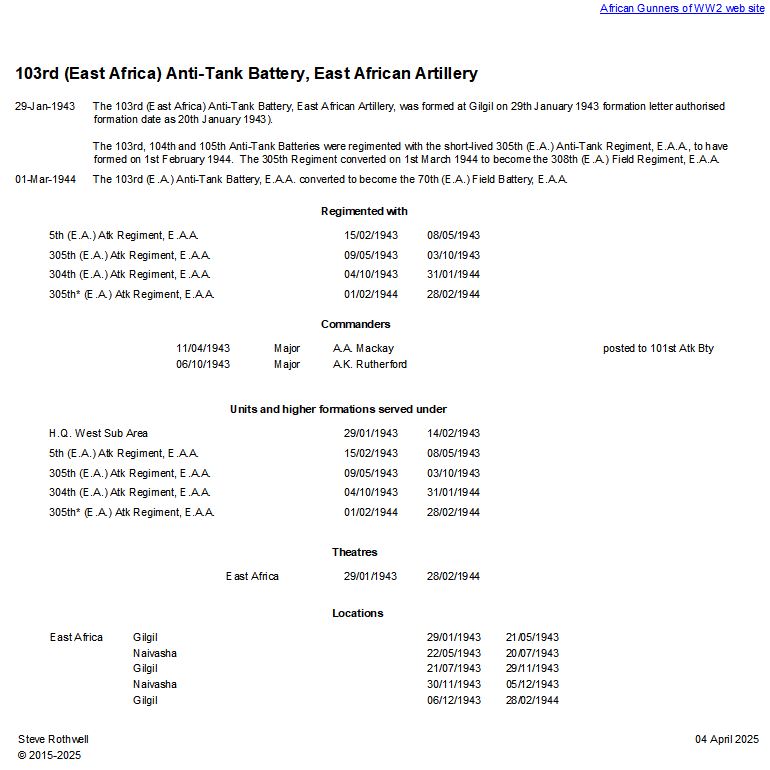
Summary history of the 103rd (East Africa) Anti-Tank Battery
© Steve Rothwell
04 April 2025
[1] War diary 5th (E.A.) Anti-Tank Regiment, WO 169/14076
[2] War diary 305th (E.A.) Anti-Tank Regiment, WO 169/14077
[3] WO 169/14077
[4] WO 169/14077
[5] WO 169/14077
[6] WO 169/14077
[7] War diary 304th (E.A.) Atk/L.A.A. Regiment, WO 172/6522
[8] War diary A.A. Defence Commander, WO 169/18317; Frederick
[9] WO 169/18317; War diary 105th (E.A.) Anti-Tank Battery, WO 169/18304