1st – 53rd (East Africa) Light Battery, E.A.A.
The 1st (East Africa) Field Battery was formed in September 1939 and on 18th October 1940 was redesignated to become the 53rd (East Africa) Light Battery. Despite being equipped with a heavier weapon on 1st February 1942, the 53rd Battery continued to be designated a ‘light’ battery until 1st June 1943 when it was redesignated as a field battery. In India, on return from operations in Burma where it had been equipped with the 3.7-inch howitzer, the Battery became the 53rd (East Africa) Light Battery, E.A.A. on 14th January 1945. It reverted to being a field battery on 19th July 1945, when it re-equipped with the 25-pounder gun.
1st East Africa Light Battery
The 1st East Africa Light Battery was formed and embodied at Mbagathi, Nairobi on 20th September 1939. Forty N.C.O.s and Privates of the Kenya Regiment arrived on 21st September 1939 to form the nucleus of the Battery. Major W.W. MacKinlay was the Commanding Officer.[1]
The Battery, equipped with four 3.7-inch howitzers embarked at Mombasa on 2nd July 1940 on the H.M.T.S. Talamba for British Somaliland, to join British Indian and African troops forming the garrison. It disembarked at Berbera on 11th July and moved to Tugargen (Tug Argan). Here was fought the decisive battle during the Italian invasion of British Somaliland, between 10th and 15th August. The Battery was heavily engaged in the fighting but when withdrawal was ordered on 15th August, the Right Section was forced to disable its two guns and leave them behind. The personnel embarked at Berbera on the S.S. Laemedon in the early hours of 17th August and the ship sailed in convoy on the evening of 18th August. The Battery disembarked at Aden on 19th August and on 5th September re-embarked for Mombasa which was reached on 17th September. The next day, the Battery arrived at Mitubiri, Nairobi.[2]
The 1st East Africa Light Battery was redesignated to become the 53rd (East Africa) Light Battery on 18th October 1940.[3]
53rd (East Africa) Light Battery, E.A.A.
The Battery moved to Kabete, Nairobi on 31st October 1940. On 1st January 1941, the Battery was at the R.A. Depot, Kijabe before leaving on 4th February for Bura, arriving on 7th February. En route at Garissa, on 6th February, the Battery came under the command of the 11th (African) Infantry Division for the advance on Kismayu, Italian Somaliland. Moving with the Division, the Battery arrived at Kismayu on 17th February, which had been occupied on 14th February, before moving to Afmadu on 18th February where it came under the command of the 12th (African) Infantry Division the next day. It was now ordered to support the 24th (Gold Coast) Infantry Brigade attack on Alessandra, near Jelib (Gelib) on the Juba River. On 23rd February, the Battery moved to the crossing at Mabungo (Mabuungo) where from the West bank it supported infantry on the far side. Moving across the Juba on 28th February, the Battery reached Bardera on 2nd March. Ordered to Moyale, Kenya on 7th March, the Battery arrived there the next day where it was attached to the 21st (E.A.) Infantry Brigade on 9th March.[4]
The Battery moved to Yavello, Ethiopia, on 20th March, arriving the next day. It took part in an action at Soroppa (Surupa) Ridge on 31st March and remained in the area until returning to Yavello on 7th April, returning to the 12th (African) Division. The Battery was in the Finchua (Finchawa) area from 2nd May 1941, where it was in action between 6th and 7th May. It moved to Alghe on 10th May, arriving two days later. It moved again on 16th May to Giabsirre and then to Kisigani, reached on 24th May. Leaving on 27th May, the Battery arrived at Dilla the next day. The Battery arrived at Uondo on 17th June, after a difficult journey in heavy rain and short of petrol, having left Dilla on 5th June. It left Uondo on 26th June to reach Moggio (Mojo), near Addis Ababa, two days later. The next day it set off for Jijiga which was reached on 3rd July. At Jijiga, the Battery came under the command of the 26th (E.A.) Infantry Brigade and then, from week ending 3rd August, the 24th (Gold Coast) Infantry Brigade until leaving for Addis Ababa on 13th August. By 20th August, the Battery was in camp at Ridotta Susa, Addis Ababa, once again under the command of the 12th (African) Infantry Division.[5]
In June or July 1941, Major C.F. Rouse took command of the Battery.[6]
Addis Ababa was left on 29th October 1941, the Battery being ordered to join 12th (African) Infantry Division operations North of Gondar. The Battery reached camp near Amba Gheorghis on 7th November and three days later was ordered into action. It took part on the final battle for Gondar until firing its last shot of the East African campaign on 28th November. The Battery remained in the Gondar area until leaving on 6th December for Asmara which was reached on 9th December. It moved to Massawa on 13th December where on 28th December it embarked on the S.S. Salween and sailed to Aden where it arrived on 31st December.[7]
Leaving Aden on 1st January 1942, the Battery sailed for Mombasa, guarding Italian prisoners-of-war en route. On arrival at Mombasa on 7th January, the POWs were handed over and the Battery went to a transit camp. The main body left Mombasa on 9th January by train for Nairobi and then by road to the R.A. Depot at Larkhill, arriving the next day. On 1st February, training began with the 18/25-pounder.[8]
Despite being equipped with a heavier weapon, the 53rd Battery continued to be designated a ‘light’ battery. The Battery left Larkhill on 8th March 1942 for Mombasa where the next day it embarked on the S.S. Landaff Castle for Ceylon. The motor transport and guns sailed on the S.S. Northmoor. The ships sailed on 10th March to reach Colombo on 20th March. The personnel disembarked the next day and went to Anaradhupura, where it was found that the vehicles and guns had already arrived. The Battery was now under the command of the 21st (E.A.) Infantry Brigade.
‘C’ Troop went to Vavuniya on 7th April 1942 while the Battery less ‘C’ Troop went to a camp over 50 miles from Trincomalee on 9th April. On this day, the Japanese navy launched its second aerial attack on Ceylon, this time on Trincomalee. On 23rd April, Battery H.Q. and ‘D’ Troop joined ‘C’ Troop at Vavuniya. The Battery collected 25-pounder guns from Kandy on 28th April.
Since 20th April 1942, the Battery had been regimented with the newly formed 162nd (Rast Africa) Field Regiment, R.A. With the Regiment, the Battery went to practice camp at Munnar between 11th and 14th May, returning to Vavuniya on 15th May.[9]
Major Rouse was appointed Regimental Second-in-Command in February 1943 and Major A.G. Molison, M.C. was appointed Battery Commander of the 53rd Battery, having taken up the post in December 1942 when Major Rouse was admitted to hospital.[10]
On 30th April 1943 (with effect from 1st April 1943), the Regiment was redesignated as the 303rd (E.A.) Field Regiment, E.A.A.[11]
The 53rd (E.A.) Light Battery appears to have been re-designated as a ‘Field’ battery from 1st June 1943.
53rd (East Africa) Field Battery, E.A.A.
The 303rd (E.A.) Field Regiment, E.A.A. remained at Mankulam, Ceylon, as part of the 21st (E.A.) Infantry Brigade Group, with the 53rd and 54th Field Batteries. The Regiment came under command of the 11th (E.A.) Infantry Division, as Divisional Troops, on 4th July 1943.[12]
Major G.E.V. Jones became Battery Commander from 1st April 1944.[13]
The 53rd Battery served with the 303rd (E.A.) Field Regiment in Ceylon until the Regiment sailed for India on 20th June 1944. Disembarking at Chittagong on 27th June, the Regiment went to camp at Dohazari. Moving to Assam, upon arrival at Kaching, near Palel, on 10th August, the Regiment settled into camp at Kaching and the vehicles and guns arrived in stages; sixteen 3.7-inch howitzers arriving on 11th August and the remaining eight on 16th August. However, the Regiment continued to be designated a field regiment until January 1945.[14]
On 19th August 1944, Major Jones left to take up a staff appointment with the H.Q. R.A. 11th (E.A.) Infantry Division. Captain E.R. Block was made temporary Battery Commander, a post he held subsequently as acting Major from January 1945 until August/September 1945.[15]
The 53rd Battery served with the Regiment in the Kabaw Valley operation between September and December 1944. Notably, 3.7-inch howitzers of the Battery were airdropped from Dakota aircraft on 6th and 7th October, the personnel catching up with the guns by road.[16]
After the successful conclusion of the 11th (E.A.) Infantry Division in the Kabaw Valley, it was withdrawn to India into 14th Army reserve. The Regiment left Kalewa on 19th December 1944 to reach camp at Bokajan, near Dimapur, on 23rd December.
53rd (East Africa) Light Battery, E.A.A.
At Bokajan on 14th January 1945, the title of the Regiment was amended and it became the 303rd (E.A.) Light Regiment, E.A.A., with effect from 1st January. The batteries were redesignated (finally) as light batteries.[17]
The Regiment moved to Chas, arriving on 13th April 1945 and in May went to Dhipatoli Camp, near Ranchi, arriving on 23rd May.
53rd (East Africa) Field Battery, E.A.A.
On 19th July 1945 the 303rd Regiment became a field regiment once again, equipped with 25-pounder guns; the batteries becoming field batteries. The 302nd Regiment’s 25-pounder guns arrived on 23rd July and the 303rd Regiment’s 3.7-inch howitzers were despatched to the ordnance depot two days later.[18]
The Regiment moved to Chas on 2nd September 1945. On 23rd September, the Regiment celebrated the sixth anniversary of the formation of the 53rd Battery.[19]
Captain J.D. Durie became Battery Commander during September 1945. Major Block returned in October and appears to have remained as Battery Commander until the Battery’s disbandment.[20]
The Regiment left for Bombay for embarkation to East Africa on 9th January 1946 and disembarked at Mombasa on 29th January before going to Athi River the next day. During February, the African Other Ranks were released from service and the Regiment was disbanded on 31st March 1946.[21]
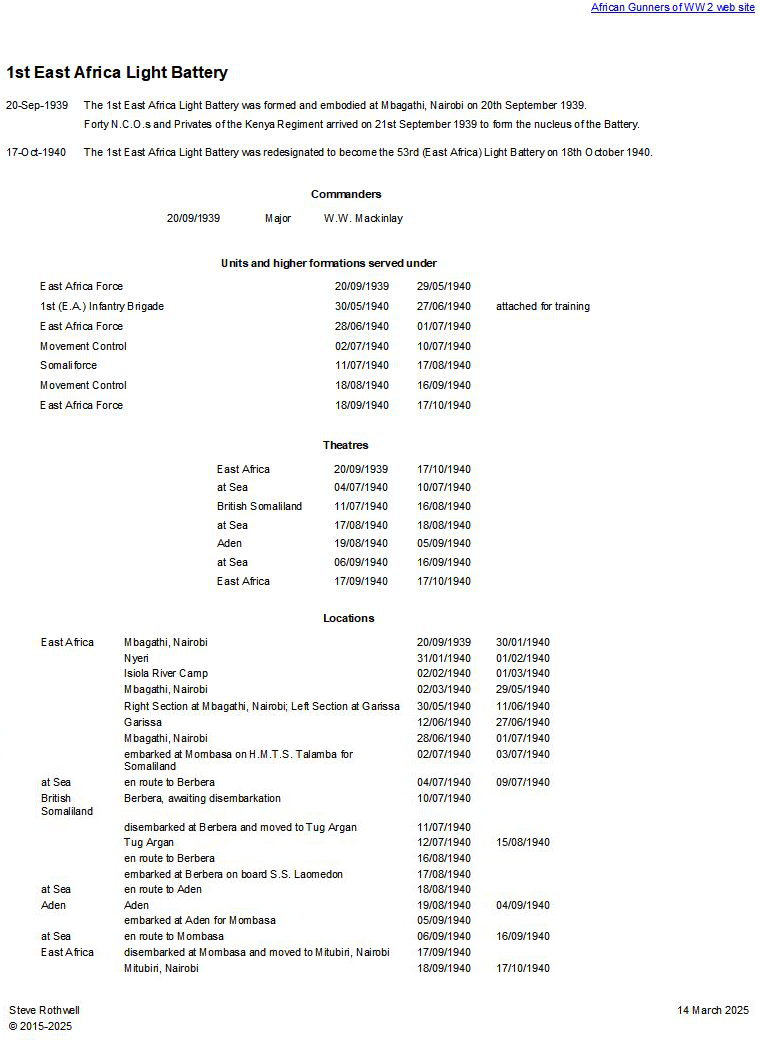
Summary history of the 1st East Africa Light Battery
© Steve Rothwell

Summary history of the 53rd (East Africa) Light Battery, E.A.A.
© Steve Rothwell
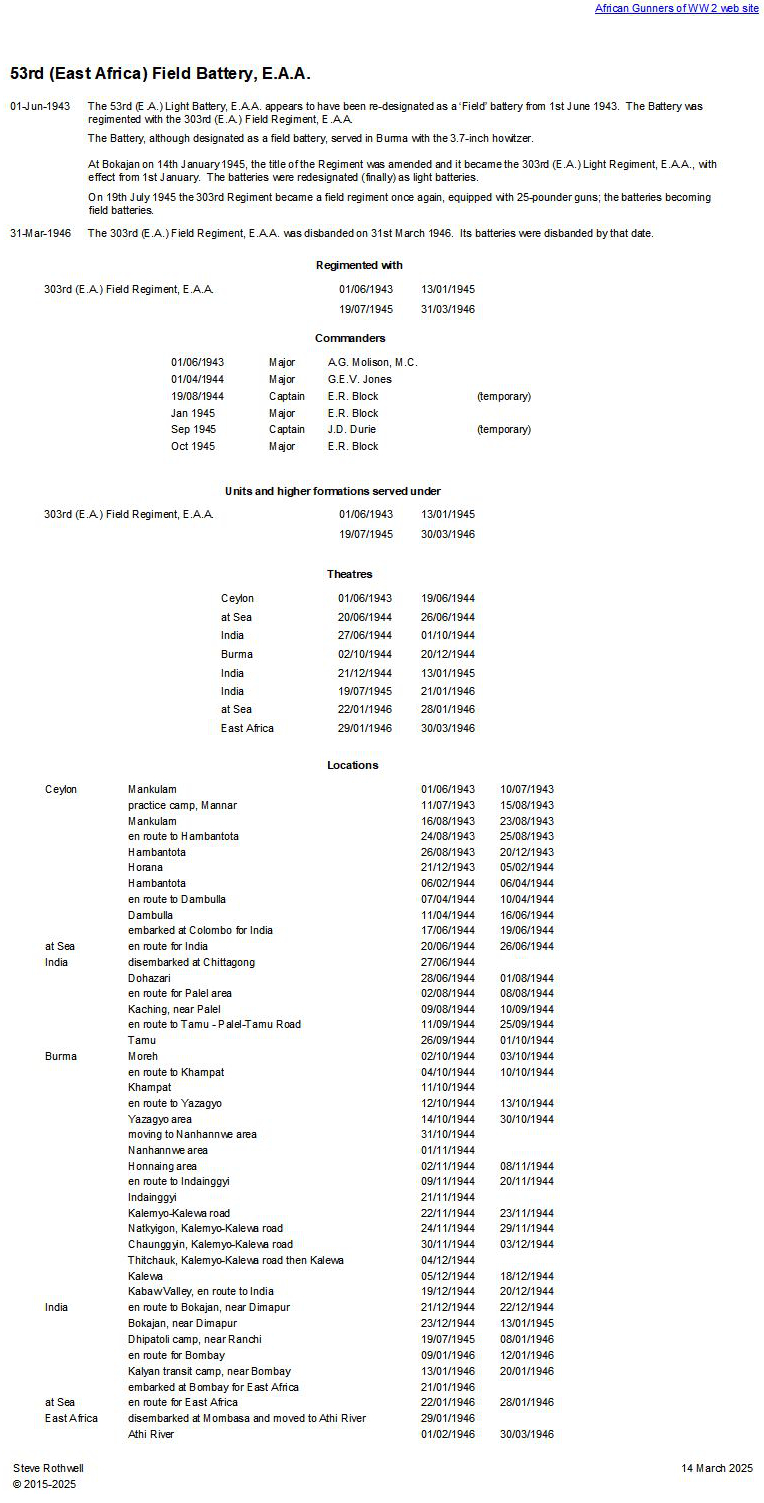
Summary history of the 53rd (East Africa) Field Battery, E.A.A.
© Steve Rothwell
14 March 2025
[1] War diary 53rd (E.A.) Light Battery, E.A.A., WO 169/756
[2] WO 169/756
[3] WO 169/756
[4] War diary 53rd (E.A.) Light Battery, E.A.A., WO 169/2979
[5] WO 169/2979
[6] WO 169/2979
[7] WO 169/2979
[8] War diary 53rd (E.A.) Light Battery, E.A.A., WO 169/6999
[9] War diary 162nd (E.A.) Field Regiment, R.A., WO 172/1679
[10] WO 172/1679
[11] WO 172/4018
[13] War diary 303rd (E.A.) Field Regiment, E.A.A., WO 172/6526
[14] WO 172/6526
[15] WO 172/6526; WO 172/9474
[16] WO 172/6526; Official History
[17] War diary 303rd (E.A.) Field Regiment, E.A.A., WO 172/9474
[18] WO 172/9474
[19] WO 172/9474
[20] WO 172/9474; War diary 303rd (E.A.) Field Regiment, E.A.A., WO 172/11264, WO 169/24350
[21] WO 172/11264, WO 169/24350